

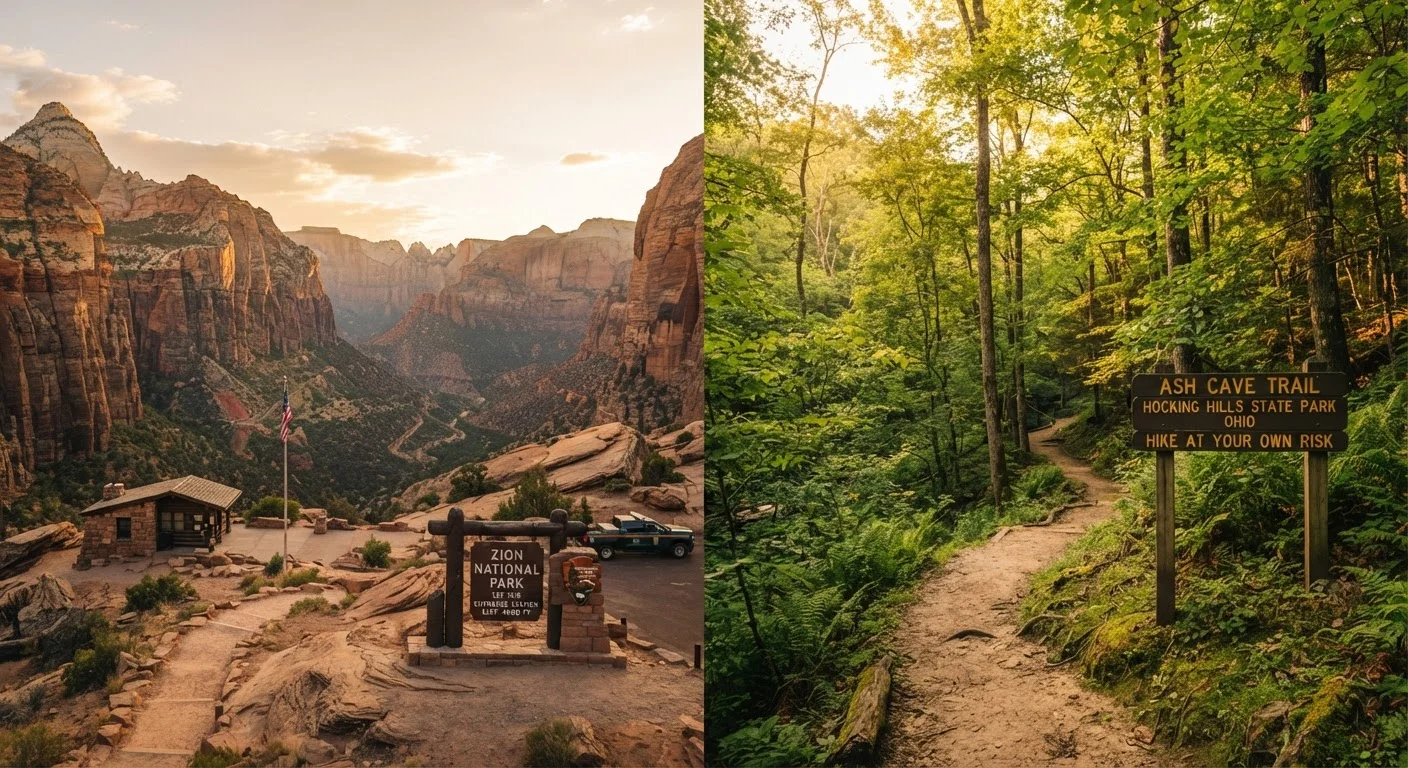
Key Takeaways
State Park vs. National Park
National parks are federally protected lands managed by the U.S. National Park Service (NPS), a branch of the federal government. State parks, on the other hand, are managed by individual state governments and vary widely in rules, fees, and character from one state to the next. Both protect natural or cultural landscapes, but who's in charge - and how they operate - differs significantly.
The National Park System includes not just "national parks" but also national monuments, recreation areas, seashores, and other designations - all under NPS authority. State systems have no single unifying federal standard.
Who's Actually in Charge?
The most fundamental difference between state and national parks comes down to governance. National parks are managed by the U.S. National Park Service, a federal agency within the Department of the Interior. That means consistent rules, a nationwide ranger workforce, and federal funding - along with federal-level politics that can affect hours, staffing, and services.
State parks are administered by each state's own parks department. Because there are 50 different state systems, the experience can vary dramatically. A California state park operates differently from one in Montana or Florida. Fees, hours, permit requirements, and even conservation priorities are set at the state level.
This matters practically: a pass you buy in one state won't get you into parks elsewhere, and rules you're used to at a federal park may not apply at a state one - and vice versa.
"National Park" Is an Umbrella Term
When people say "national park," they often mean any federally protected land - but technically, "national park" is just one of more than a dozen NPS site designations. National monuments, recreation areas, and historic sites are also part of the NPS system but operate under different regulations. Always check the specific designation before assuming what activities are permitted.
Scale, Scope, and What's Protected
The National Park System includes more than 400 sites - and "national park" is just one of many designations. You'll also find national monuments, recreation areas, historic sites, lakeshores, seashores, parkways, and more, all under NPS management. Icons like Yellowstone, the Grand Canyon, and the Smoky Mountains sit under this umbrella, but so do lesser-visited gems. If you're curious about those overlooked landscapes, check out national parks beyond Yellowstone and the Grand Canyon.
State park systems collectively protect tens of millions of acres across the country. Many preserve landscapes that didn't quite make the federal cut - but are no less stunning. Think hidden waterfalls, coastal bluffs, or dense forest reserves that feel genuinely wild yet are an easy drive from a major city.
400+
Sites in the U.S. National Park System
The National Park Service manages more than 400 units across all 50 states, Washington D.C., and U.S. territories.
10,000+
State parks across the U.S.
According to the National Association of State Park Directors, state park systems collectively manage over 10,000 individual park units nationwide.
~$35
Maximum NPS single-vehicle entry fee
The most visited national parks - such as Grand Canyon and Yellowstone - charge up to $35 per vehicle, as listed on the NPS website.
Costs, Passes, and What to Expect at the Entrance Gate
Entry fees are one of the clearest practical differences. National parks typically charge per vehicle, with fees ranging from around $15 to $35 depending on the park. Frequent visitors can offset this with the America the Beautiful annual pass, which covers entrance fees at all NPS-managed sites for one year.
State park fees vary wildly. Some parks charge a few dollars per person; others are free. Many states offer their own annual pass valid across all parks in that state - often a worthwhile purchase if you're planning multiple visits.
One thing to keep in mind: some national park campgrounds and permits require reservations months in advance, especially at high-traffic sites during summer. State park reservation systems are generally less competitive, though popular spots near cities fill up quickly. For help thinking through your accommodation approach, see our piece on camping vs. staying in a lodge inside a national park.
On-the-Ground Experience: What Actually Differs
Beyond governance and fees, the day-to-day experience in each type of park can feel quite different. National parks often come with more developed infrastructure - visitor centers, interpretive programs, maintained trail networks, and on-site rangers available to answer questions. That infrastructure comes at a cost: crowds at the most popular parks can be significant, particularly in summer.
State parks frequently offer a more low-key, local vibe. You're likely to encounter families from the surrounding region, fewer tour buses, and less polished signage - but also more elbow room. Pet policies are often more relaxed, and off-trail flexibility may be greater depending on the park.
Planning logistics for either type of park can also depend on whether you're going solo or with a group. The scale of national parks makes group coordination more complex. Our guide on solo vs. group travel planning walks through how those dynamics shift.
Whichever type of park you're headed to, seasonality plays a major role in your experience. Trails close, weather shifts, and crowd levels swing dramatically throughout the year - a point worth reading up on before you finalize any plans.