

Key Takeaways
Binoculars require zero setup or alignment
They are ready to use the moment you step outside, which significantly lowers the barrier to casual, spontaneous observing sessions.
Reflectors offer the most aperture per dollar
A Dobsonian reflector can deliver six or more inches of aperture at a price comparable to a modest 3-inch refractor, dramatically increasing light-gathering capability.
Refractors are virtually maintenance-free
Sealed tubes keep optics dust-free and the lens never needs realignment, making refractors reliable instruments over many years of use.
GoTo mounts make object-finding automatic
After alignment, motorized mounts can locate thousands of objects on command - a genuine advantage for observers with limited time or physical constraints.
All options scale to dark-sky observing
Whether you use binoculars or a large reflector, escaping light pollution dramatically improves the quality of what you see with any instrument.
Binoculars cannot achieve useful planetary magnification
Even at 10× magnification, Saturn's rings are barely distinguishable and Jupiter shows only a disk; detailed planetary study requires a telescope of at least 60-70mm aperture.
Refractors become expensive at larger apertures
High-quality optical glass and precision lens grinding drive costs sharply upward beyond about 4 inches, pricing large refractors out of reach for most beginners.
Reflectors require periodic mirror collimation
Mirrors can shift out of alignment during transport or temperature changes; recollimating is straightforward once learned, but adds a maintenance step refractors avoid.
GoTo mounts add weight, cost, and power dependency
Motorized systems can double the weight of a setup and require reliable power - batteries deplete in cold weather, complicating field use.
Poor-quality 'department store' telescopes disappoint reliably
Telescopes marketed on high magnification with thin plastic mounts and low-grade eyepieces consistently underperform and frequently discourage beginners from continuing the hobby.
Large aperture instruments are difficult to transport
A 10-inch Dobsonian provides spectacular views but requires a vehicle, help carrying the tube, and significant storage space - factors easy to underestimate before purchase.
Our Verdict
No single piece of astronomy equipment is right for everyone. Binoculars suit casual observers and those new to the sky; a mid-aperture reflector on a manual mount offers the best balance of performance and value for dedicated beginners; and computerized setups reward those willing to invest time in setup and learning. Understanding the trade-offs before purchasing - rather than chasing the most impressive-looking instrument - is the surest path to equipment you will actually use.
Best for curious adults and older teens who want to move beyond naked-eye stargazing with a clear sense of what each instrument type genuinely offers.
Why Equipment Choice Matters More Than You Think
Astronomy is one of the few sciences where everyday people can make meaningful observations with modest tools. Yet telescope retailers' shelves are packed with instruments that promise dazzling views and deliver frustration. The most common reason beginners abandon the hobby is not a lack of interest - it is a mismatch between expectations and equipment.
Before comparing specifications, it helps to understand two foundational concepts. Aperture is the diameter of the telescope's primary lens or mirror; it determines how much light the instrument gathers and therefore how faint an object you can see. Magnification is secondary: a high-magnification eyepiece on a small-aperture scope produces a bright blur, not a sharp image. If you only remember one number when evaluating any instrument, make it aperture. For a plain-language glossary of terms like these, see Key Terms Every Space Enthusiast Should Know.
Binoculars: Underrated and Genuinely Useful
A quality pair of binoculars - typically 7×50 or 10×50 (magnification × objective lens diameter in millimeters) - reveals craters on the Moon, Jupiter's four largest moons, star clusters, and even the Andromeda Galaxy. They require no setup, fit in a bag, and work immediately in the dark without any alignment procedure.
Binoculars require zero setup or alignment
They are ready to use the moment you step outside, which significantly lowers the barrier to casual, spontaneous observing sessions.
Reflectors offer the most aperture per dollar
A Dobsonian reflector can deliver six or more inches of aperture at a price comparable to a modest 3-inch refractor, dramatically increasing light-gathering capability.
Refractors are virtually maintenance-free
Sealed tubes keep optics dust-free and the lens never needs realignment, making refractors reliable instruments over many years of use.
GoTo mounts make object-finding automatic
After alignment, motorized mounts can locate thousands of objects on command - a genuine advantage for observers with limited time or physical constraints.
All options scale to dark-sky observing
Whether you use binoculars or a large reflector, escaping light pollution dramatically improves the quality of what you see with any instrument.
The trade-offs are real, however. Binoculars cannot match a telescope's magnification, and hand tremor limits how much you can push the optics before the image shakes. For targets like Saturn's rings or fine lunar detail, a telescope is necessary. Still, many experienced astronomers recommend that beginners spend their first months with binoculars, learning the sky before committing to a telescope. Pairing binoculars with a good star map accelerates that learning - see Reading a Star Map for practical guidance.
Refractors vs. Reflectors: The Core Telescope Trade-Off
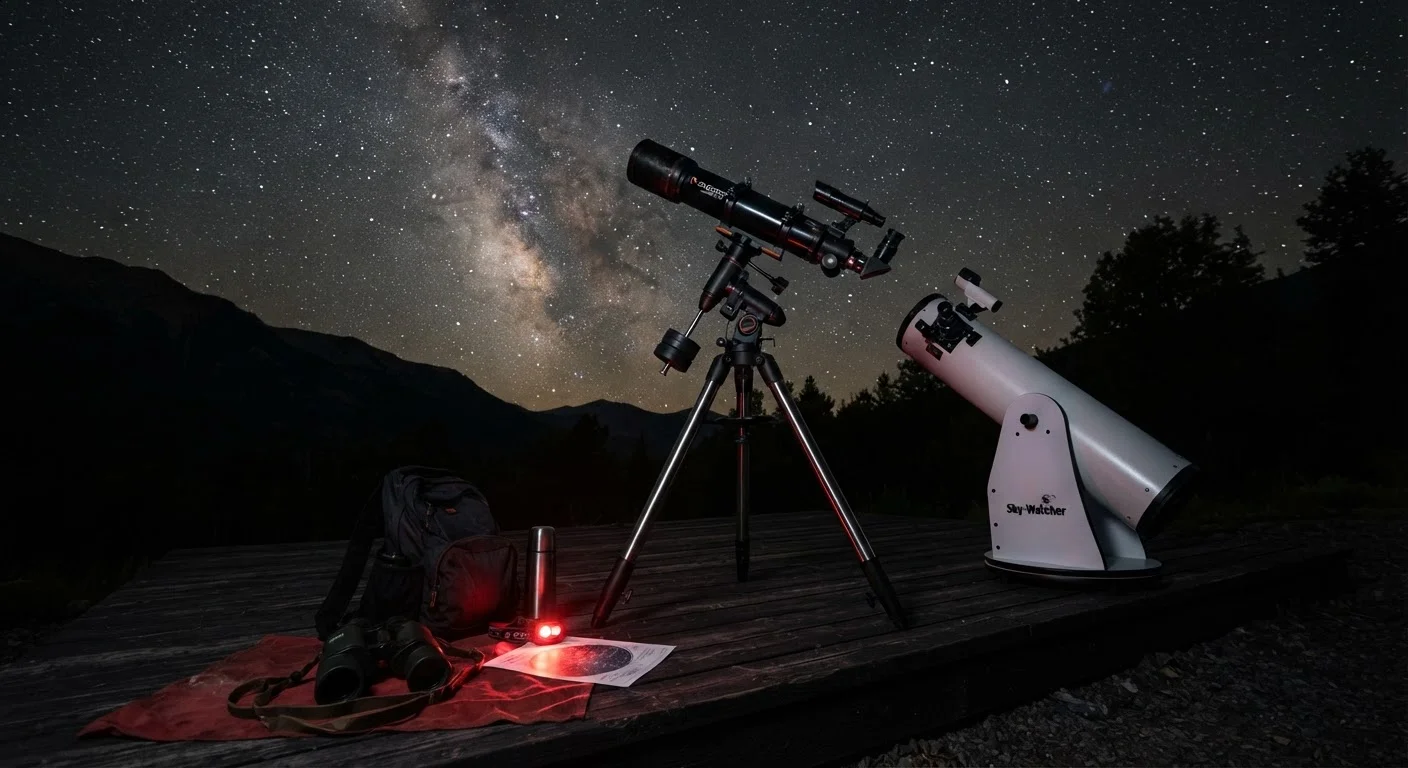
Refractor telescopes use a lens at the front of the tube to focus light. They produce high-contrast, sharp images well-suited to planetary and lunar observation, require almost no maintenance, and are sealed against dust and air currents. Their drawback is cost: glass of sufficient optical quality becomes expensive as aperture increases, making large refractors prohibitively priced for most amateurs.
Reflector telescopes use a curved mirror instead of a lens. The most common design for beginners is the Newtonian reflector, often sold in a Dobsonian mount - a simple, stable rocker-box base that keeps cost low. A 6-inch (150mm) Dobsonian typically gathers more than twice the light of a 4-inch refractor at a fraction of the price. Reflectors do require occasional mirror alignment (called collimation) and the mirrors can accumulate dust over time.
Binoculars cannot achieve useful planetary magnification
Even at 10× magnification, Saturn's rings are barely distinguishable and Jupiter shows only a disk; detailed planetary study requires a telescope of at least 60-70mm aperture.
Refractors become expensive at larger apertures
High-quality optical glass and precision lens grinding drive costs sharply upward beyond about 4 inches, pricing large refractors out of reach for most beginners.
Reflectors require periodic mirror collimation
Mirrors can shift out of alignment during transport or temperature changes; recollimating is straightforward once learned, but adds a maintenance step refractors avoid.
GoTo mounts add weight, cost, and power dependency
Motorized systems can double the weight of a setup and require reliable power - batteries deplete in cold weather, complicating field use.
Poor-quality 'department store' telescopes disappoint reliably
Telescopes marketed on high magnification with thin plastic mounts and low-grade eyepieces consistently underperform and frequently discourage beginners from continuing the hobby.
Large aperture instruments are difficult to transport
A 10-inch Dobsonian provides spectacular views but requires a vehicle, help carrying the tube, and significant storage space - factors easy to underestimate before purchase.
For deep-sky objects - nebulae, galaxies, star clusters - a larger-aperture reflector generally outperforms a smaller refractor at the same price point. For crisp planetary detail, a quality refractor has an edge. Most beginners are better served by aperture, which points toward reflectors.
~2.5×
Light-gathering advantage of 6" vs. 4" aperture
Light-gathering power scales with the square of aperture diameter, so a 6-inch mirror collects roughly 2.5 times more light than a 4-inch lens of equivalent optical quality.
50mm
Recommended minimum binocular objective for astronomy
Optical societies and astronomy clubs widely recommend 50mm objective binoculars as the practical minimum for useful wide-field sky observation in typical suburban skies.
Computerized (GoTo) Mounts: Convenience With Real Costs
A GoTo mount contains motors and an onboard database of thousands of celestial objects. After a brief alignment procedure using a few bright stars, the mount will automatically slew the telescope to any target you select. For someone who struggles to locate objects manually, this sounds ideal.
In practice, GoTo systems add significant weight, require power (batteries or a power pack), and depend on accurate alignment - which itself requires knowing where a handful of bright stars are. If the alignment is even slightly off, the mount points to empty sky. Many beginners find that learning to navigate the sky manually first, using a star atlas or the chart-reading skills outlined here, builds a lasting understanding that GoTo systems can short-circuit.
GoTo mounts justify their cost for astrophotographers who need precise tracking and for observers with physical limitations who benefit from motorized operation. For visual observing, a solid manual mount paired with a good chart is often more rewarding and more reliable.
Making a Decision That Fits Your Situation
Before settling on any instrument, ask three practical questions: Where will you observe (backyard, balcony, or a dark-sky site requiring transport)? What do you most want to see (planets, deep-sky objects, or a wide variety)? And how much storage space do you have? A large Dobsonian delivers impressive views but is impractical in a third-floor apartment with no car.
Storage and Portability Are Often Overlooked
Many first-time buyers focus entirely on optical performance and overlook the practical question of where the instrument will live between sessions. A telescope stored inconveniently - in a garage, disassembled in boxes - gets used far less often than one stored near the door and ready in minutes. Portability and ease of setup are legitimate optical specifications in their own right. Consider your living situation as carefully as you consider aperture.
For a more structured approach to evaluating any significant purchase - covering how to assess claims, compare specifications honestly, and avoid marketing hype - Smart Shopping From Start to Finish offers a transferable framework. Once you have your equipment, planning your first sessions carefully pays dividends - Planning a Night of Stargazing covers moon phase, light pollution, and gear checks before you head out.