

Key Takeaways
The Parks Nobody's Talking About (But Should Be)
Yellowstone draws roughly four million visitors a year. The Grand Canyon pulls in close to six million. Those numbers are a testament to their grandeur - but they also mean gridlocked entrance roads, booked-solid campgrounds, and the nagging sense that you're sharing a wilderness with a small city. Here's the good news: the National Park Service protects more than 400 sites across the country, and the vast majority sit well off the tourist radar.
Whether you're chasing old-growth forests, alien lava fields, remote island wilderness, or cathedral-like cave systems, there's almost certainly a park that matches your travel personality and offers the kind of quiet that the famous ones can no longer reliably provide. Before you go, it's worth reviewing how seasonality shapes any park visit - even less-visited parks have peak windows that affect what you'll see and how crowded trails feel.
Congaree National Park, South Carolina
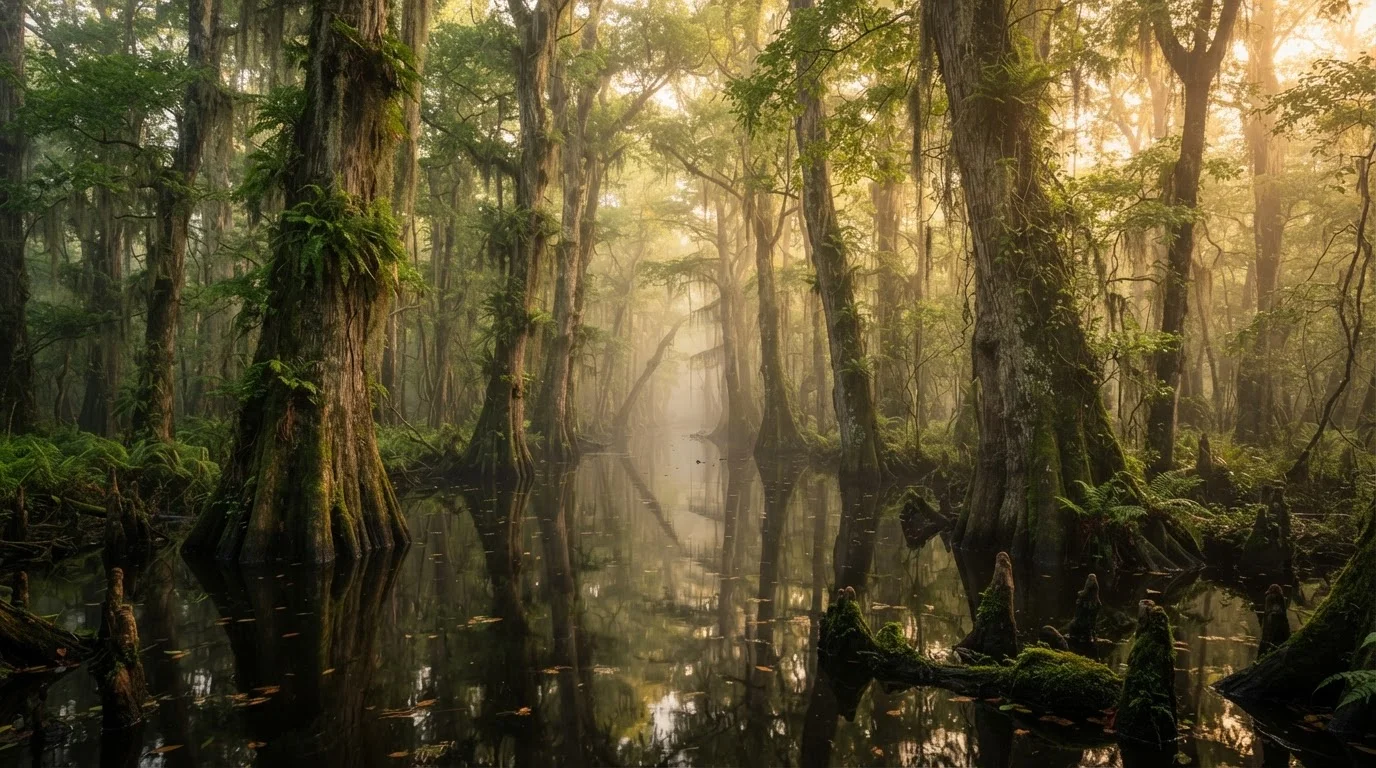
Located about 20 miles southeast of Columbia, Congaree protects the largest intact expanse of old-growth bottomland hardwood forest remaining in the southeastern United States. The trees here are genuinely record-breaking - some champion loblolly pines and bald cypresses that tower over 150 feet, their roots submerged in tannin-dark floodwater for much of the year.
The park's Boardwalk Loop Trail offers an accessible two-and-a-half-mile route through the floodplain with zero elevation gain, making it a strong option for visitors of varying physical abilities. Kayaking and canoe trips through the sloughs offer an entirely different vantage point. Congaree receives fewer than one million visitors annually - a fraction of the park system's most popular destinations.
Congaree's ancient cypresses rise over 150 feet from floodwater - and almost nobody is there to see them.
Isle Royale National Park, Michigan
Sitting in the far northwestern corner of Lake Superior, Isle Royale is one of the least-visited national parks in the lower 48 - and that's entirely by design. Accessible only by ferry or seaplane, this 45-mile-long island is a genuine backcountry destination where moose and wolves live in one of the longest-studied predator-prey relationships in the world.
The park is open roughly from mid-April through October, and most visits involve multi-day backpacking or paddling trips. There are no roads, no cars, and no shortcuts. For travelers willing to earn their views, Isle Royale delivers an island wilderness that feels more like the Canadian boreal than the American Midwest. Confirm ferry schedules and departure points in advance, as options vary by season and origin city.
Isle Royale has no roads, no cars, and a wolf-moose dynamic that scientists have tracked for decades.
Lassen Volcanic National Park, California
Most travelers passing through Northern California's volcanic highlands are headed somewhere else. That's a mistake. Lassen Volcanic National Park contains all four types of volcanoes found on Earth - plug dome, shield, cinder cone, and composite - within a single compact landscape. Its hydrothermal features, including boiling mud pots and steaming fumaroles at Bumpass Hell, rival anything in Yellowstone for sheer geological weirdness.
The park sits at elevation, meaning summer wildflower meadows and snowpack linger later into the year than visitors expect. Roads can close well into spring. Check current conditions through the NPS before planning a visit, particularly if you're traveling before July.
Lassen is one of the only places on Earth where all four volcano types exist side by side.
Guadalupe Mountains National Park, Texas
In far West Texas - about 110 miles east of El Paso - the Guadalupe Mountains rise abruptly from the Chihuahuan Desert to form the highest terrain in the state. Guadalupe Peak, at 8,749 feet, is the tallest point in Texas and a straightforward if strenuous day hike. The park also shelters McKittrick Canyon, widely regarded among hikers as one of the most beautiful spots in Texas, particularly during the brief fall color season.
Guadalupe Mountains pairs naturally with Carlsbad Caverns National Park, just across the New Mexico state line, making a combined visit one of the more rewarding multi-park itineraries in the Southwest. Our broader look at the American Southwest's geography and heritage offers helpful context for planning this region thoughtfully.
McKittrick Canyon's fall colors in the Chihuahuan Desert are a sight almost no one expects to find.
Craters of the Moon National Monument & Preserve, Idaho
The name is not hyperbole. Craters of the Moon, located along the Snake River Plain in central Idaho, is a vast lava field created by a series of eruptions that occurred over roughly 15,000 years - with the most recent activity estimated at around 2,000 years ago. The landscape of cinder cones, lava tubes, and spatter cones looks genuinely otherworldly.
The park is jointly managed as a National Monument and Preserve, a designation that allows for some uses - including hunting in the preserve section - that differ from standard national parks. See how different NPS designations affect your visit to understand what that means before you arrive. Summer temperatures can be extreme on the dark lava surface; early morning visits are strongly advisable.
Craters of the Moon's volcanic landscape is so otherworldly that NASA astronauts trained here.
North Cascades National Park, Washington
Washington State's North Cascades National Park is sometimes called the American Alps - a comparison that undersells it. The park contains more glaciers than any other area in the contiguous United States outside Alaska, with rugged peaks, dense temperate rainforest, and turquoise glacial lakes defining a landscape that receives dramatically fewer visitors than nearby Mount Rainier or Olympic.
Access is primarily via the North Cascades Highway (Highway 20), which closes in winter. The park has limited facilities and no entrance fee at most access points, though the adjacent Ross Lake and Lake Chelan National Recreation Areas have their own fee structures. For a comparison of Alaska's and Washington's dramatically different wilderness profiles, our guide to Alaska versus Hawaii as wilderness destinations offers useful perspective on scale and remoteness.
North Cascades holds more glaciers than anywhere else in the lower 48 - and sees a fraction of Rainier's crowds.
Planning Your Visit to an Underrated Park
Lesser-known parks rarely have the same infrastructure as the marquee names - shuttle systems, multiple visitor centers, and abundant on-site lodging are often absent. That's part of the charm, but it requires a bit more planning on your end. Always verify current entry fees, hours, and any permit requirements directly with the NPS website before you travel, since conditions and access can change.
Use the America the Beautiful Pass Wisely
The America the Beautiful Interagency Annual Pass covers entrance fees at most federally managed lands, including national parks, monuments, and recreation areas. If you're planning visits to two or more fee-charging sites in a calendar year, the math often favors the annual pass. Check the NPS website for current pricing and participating sites, as coverage rules can vary by location.
For travelers weighing how to sleep near these parks, our guide to camping versus lodge stays inside a national park breaks down the tradeoffs in detail. And if you're curious how national parks differ from the state parks you might encounter along the way, understanding what each designation actually means will save you from surprises at the gate.
The rewards for doing a little extra homework are real: more elbow room on trails, better odds of genuine wildlife sightings, and the particular satisfaction of discovering a place that feels like a well-kept secret - even if it's been quietly magnificent all along.