

Key Takeaways
Why Unit Price Is the Number That Actually Matters
Sticker price tells you what leaves your wallet at the register. Unit price tells you what you're actually getting for that money. These two numbers often point in very different directions - and most marketing is designed to keep your attention on the former.
Unit pricing strips away packaging size, promotional framing, and visual design to express a single comparable figure: cost per ounce, per count, per square foot, per fluid ounce, or per serving. Once everything is expressed in the same unit, comparisons become honest. A 32-oz bottle at $4.99 and a 20-oz bottle at $3.49 look close in price - until you calculate $0.156/oz versus $0.175/oz.
This kind of quiet math is foundational to understanding what you're actually paying for rather than what a product appears to cost. It also helps counteract the psychological pricing tactics - charm prices, anchor discounts, oversized packaging - that shape perceived value more than real value.
Unit pricing works across nearly every product category: groceries, cleaning supplies, personal care, paper goods, pet food, and even subscription services priced per month versus per year. The formula is always the same.
What You Need Before You Start
What you will need
Calculator (phone app)
Performs the price-divided-by-quantity calculation instantly in the aisle or at home.
Pen and small notepad
Useful for recording unit prices of multiple options when comparing across different shelf sections.
Retailer's shelf tag
Many stores are required to display unit price on the shelf label - locate it before calculating manually.
How to Calculate and Use Unit Price Step by Step
Identify the unit of measure for each product
Before any math, confirm what unit is being used. Packaged goods measure by weight (oz, lb, g), volume (fl oz, mL), or count (sheets, tablets, pieces). Two competing products must share the same base unit for the comparison to be valid.
If one product lists 16 oz and another lists 500g, convert first. One ounce equals approximately 28.35 grams, so 16 oz ≈ 453g. Mismatched units are a common reason shoppers draw wrong conclusions from shelf tags.
Apply the unit price formula
The formula is straightforward:
Unit Price = Total Price ÷ Total Quantity
Example: A 48-oz bottle of dish soap priced at $5.76 has a unit price of $5.76 ÷ 48 = $0.12 per oz. A 28-oz bottle at $3.92 is $3.92 ÷ 28 = $0.14 per oz. The larger bottle is about 14% cheaper per ounce.
Run this calculation for each option you're evaluating and write down or remember the results.
Factor in realistic usage and perishability
The lowest unit price is the most cost-efficient - but only if you'll actually use the full quantity before it expires, degrades, or takes up storage space you don't have. Adjust your comparison to reflect real-world consumption.
For non-perishables with a long shelf life and a use you're confident about, a lower unit price on a larger package is generally the more economical choice. For perishables or products you use infrequently, a smaller package at a slightly higher unit price may result in less waste and lower actual spend.
Compare final unit prices and make the call
With unit prices calculated on a consistent base unit and adjusted for realistic usage, compare the figures directly. The lower number is the more cost-efficient option for equivalent products.
If the quality of the options is meaningfully different - different formulations, materials, or performance - weigh unit price efficiency against quality. Unit price answers the efficiency question, not the value question in full. Both matter, and the right balance depends on your priorities for that specific purchase.
Keep a Calculator Handy While Shopping
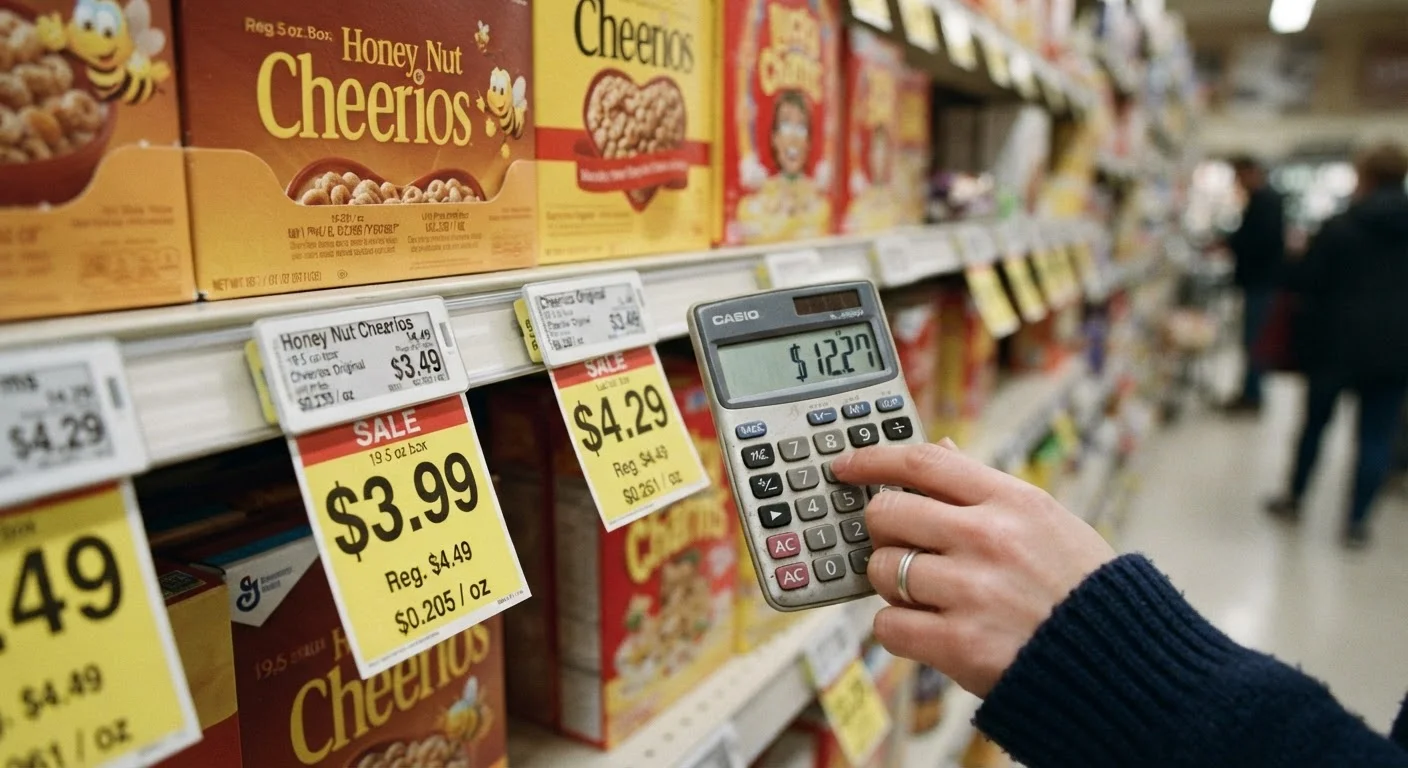
Your phone's calculator app is all you need to run unit price comparisons on the spot. Divide the total price by the number of units, ounces, or count listed on the label. This takes under 30 seconds and often reveals surprising differences between package sizes.
Unit Pricing Laws Vary by State
While many U.S. states require retailers to display unit prices on shelf tags, requirements differ by store type, product category, and package size. If you don't see a unit price displayed, you may need to calculate it yourself. Don't assume the posted price reflects the most cost-effective option.
Common Pitfalls That Distort the Math
Unit pricing is reliable, but a few variables can skew the comparison if you don't account for them.
Different base units: Some shelves display price per ounce for one product and price per 100g for another. Convert to a common unit before comparing - mixing metric and imperial measures is a frequent source of error.
Perishability: A bulk package may offer a lower unit price but produce waste if you can't use it before spoilage. The true cost includes what you throw away. Factor realistic consumption into the calculation.
Sale pricing without unit context: A 20% discount on an already expensive unit price may still be worse value than an everyday price on a competitor product. Promotional pricing can make spending feel like saving - unit math cuts through that framing.
Bundle and BOGO structures: These formats are specifically designed to make unit cost harder to isolate. Common discount structures often obscure true cost - apply the same unit price formula to the combined deal price and total quantity to get a real number.
Unit price is a powerful signal, but it works best alongside other quality indicators. A lower unit price isn't always a better purchase - evaluating whether higher cost reflects genuine quality requires a separate judgment call. Unit pricing answers the cost-efficiency question; it doesn't answer the quality question. Use both lenses together for the most complete picture, and visit the consumer spending resource hub for more frameworks on spending wisely.