

Key Takeaways
How Retail Pricing Is Designed to Shape Perception
Retail pricing is rarely a neutral reflection of cost plus margin. It is, in most cases, a communication strategy - one intended to shape how shoppers perceive value before a single item lands in a cart. Understanding the basic architecture of that strategy is what separates a reflexive response to a sale sign from a considered spending decision.
Two mechanisms do most of the heavy lifting. The first is anchor pricing: displaying a high reference number so that any lower price appears favorable by comparison, regardless of what the item typically sells for. The second is urgency framing: creating time pressure or scarcity signals that discourage the comparison-shopping that would otherwise reveal whether the price is genuinely competitive. Both are well-documented in consumer psychology literature and are standard features of modern retail environments, including online storefronts.
None of this makes sales inherently dishonest. Genuine markdowns exist. But they exist alongside manufactured ones, and without a framework for telling them apart, shoppers have no reliable way to distinguish between the two. The myth-vs-fact pairs below address the most common misconceptions directly.
Myth
If a price is crossed out and replaced with a lower number, I'm definitely saving money.
Fact
The crossed-out "original" price may have been set artificially high or held only briefly, making the discount misleading.
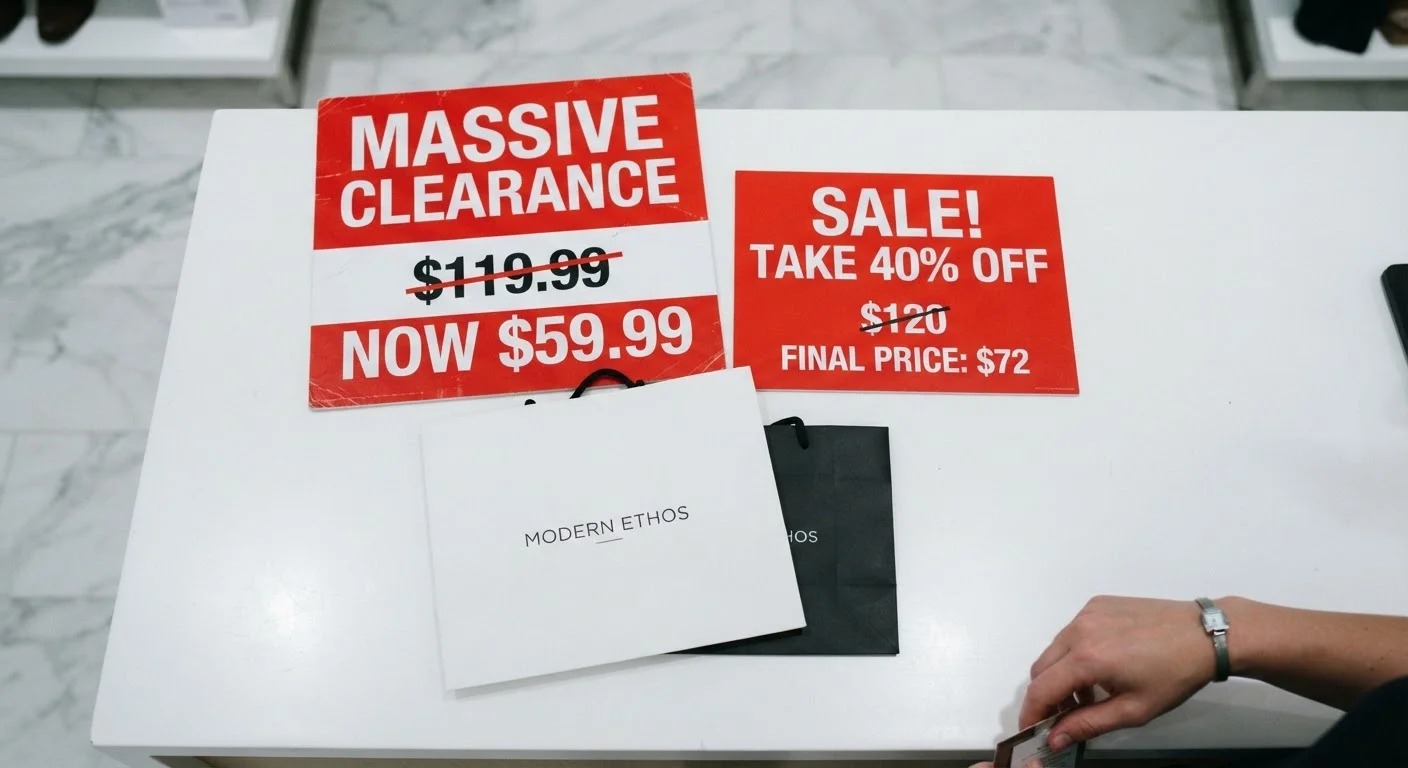
Reference pricing - showing a higher "was" price next to a lower "now" price - is one of the most studied tools in retail psychology. Research in consumer behavior consistently shows that shoppers anchor heavily on the first number they see, making the sale price feel like a bargain regardless of its absolute value. Some retailers set an elevated reference price for a short window specifically to justify a headline discount later. The Federal Trade Commission has guidance requiring that advertised "original" prices reflect prices at which goods were genuinely offered for a reasonable time, but enforcement is uneven, and the practice remains widespread. The crossed-out figure tells you very little on its own.
Myth
A limited-time countdown timer means the deal is about to expire and I need to act fast.
Fact
Many countdown timers reset automatically or represent rolling promotional windows, not true deadlines.
Manufactured urgency is a documented persuasion technique. Timers that reach zero and quietly restart, "today only" banners that persist across multiple days, and low-stock indicators that don't reflect actual inventory are all designed to compress deliberation time. When shoppers feel rushed, they're less likely to compare alternatives or question whether they need the item at all. If a deal feels urgent, that's often the signal to pause rather than act. Check whether the same price or a comparable one is available elsewhere before treating any deadline as firm.
Myth
Buying a discounted item I don't need still saves me money overall.
Fact
Spending money you didn't plan to spend is an expense, regardless of how large the markdown is.
This is one of the most durable misconceptions in consumer spending. If you spend $40 on an item marked down from $80, you have not saved $40 - you have spent $40. The $40 "saved" only exists if you intended to buy that item anyway at its regular price. Promotional design exploits this confusion deliberately: framing purchases as savings encourages spending that wouldn't otherwise occur. A useful mental check is to ask whether the item would be on your list if it were full price. If the answer is no, the discount is a reason to spend, not a reason to save.
Myth
Sale events like major shopping holidays offer the deepest discounts of the year on everything.
Fact
Discount depth and product selection during major sale events vary widely; some categories see minimal price reductions.
Analysis of pricing data around major retail sale periods - including holiday shopping events - has repeatedly shown that not all categories participate equally. Electronics, for example, may see moderate discounts on prior-generation models while current inventory holds price. Apparel discounts can be substantial, but often on overstocked or end-of-season items rather than current lines. Some items are priced identically in the weeks before and during a sale event. Price-tracking tools and browser extensions that log historical price data can help shoppers verify whether a sale-event price is genuinely lower than the item's recent typical price. See how psychological pricing shapes perceived value for more on the mechanics behind this.
Myth
Percentage discounts are the clearest way to judge how good a deal is.
Fact
Percentage off is only meaningful if the base price is accurate and the item fits your actual needs at any price.
A 50% discount on an overpriced item may still leave you paying above market rate. Conversely, a 10% reduction on a commodity product that's widely available at a stable price may represent genuine value. The percentage figure also says nothing about quality, longevity, or whether a competing product offers better value at a similar or lower price. Unit pricing - the cost per ounce, per use, or per year - is often a more reliable comparative measure than the headline discount percentage, particularly for consumables and subscription-linked products.
What Actually Determines Whether a Price Is a Good One
Stripping away promotional framing, a price is worth what it costs relative to what you'd otherwise pay for equivalent value. That requires a few concrete reference points most shoppers don't routinely check.
Price history is the most direct indicator. If a product has sold at $35 for the past six months and is now listed at $34 with a "sale" badge, no meaningful discount has occurred. Browser extensions and price-tracking tools maintain historical records for major retail categories and can display this context at the point of purchase.
Cross-retailer comparison takes only minutes but is skipped more often than not. The same or comparable item may be priced lower at another retailer without any promotional language at all. See the hidden costs built into everyday purchases for a reminder that shipping, restocking fees, and returns policies can affect the real price of any purchase.
Unit price is particularly useful for consumables and packaged goods. A sale-priced large format may still cost more per unit than the standard size at regular price. Many grocery retailers are required to display unit pricing on shelf tags; checking it takes seconds and often reveals more than the headline figure. For a deeper look at this, see why unit price often matters more than sticker price.
Finally, need and timing remain the most underrated filters. A price that's genuinely lower than usual is still not a good deal on an item you don't need or won't use before it expires, degrades, or becomes obsolete. Bulk buying follows the same logic: volume discounts only pay off if consumption keeps pace. Evaluating a deal on its own terms means asking what the item costs, what it's worth to you, and whether you'd have bought it otherwise - in that order.
Spending More Is Not Saving
Saving money requires spending less than you otherwise would have - not spending more on a discounted item you didn't plan to buy. This distinction matters because retailers design promotions to increase purchase volume, not to help shoppers reduce outflows. Before acting on a sale, ask whether you'd have bought this item at full price or at all.
This article is for informational purposes only and does not constitute financial or purchasing advice tailored to your individual situation.