

Key Takeaways
Option A
Sticker Price
The number that gets your attention first.
Best for: Quickly confirming whether a purchase fits your total budget before checkout.
Option B
Unit Price
The number that reveals true value.
Best for: Comparing products of different sizes or quantities to find the most efficient spend.
If you need to stay within a strict per-trip budget
Sticker Price
Sticker price tells you exactly what leaves your wallet at checkout. When total spend is the constraint, it's the number to watch.
If you're comparing two similar products of different sizes
Unit Price
Unit price normalizes the comparison so package size doesn't mislead you. It's the only reliable way to judge value between different quantities.
If you shop in bulk or warehouse stores regularly
Unit Price
Large-format packages usually offer lower unit prices, but not always. Checking unit price confirms whether the bulk option is actually more efficient.
If you have limited storage space or buy perishables
Sticker Price
A lower unit price means nothing if half the product goes to waste. In these cases, right-sizing the purchase matters more than maximizing per-unit efficiency.
What Each Number Actually Tells You
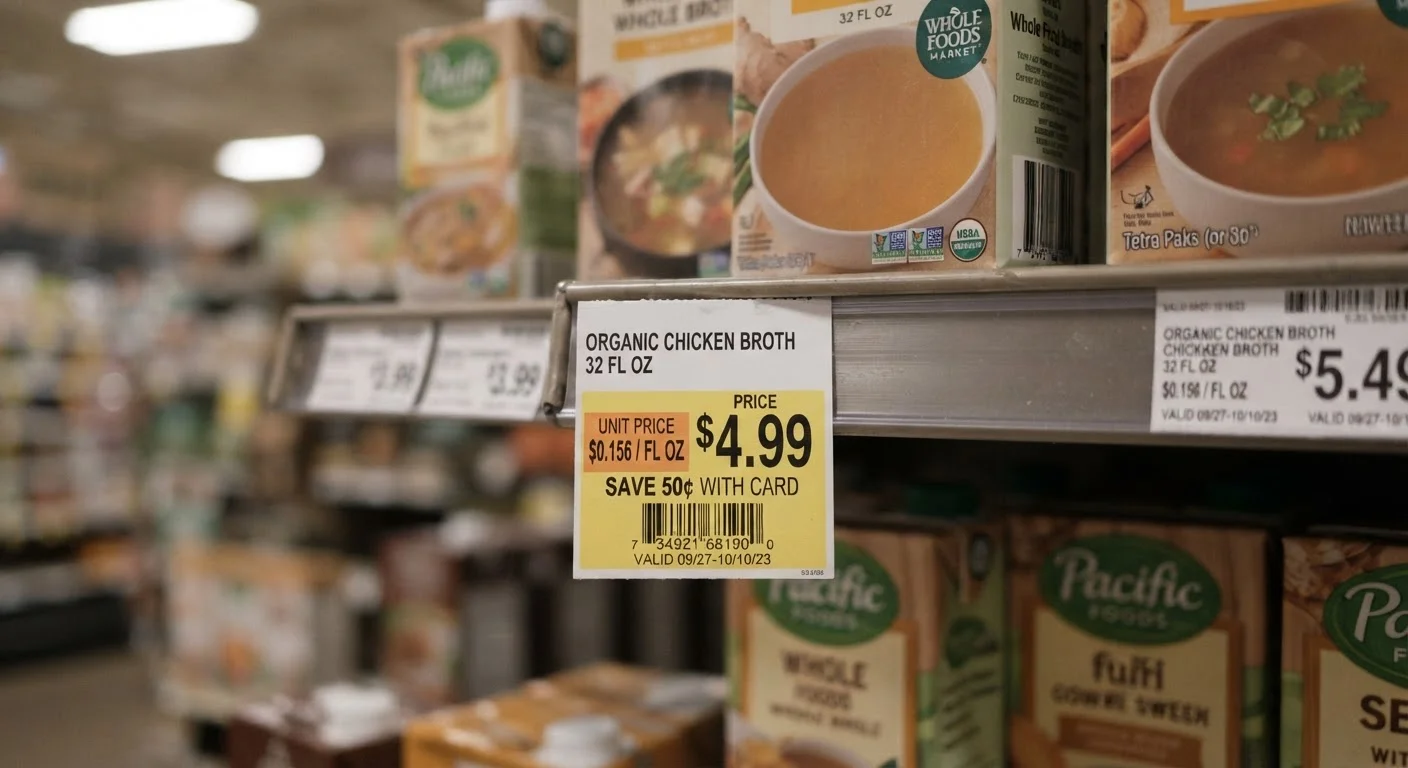
Every product on a store shelf carries at least one price - the sticker price, meaning the total dollar amount you pay to take that item home. It's the figure printed on the tag, the one that shows up in your cart total, and the one most shoppers use to make quick decisions.
The unit price is different. It expresses cost per standardized measure - per ounce, per fluid ounce, per count, per square foot, or whatever unit applies to that product category. You'll typically find it printed in smaller text on the shelf label, often expressed as something like $0.18/oz or $1.12/100 ct.
These two numbers answer different questions. Sticker price answers: Can I afford this right now? Unit price answers: Am I getting the most product for my money compared to alternatives? Neither is inherently more important - but they're not interchangeable, and conflating them is one of the most common ways shoppers overspend without realizing it.
Understanding how retailers use sticker prices to shape perception is its own topic - see our piece on how psychological pricing shapes what you think a product is worth for context on the tactics involved.
Where the Confusion Happens - and Why It Costs You
The gap between sticker price and unit price becomes most consequential when products come in different sizes. A 12-oz jar priced at $3.49 looks cheaper than a 20-oz jar at $4.99. But the unit prices - roughly $0.29/oz versus $0.25/oz - tell a different story. The more expensive sticker price is actually the more efficient purchase.
This dynamic plays out constantly in grocery, household goods, and personal care aisles. Retailers don't always make the comparison easy. Package sizes are frequently adjusted - a practice sometimes called shrinkflation - meaning a product's contents decrease while the sticker price holds steady or rises slightly. Without checking unit price, these changes are nearly invisible to shoppers.
| Criterion | Sticker Price | Unit Price |
|---|---|---|
| What it measures | Total purchase cost | Cost per standardized unit |
| Best use | Budget management at checkout | Comparing value across sizes |
| Affected by package size | Yes - larger packs cost more | Normalizes for size differences |
| Visible on shelf tag | Always, prominently | Usually, in smaller print |
| Reveals shrinkflation | No | Yes, if tracked over time |
| Useful for bulk buying decisions | Partially - shows total outlay | Yes - confirms efficiency |
Promotional pricing adds another layer of complexity. A "sale" sticker can make a product feel like a value even when the unit price hasn't changed significantly, or when a competing product at full sticker price still offers a lower cost per unit. Our editorial on why sale prices don't always mean you're saving covers how manufactured urgency can distort these judgments.
How to Use Unit Price Practically Without Overthinking It
Most U.S. states require grocery retailers to display unit prices on shelf tags, though the specific rules vary by jurisdiction. In practice, the unit price is almost always visible - it just requires a deliberate second look rather than a glance at the large number.
A few practical guidelines:
- Compare within the same unit. Unit prices are only directly comparable when expressed in the same measure. Ounces vs. liters, or count vs. weight, require additional conversion and are easy to misread.
- Factor in waste for perishables. A lower unit price on a larger package of something that may spoil isn't necessarily a savings. Waste offsets efficiency gains.
- Check bulk sizes critically. Warehouse and club store items often carry lower unit prices, but not universally. Some specialty or branded items at big-box stores carry unit prices above what a standard grocery offers on the same product. Always verify.
- Use your phone's calculator. When a shelf tag is missing or unclear, divide sticker price by total quantity. It takes ten seconds and eliminates guesswork.
For a deeper look at how unit pricing works across different product categories, our piece on price per unit and the math that reveals true value offers a practical walkthrough. And if bundle pricing or multi-buy promotions are in the mix, confusing discount strategies that cost shoppers more explains how those structures can obscure the real numbers.
Unit price won't tell you everything. It doesn't speak to quality, ingredients, or durability - factors that matter just as much in some categories. For a framework on weighing price against quality, see how to judge whether something is worth more.
When Unit Price Has Limits
Unit price is a cost-efficiency tool, not a quality indicator. Two products can share an identical unit price while differing significantly in ingredients, concentration, or durability. In categories like cleaning products or nutritional supplements, a higher-concentration formula may deliver more value per use even at a higher unit price. Use unit price to establish a cost baseline, then layer in product-specific factors before making the final call.