

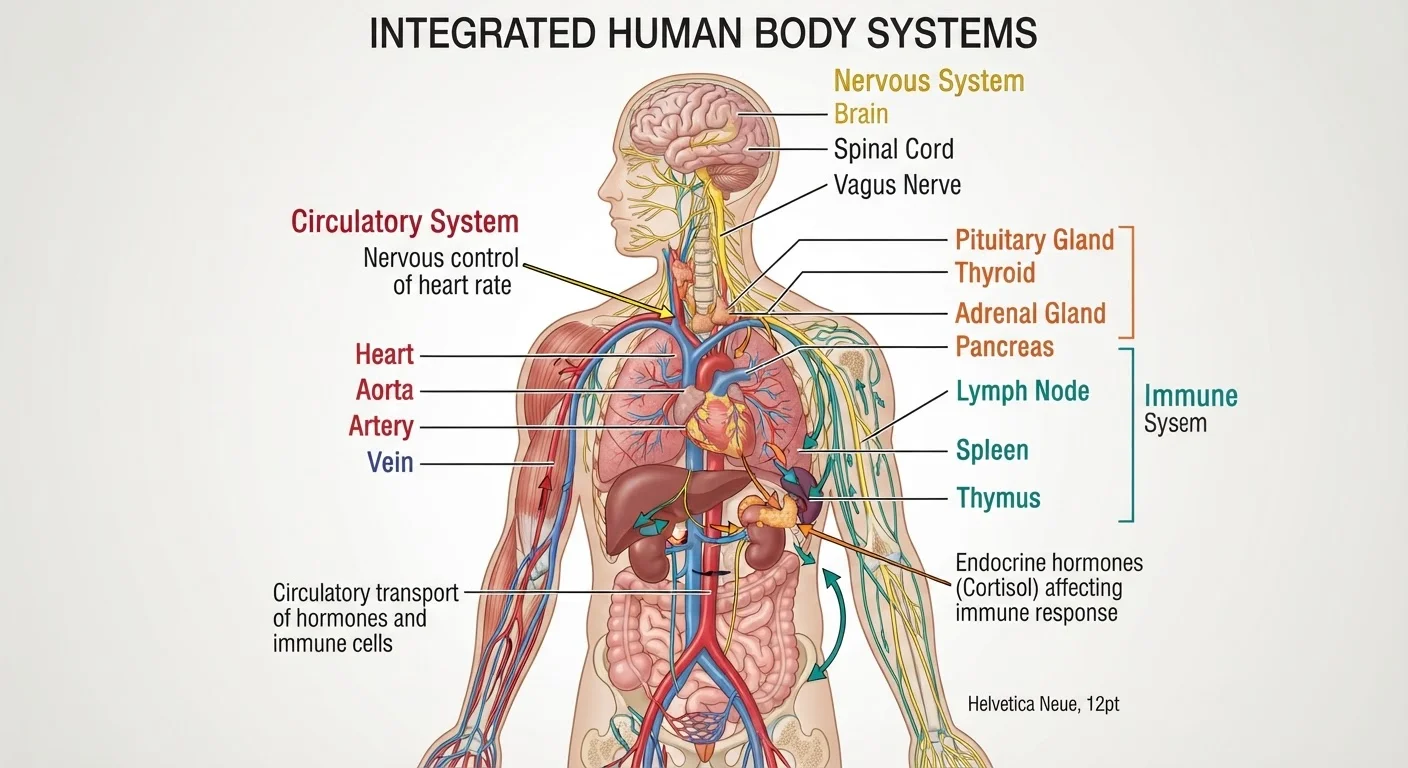
Key Takeaways
The Body Is Not a Collection of Separate Departments
Textbooks tend to present human biology one system at a time - a chapter on the nervous system, another on the circulatory system, another on digestion. This structure is convenient for learning, but it can leave readers with a misleading picture: that each system operates within its own silo, rarely crossing into another's territory.
In reality, the body's systems are deeply entangled. They share signaling molecules, anatomical pathways, and feedback loops that make it impossible for one system to change without affecting others. Understanding these relationships is essential for making sense of how the body stays stable - and why disruption in one area so often shows up somewhere unexpected.
The six cross-system relationships below are among the most significant and the most commonly overlooked in everyday anatomy education. For a broader look at how misinformation enters basic biology content, see where anatomy education often goes wrong.
The Nervous System and the Endocrine System
These two systems are the body's primary communication networks, and they are more intertwined than most people realize. The nervous system transmits signals electrically and nearly instantly through neurons. The endocrine system sends chemical messages - hormones - through the bloodstream, which act more slowly but can sustain effects over longer periods.
The hypothalamus, a small region at the base of the brain, sits at the intersection of both. It receives neural input and responds by directing the pituitary gland - the endocrine system's master regulator - to release hormones that trigger cascading effects throughout the body. During a perceived threat, for instance, the hypothalamus activates both the nervous system's rapid stress response and the endocrine release of cortisol, which sustains the body's alert state long after the initial neural signal has fired.
The hypothalamus acts as a bridge, translating nerve signals directly into hormone release.
The Circulatory System and the Immune System
The immune system depends entirely on the circulatory system for transportation. White blood cells - the immune system's primary defense agents - are manufactured in bone marrow and the thymus, then circulate through blood vessels until they are needed. When pathogens enter tissue, chemical signals cause local blood vessels to dilate and become more permeable, allowing immune cells to migrate out of the bloodstream and into the infected area.
The lymphatic system runs parallel to the circulatory system and plays an equally critical role, draining fluid from tissues and carrying immune cells to lymph nodes where pathogens are identified and targeted. Remove either network, and immune defense collapses.
Without blood vessels to travel through, immune cells cannot reach the sites where they are needed.
The Endocrine System and the Immune System
Chronic stress is a well-documented example of how the endocrine and immune systems intersect. Sustained elevated cortisol - a hormone released by the adrenal glands in response to stress signals - is broadly immunosuppressive. It reduces the production and activity of several types of immune cells and dampens inflammatory responses that would otherwise fight infection.
This relationship is bidirectional. Immune activity itself triggers the release of chemical messengers called cytokines, which can cross into the brain, alter mood, reduce appetite, and increase the sensation of fatigue. This is why illness often produces psychological symptoms, and why psychological stress can increase susceptibility to infection - the two systems are communicating constantly.
Chronic cortisol elevation doesn't just affect energy - it actively reduces immune cell activity.
The Digestive System and the Nervous System
The gut contains an estimated 100 million neurons - enough to be described by researchers as the body's "second brain," a structure formally called the enteric nervous system. This network operates semi-independently, coordinating muscle contractions, enzyme release, and fluid balance throughout the digestive tract without waiting for instructions from the brain.
The gut and the brain maintain a continuous two-way communication channel known as the gut-brain axis, primarily through the vagus nerve and via signaling molecules produced by gut bacteria. Changes in the gut microbiome - the community of microorganisms living in the digestive tract - have been associated in research with changes in mood, cognition, and stress responsiveness, though the mechanisms are still an active area of scientific investigation. Learn more about how this pathway begins in our overview of the digestive tract.
The gut's 100 million neurons form a semi-independent system that communicates directly with the brain.
The Integumentary System and the Circulatory System
The skin - covered in more detail in our article on the skin as an organ - is not merely a passive wrapper. It actively participates in thermoregulation through a mechanism that relies completely on the circulatory system. When core temperature rises, blood vessels near the skin's surface dilate, bringing warm blood closer to the exterior where heat can radiate away. When temperatures drop, those vessels constrict, conserving warmth for the body's core.
Skin also houses immune cells called Langerhans cells, which patrol the epidermis and alert the broader immune system to pathogens that breach the surface barrier. In this way, the integumentary system functions simultaneously as a circulatory partner and an immune outpost.
Skin blood vessel dilation and constriction are how the body fine-tunes its internal temperature.
The Musculoskeletal System and the Endocrine System
Bone is not static tissue - it is continuously remodeled by two types of cells: osteoblasts, which build new bone, and osteoclasts, which break it down. This remodeling is regulated substantially by hormones. Estrogen, for example, suppresses osteoclast activity; its decline after menopause accelerates bone loss and increases fracture risk. Parathyroid hormone (PTH) directly controls calcium release from bone to maintain blood calcium levels.
Muscle tissue, similarly, is responsive to hormonal signals. Testosterone and growth hormone promote muscle protein synthesis, while cortisol has a catabolic effect - breaking muscle down during periods of prolonged stress or illness. The structural integrity of the body, in other words, is partly a product of the endocrine environment it operates in. Understanding connective tissue within this system is explored further in our piece on tendons, ligaments, and cartilage.
Bone is living tissue continuously reshaped by hormonal signals, not a fixed structural scaffold.
Why These Connections Matter
Each of the relationships described above has real implications for understanding health. When a physician evaluates a patient's symptoms, they are - whether explicitly or not - tracing signals across system boundaries. A spike in blood pressure might reflect nervous system activation, endocrine output, or cardiovascular disease; often, all three are involved simultaneously.
Appreciating this complexity doesn't require a medical degree. It requires recognizing that the body maintains stability - a state biologists call homeostasis - through coordination, not isolation. No single system holds that balance alone.
Think in Systems, Not Symptoms
When a single symptom appears - fatigue, inflammation, mood changes - it rarely points to just one body system. Tracing the connections between systems can help you ask better questions when speaking with a healthcare provider. Always consult a qualified medical professional for evaluation of any specific health concern.
For deeper reading on specific systems mentioned here, explore our articles on how the nervous system communicates, the endocrine system's chemical messenger network, and what the lymphatic system actually does.