

Key Takeaways
Start here
What Is the Endocrine System?
Build knowledge
The Major Glands and What They Do
Go deeper
How Hormones Travel and Take Effect
Apply it
When the System Gets Out of Balance
Take action
Everyday Factors That Influence Hormone Health
What Is the Endocrine System?
The endocrine system is a network of glands and organs that produce, store, and release hormones directly into the bloodstream. Unlike the nervous system - which fires electrical impulses in milliseconds - the endocrine system operates on a slower timeline, but its effects are pervasive and long-lasting. Think of it as the body's chemical postal service: messages are dispatched from one location, travel through the blood, and arrive at distant target cells to change how they behave.
The word endocrine comes from Greek roots meaning "to secrete within," distinguishing these glands from exocrine glands (such as sweat glands) that release substances through ducts. Hormones govern an enormous range of processes: metabolism, growth and development, mood regulation, the sleep-wake cycle, sexual function, and the body's response to stress. To understand how interconnected these processes are, see our overview of body systems that work together.
Hormone
A chemical messenger produced by a gland and released into the bloodstream to signal target cells elsewhere in the body.
Gland
An organ or tissue that produces and secretes a substance - in the endocrine system, that substance is always a hormone released directly into the blood.
Negative feedback loop
A self-regulating mechanism where rising hormone levels signal the producing gland to slow down, preventing overproduction - similar to how a thermostat controls room temperature.
Receptor
A protein on or inside a cell that a specific hormone binds to - only cells with the matching receptor respond to a given hormone.
Endocrine disruptor
A chemical (natural or synthetic) that interferes with hormone signaling by mimicking, blocking, or altering hormone activity in the body.
Metabolism
The set of chemical processes the body uses to convert food and oxygen into energy; strongly regulated by thyroid hormones and insulin.
The Major Glands and What They Do
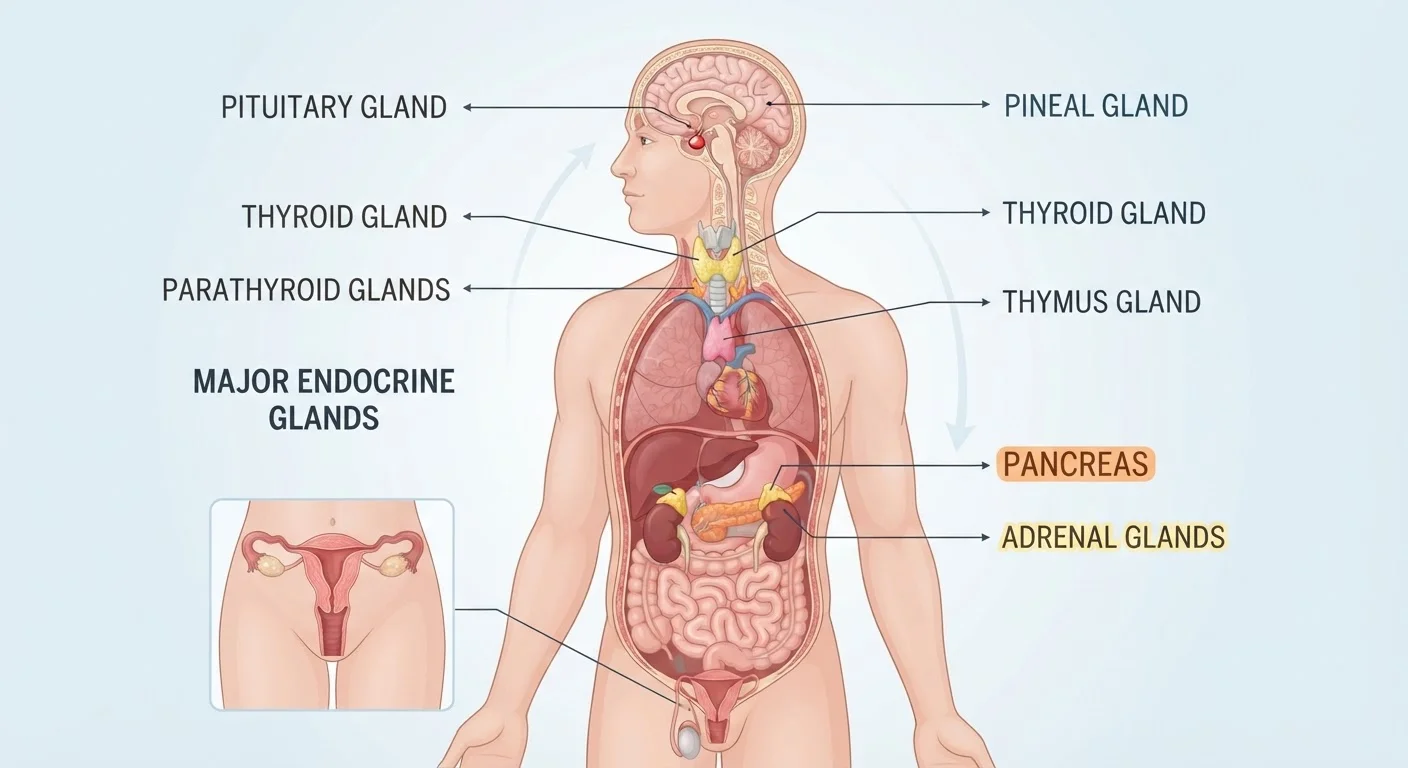
Several key glands make up the endocrine system, each with a distinct set of hormones and responsibilities.
- Hypothalamus: A small region of the brain that acts as the control center, linking the nervous system to the endocrine system. It monitors body conditions and sends releasing or inhibiting hormones to the pituitary gland.
- Pituitary gland: Often called the "master gland," it sits at the base of the brain and releases hormones that regulate growth, reproduction, and the activity of other glands - including the thyroid and adrenal glands.
- Thyroid gland: Located in the neck, it produces thyroid hormones (T3 and T4) that set the pace of metabolism - how efficiently cells convert nutrients into energy.
- Adrenal glands: Perched above each kidney, they release cortisol (the primary stress hormone), adrenaline (epinephrine), and hormones that regulate salt and water balance.
- Pancreas: Serves a dual role - it releases digestive enzymes through ducts (exocrine) and secretes insulin and glucagon into the blood (endocrine) to regulate blood sugar levels.
- Gonads (ovaries and testes): Produce sex hormones - estrogen, progesterone, and testosterone - that direct reproductive development and function.
- Pineal gland: Releases melatonin in response to darkness, helping regulate the circadian rhythm and sleep cycles.
How Hormones Travel and Take Effect
Once released into the bloodstream, hormones circulate throughout the body but only affect cells that carry the matching receptor - a lock-and-key mechanism. A hormone may pass thousands of cell types before it finds its target, binding only where the receptor fits precisely. This selectivity allows the same bloodstream to carry many different hormonal signals simultaneously without chaos.
The body regulates hormone levels primarily through negative feedback loops. When levels of a hormone rise high enough to accomplish their task, a signal travels back to the originating gland to slow production. The thyroid axis is a clear example: the hypothalamus releases thyrotropin-releasing hormone (TRH), prompting the pituitary to release thyroid-stimulating hormone (TSH), which then prompts the thyroid to produce T3 and T4. Rising T3/T4 levels feed back to the hypothalamus and pituitary to reduce TRH and TSH output - self-correcting like a thermostat.
Compared to the lightning-fast nerve signals described in our guide to the human nervous system, hormonal communication is measured in minutes to hours. That slower pace is actually a feature: sustained regulation of metabolism or growth requires a steady, lasting signal rather than a brief electrical burst.
When the System Gets Out of Balance
Because hormones regulate so many functions, imbalances - whether too much or too little - can have wide-ranging consequences. Some of the most common endocrine disorders include:
- Type 2 diabetes
- Cells become resistant to insulin, preventing efficient blood sugar uptake. The pancreas compensates by producing more insulin until it can no longer keep pace.
- Hypothyroidism
- An underactive thyroid produces insufficient T3 and T4, leading to fatigue, weight gain, cold sensitivity, and slowed thinking.
- Hyperthyroidism
- An overactive thyroid accelerates metabolism, causing unintended weight loss, rapid heartbeat, and anxiety.
- Cushing's syndrome
- Excess cortisol - from a tumor or long-term corticosteroid medication - causes weight gain concentrated around the trunk, skin changes, and immune suppression.
- Polycystic ovary syndrome (PCOS)
- A hormonal disorder involving elevated androgens that affects ovulation and metabolic health in many people with ovaries.
Most endocrine conditions are diagnosable through blood tests that measure hormone concentrations directly. Treatment varies widely - from hormone replacement therapy to medication that suppresses gland overactivity - and should always be guided by a qualified healthcare provider.
Everyday Factors That Influence Hormone Health
The endocrine system doesn't operate in isolation from daily life. Research consistently shows that several lifestyle factors meaningfully influence hormone regulation:
- Sleep: The majority of growth hormone secretion occurs during deep sleep. Insufficient sleep elevates cortisol and disrupts insulin sensitivity, according to research published in journals such as Sleep Medicine Reviews.
- Chronic stress: Sustained psychological stress keeps cortisol elevated beyond its short-term usefulness, gradually impairing immune function and interfering with reproductive hormones.
- Physical activity: Exercise sensitizes cells to insulin and influences hormones linked to appetite regulation, including leptin and ghrelin. Both aerobic and resistance training show measurable endocrine benefits in peer-reviewed studies.
- Nutrition: Dietary fat intake affects sex hormone production; iodine deficiency impairs thyroid function; blood sugar swings stress pancreatic insulin output.
- Environmental exposures: Certain synthetic chemicals - called endocrine-disrupting compounds (EDCs) - can mimic or block hormone action. Common sources studied include some plastics and pesticides; research in this area is ongoing.
Talk to Your Doctor About Hormone Testing
If you suspect a hormonal imbalance - persistent fatigue, unexplained weight changes, mood disruption, or irregular cycles - a simple blood panel can measure many key hormones directly. Early detection of conditions like hypothyroidism or prediabetes can make treatment significantly more effective. Don't self-diagnose based on symptoms alone, as many endocrine conditions share overlapping signs.
This article is for general educational purposes only and is not a substitute for professional medical advice, diagnosis, or treatment. Consult a qualified healthcare provider regarding any health concerns or before making changes to your health management.