

Key Takeaways
Human Nervous System
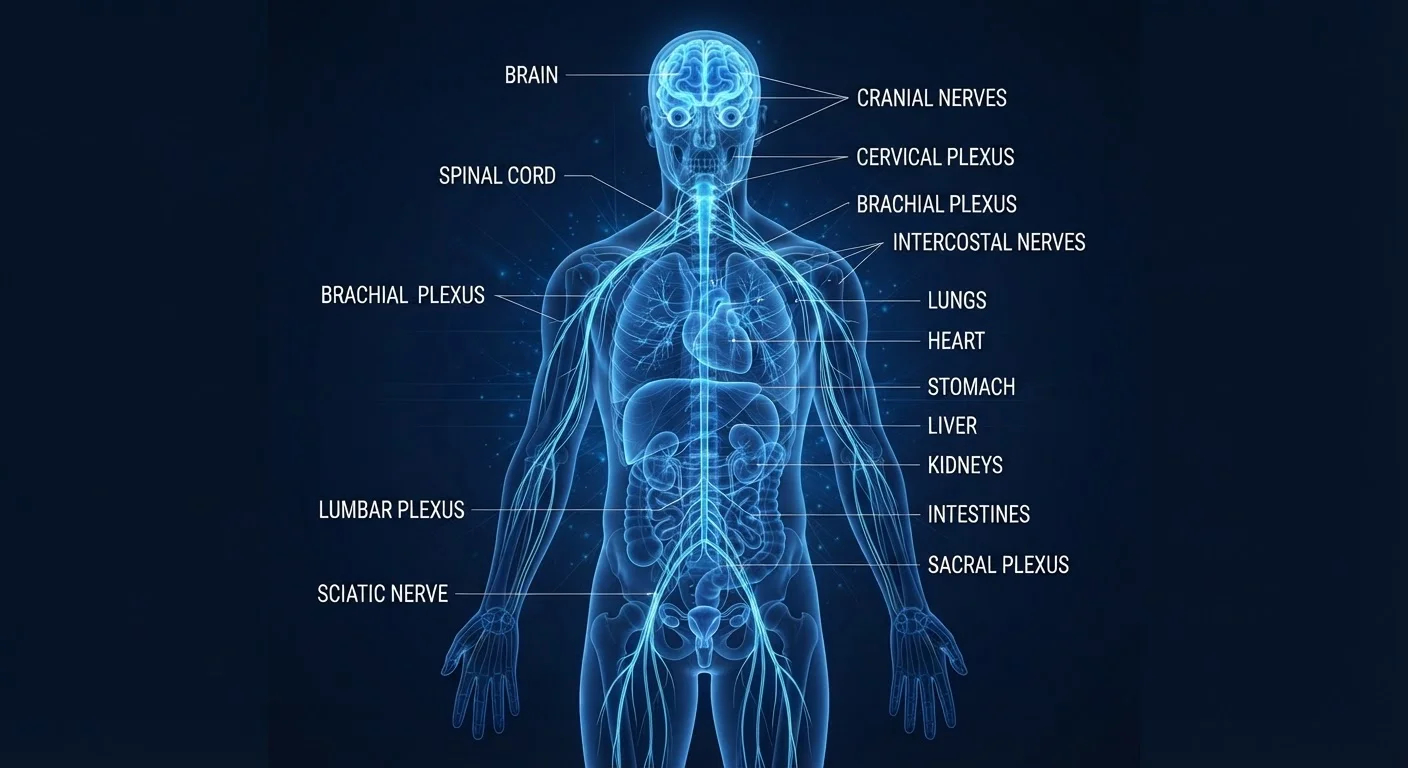
The nervous system is the body's primary communication network, responsible for receiving information from the environment, processing it, and sending instructions to muscles, organs, and glands. It consists of the brain, spinal cord, and an extensive web of nerves reaching every corner of the body. In simple terms, it is what allows you to think, feel, move, and automatically regulate functions like breathing and heart rate.
Neuroscientists divide the nervous system into the central nervous system (CNS), comprising the brain and spinal cord, and the peripheral nervous system (PNS), which includes all other neural tissue - sensory neurons, motor neurons, and the autonomic branches.
The Two Major Divisions
The nervous system is typically split into two interconnected parts. The central nervous system (CNS) - made up of the brain and spinal cord - acts as the command center, integrating incoming information and generating coordinated responses. The peripheral nervous system (PNS) is everything beyond that: the vast network of sensory and motor nerves that fan out to your skin, muscles, and internal organs.
Within the PNS, scientists distinguish between the somatic nervous system, which handles voluntary muscle control and sensory perception, and the autonomic nervous system, which regulates involuntary processes. The autonomic branch further divides into the sympathetic system - responsible for the well-known 'fight-or-flight' response - and the parasympathetic system, which governs the body's rest-and-digest state. Understanding this architecture helps explain why touching a hot stove and falling asleep involve very different neural circuits.
Neurons: The Messengers Behind Every Thought and Movement
The fundamental unit of the nervous system is the neuron, a specialized cell designed to carry electrical and chemical signals. A typical neuron consists of three parts: the cell body, which contains the nucleus; dendrites, short branching extensions that receive incoming signals; and the axon, a long projection that transmits outgoing signals to the next cell.
Signals travel along an axon as an action potential - a brief, self-propagating wave of electrical charge. When the signal reaches the end of the axon, it triggers the release of chemical messengers called neurotransmitters into the gap between cells, known as the synapse. The receiving neuron detects these chemicals and either fires its own signal or stays quiet, depending on the balance of excitatory and inhibitory inputs it receives.
86 billion
Neurons in the human brain
According to a landmark 2009 study by Azevedo et al. published in the Journal of Comparative Neurology, the human brain contains approximately 86 billion neurons.
268 mph
Peak nerve signal conduction speed
Large, myelinated motor neurons can transmit action potentials at up to 268 miles per hour, as documented in standard neurophysiology literature.
100 trillion
Estimated synaptic connections in the brain
Neuroscientists estimate the adult human brain contains roughly 100 trillion synapses, giving it extraordinary computational capacity.
Many axons are wrapped in a fatty coating called myelin, which acts like insulation on an electrical wire, dramatically accelerating signal speed and energy efficiency. Diseases such as multiple sclerosis damage myelin and are a direct demonstration of how critical this coating is to normal neural function.
How Your Brain Processes and Responds to the World
The brain is the most complex organ in the known universe, housing approximately 86 billion neurons connected by an estimated 100 trillion synapses. Different regions specialize in distinct roles: the cerebral cortex handles higher thinking, language, and conscious perception; the cerebellum coordinates movement and balance; and the brainstem controls vital automatic functions like breathing, heart rate, and swallowing.
When a sensory signal - say, the sight of an approaching car - reaches the brain, multiple regions collaborate within milliseconds. The thalamus acts as a relay station, routing visual information to the appropriate cortical areas. The prefrontal cortex weighs options; the motor cortex fires signals down through the spinal cord to the muscles of your legs. This entire process, from perception to action, can unfold faster than you are consciously aware of it.
The nervous system does not work in isolation. It constantly exchanges information with the endocrine system, which uses hormones to regulate longer-term changes in the body. You can explore how these two systems compare in our article on the endocrine system as your body's chemical messenger network.
Why the Nervous System Matters for Everyday Health
Nervous system health underpins virtually every aspect of daily functioning - from maintaining balance while walking to regulating stress responses that affect heart health and immune activity. Disruptions in neural signaling are implicated in a wide range of conditions, including Parkinson's disease (dopamine-producing neurons deteriorate), epilepsy (abnormal synchronized firing of neurons), and peripheral neuropathy (damage to nerves outside the CNS, commonly linked to diabetes).
Lifestyle factors that support neural health include regular aerobic exercise, which research associates with increased production of brain-derived neurotrophic factor (BDNF) - a protein that supports neuron growth and survival - as well as adequate sleep, which allows the brain's glymphatic system to clear metabolic waste. The nervous system is also deeply intertwined with other body systems; for a broader look, see how body systems work together.
This article is for general educational purposes only and is not a substitute for professional medical advice, diagnosis, or treatment. Consult a qualified healthcare provider for concerns about your neurological health.