

Key Takeaways
The Carbon Cycle
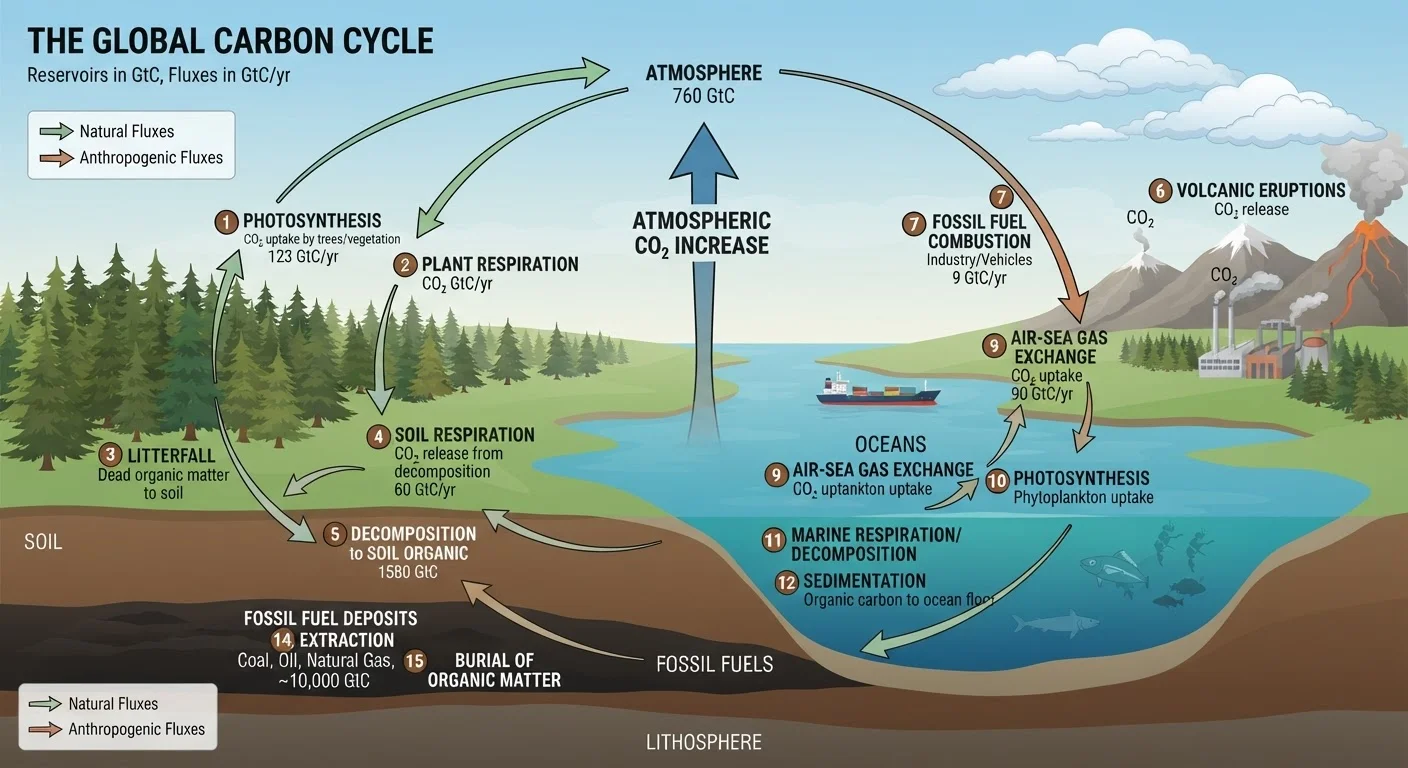
The carbon cycle is the set of natural processes by which carbon atoms continuously move through Earth's atmosphere, oceans, soil, living organisms, and rock. Carbon doesn't disappear - it changes form and location, cycling between reservoirs over timescales ranging from days to millions of years. Understanding this cycle is fundamental to understanding climate change.
Scientists distinguish between the fast carbon cycle (biological and atmospheric exchanges occurring over years to centuries) and the slow carbon cycle (geological processes spanning millions of years, including volcanic outgassing and rock weathering).
What the Carbon Cycle Actually Is
Carbon is the backbone of life on Earth. Every living cell, every breath, and every drop of the ocean contains carbon in some form. The carbon cycle describes how this element moves continuously among Earth's major systems - never being created or destroyed, only transformed and relocated.
Scientists organize these movements around four key reservoirs: the atmosphere (where carbon exists mainly as CO₂ and methane), the biosphere (all living organisms and organic matter), the hydrosphere (oceans, rivers, and lakes), and the lithosphere (rocks, sediments, and fossil fuel deposits). Carbon flows between these reservoirs through a web of biological, chemical, and physical processes.
If you're building your climate science foundation, start with the core concepts that underpin how these systems interact.
The Fast Carbon Cycle: Life Breathing Carbon
The fast carbon cycle operates on timescales of days to centuries and is driven largely by living things. Its two primary engines are photosynthesis and respiration.
During photosynthesis, plants, algae, and cyanobacteria absorb CO₂ from the atmosphere and use solar energy to convert it into organic molecules - sugars, cellulose, and other compounds that form living tissue. This process removes carbon from the atmosphere and locks it into biomass.
Respiration runs the process in reverse. All organisms, including plants themselves, break down organic molecules to release energy, returning CO₂ to the atmosphere. When organisms die, decomposers such as bacteria and fungi break down their remains, releasing still more carbon.
Oceans play an equally important role. Seawater dissolves atmospheric CO₂ at the surface, and marine phytoplankton conduct photosynthesis on a massive scale. When marine organisms die, some of their carbon sinks to the deep ocean - a process sometimes called the biological pump - sequestering it for centuries.
~25-30%
Of human CO₂ emissions absorbed by oceans annually
According to NOAA and the Global Carbon Project, oceans absorb roughly a quarter to a third of anthropogenic CO₂ emissions each year, making them Earth's largest active liquid carbon sink.
800 Gt C
Carbon stored in Earth's atmosphere
The Global Carbon Project estimates approximately 800 gigatons of carbon currently reside in the atmosphere, compared to roughly 38,000 Gt C dissolved in the oceans.
~36 Gt CO₂
Annual global fossil fuel CO₂ emissions
The Global Carbon Project's annual budget reports place global fossil fuel and industrial CO₂ emissions at approximately 36-37 gigatons per year as of recent assessment years.
The Slow Carbon Cycle: Geology on Deep Time
Over millions of years, geological processes regulate Earth's carbon at a much grander scale. Carbon dissolved in rainwater reacts with rocks in a process called chemical weathering, forming carbonate minerals that eventually wash into the ocean and settle as sediment. Over geological time, this sediment can be subducted into Earth's mantle and returned to the atmosphere via volcanic eruptions - completing a loop that spans tens of millions of years.
Fossil fuels - coal, oil, and natural gas - are the compressed organic remains of ancient organisms buried and transformed over hundreds of millions of years. They represent carbon removed from the active cycle long ago and stored in the lithosphere. When humans burn them, that ancient carbon re-enters the atmosphere in decades rather than eons, overwhelming the cycle's natural reabsorption capacity.
How Human Activity Is Disrupting the Balance
The carbon cycle has maintained a rough equilibrium across Earth's history, but that balance depends on flows staying roughly proportional. Human fossil fuel combustion and land-use change have significantly accelerated the rate at which carbon enters the atmosphere.
Forests, which store vast amounts of carbon in biomass and soil, are both carbon sinks and potential carbon sources depending on how they're managed. The science of deforestation and reforestation clarifies what land use decisions actually mean for atmospheric carbon.
As oceans absorb excess CO₂ to buffer the atmosphere, their chemistry shifts - a consequence explored in depth in our coverage of ocean acidification and the carbon connection. Meanwhile, warming temperatures can thaw permafrost soils, releasing stored carbon and creating a feedback loop that amplifies warming further.
For a grounded look at how scientists distinguish natural climate variation from human-caused changes, see how attribution science works.
Why Understanding the Carbon Cycle Matters
The carbon cycle isn't an abstract concept - it determines the concentration of greenhouse gases in the atmosphere, the chemistry of the oceans, and the health of ecosystems that humans depend on. Every policy discussion about emissions, land use, or carbon capture connects back to the fundamental science of how carbon moves through Earth's systems.
Grasping the cycle also helps readers evaluate claims with more confidence. For a broader vocabulary of carbon and climate terminology, the key terms in climate science guide provides a reliable reference point.
“The carbon cycle is the circulatory system of the Earth. Disrupt it, and you disrupt the climate regulation that all life depends upon.”
— Richard Alley, Geoscientist and climate researcher, Pennsylvania State University