

Key Takeaways
Option A
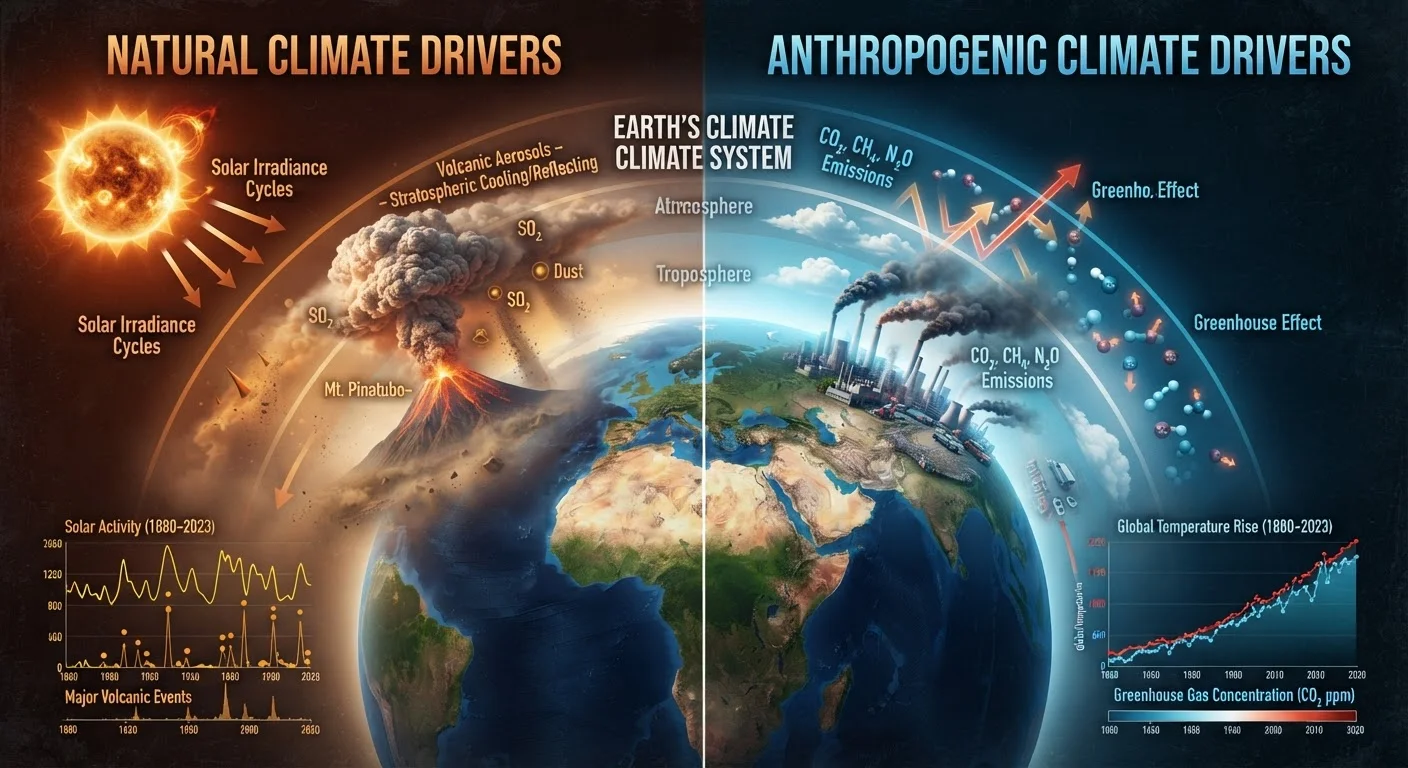
Natural Climate Variability
The Earth's built-in cycles of warming and cooling.
Best for: Understanding baseline climate behavior driven by volcanic eruptions, solar output changes, and ocean circulation patterns.
Option B
Human-Caused (Anthropogenic) Warming
The measurable, greenhouse-gas-driven temperature rise since industrialization.
Best for: Explaining the accelerated, fingerprinted warming trend observed since the mid-20th century and linked to fossil fuel combustion.
If you want to understand why climate has changed before humans existed
Natural Climate Variability
Orbital cycles, solar fluctuations, and volcanic events have driven major climate swings over millennia. This framework explains pre-industrial climate history.
If you want to understand what is driving warming right now
Human-Caused (Anthropogenic) Warming
The post-industrial temperature rise, stratospheric cooling alongside tropospheric warming, and isotopic CO₂ signatures all point to fossil fuel emissions as the dominant current driver.
If you are evaluating claims that current warming is 'just natural cycles'
Human-Caused (Anthropogenic) Warming
Attribution science has systematically tested natural-only explanations against observed data and found they cannot account for the magnitude, rate, or spatial pattern of recent warming.
What Is Natural Climate Variability?
Earth's climate is not - and never has been - static. Over geological timescales, it has been shaped by three primary natural drivers: variations in Earth's orbit around the Sun (known as Milankovitch cycles), changes in solar output, and volcanic eruptions that inject sulfur dioxide into the stratosphere, temporarily cooling the planet by reflecting sunlight.
On shorter timescales, natural ocean-atmosphere patterns like El Niño-Southern Oscillation (ENSO) and the Atlantic Meridional Overturning Circulation (AMOC) redistribute heat around the globe, producing year-to-year and decade-to-decade temperature swings. Ice ages and warm interglacial periods are classic expressions of natural variability operating over tens of thousands of years.
Understanding this history is crucial. As our explainer on climate data collection details, scientists reconstruct past climates using ice cores, tree rings, sediment records, and coral samples - proxies that reveal temperature and atmospheric composition going back hundreds of thousands of years.
What Is Human-Caused (Anthropogenic) Warming?
Since the Industrial Revolution, humans have been burning fossil fuels - coal, oil, and natural gas - releasing carbon dioxide (CO₂) and methane (CH₄) that had been locked away for millions of years. These are greenhouse gases: they absorb outgoing infrared radiation from Earth's surface and re-emit it downward, trapping heat in the lower atmosphere.
The concentration of atmospheric CO₂ has risen from roughly 280 parts per million (ppm) before industrialization to over 420 ppm today - a level not seen in at least 800,000 years, according to ice core data. Deforestation, agriculture, and industrial processes add further pressure.
This warming is not evenly distributed. The Arctic is warming roughly four times faster than the global average - a phenomenon called Arctic amplification - and the stratosphere is actually cooling while the lower atmosphere (troposphere) warms. That stratospheric cooling is a key fingerprint that distinguishes greenhouse warming from solar-driven warming, which would warm both layers simultaneously.
| Criterion | Natural Climate Variability | Human-Caused Warming |
|---|---|---|
| Primary drivers | Orbital cycles, solar output, volcanoes, ocean circulation | CO₂, methane, and other greenhouse gas emissions |
| Timescale of major shifts | Thousands to millions of years | Decades (accelerated since ~1950) |
| Current rate of warming | Cannot explain post-1950 trend | Matches observed warming in models |
| Stratospheric temperature | Warms alongside troposphere (solar) or cools briefly (volcanoes) | Cools - a unique greenhouse fingerprint |
| CO₂ isotopic signature | No fossil-fuel isotopic depletion | Depleted carbon-13 and carbon-14 confirm fossil origin |
| Arctic amplification | Not predicted by natural-only models | Consistent with greenhouse gas predictions |
| Self-correcting over time? | Yes - cycles reverse naturally | No - persists without emissions reduction |
How Scientists Tell Them Apart: Detection and Attribution
Climate attribution science is the discipline that asks: could what we're observing have occurred without human influence? Scientists use two interrelated methods.
Detection establishes that a climate change is statistically distinguishable from natural variability. Attribution then quantifies the contribution of specific causes - natural, human, or both - to that detected change.
Key tools include:
- Climate models: Scientists run simulations with and without human greenhouse gas emissions. Models that include only natural forcings cannot reproduce the observed post-1950 warming trend. Those that include anthropogenic forcings match observations closely.
- Isotopic fingerprinting: CO₂ from fossil fuels has a distinct isotopic signature (depleted in carbon-13 and carbon-14) compared with CO₂ from other sources. Atmospheric measurements confirm the rising CO₂ bears this fossil fuel fingerprint.
- Spatial patterns: Greenhouse-gas-driven warming produces specific patterns - greater warming at the poles, nights warming faster than days, stratospheric cooling - that solar variability alone does not predict.
420+ ppm
Current atmospheric CO₂ concentration
Exceeds any level recorded in at least 800,000 years of ice core data, according to NOAA and EPICA ice core research.
~10x faster
Current warming rate vs. post-ice-age natural warming
The IPCC Sixth Assessment Report notes the current rate of warming is unprecedented compared to natural post-glacial transitions.
4x faster
Arctic warming rate vs. global average
Arctic amplification, a predicted signature of greenhouse warming, has been documented in NOAA's Arctic Report Card series.
This evidence base is why the IPCC Sixth Assessment Report concluded it is unequivocal that human influence has warmed the climate - the strongest language the panel uses.
Why the Distinction Matters for Understanding Climate Risk
Natural variability is still real and it still matters. A strong El Niño year can push global temperatures temporarily higher; a major volcanic eruption can cool the planet for a year or two. These fluctuations sit on top of the human-caused warming trend - they don't cancel it.
Misidentifying the cause of warming has real consequences for how societies plan. If warming were purely cyclical, it would self-correct without human intervention. Attribution science shows it will not. Understanding the pace also matters: as our article on climate tipping points explains, the speed of change - not just its magnitude - can determine whether ecosystems and human systems can adapt.
Claims that current warming is simply a natural cycle often misuse isolated data points or short time windows - a pattern documented in climate misinformation research. Attribution methods are specifically designed to address those arguments rigorously, using the full body of evidence rather than cherry-picked segments.
The science of telling these two climate drivers apart is not perfect - uncertainty remains in quantifying the precise contribution of each factor in specific events. But the overall picture, built from multiple independent lines of evidence, is robust.