

Key Takeaways
Our Verdict
The science is clear: preventing deforestation delivers faster and larger climate benefits than reforestation alone. Reforestation is a valuable tool but not a substitute for protecting standing forests. A combined strategy - halting forest loss while actively restoring degraded land - offers the strongest climate outcome.
| Best for | Recommended |
|---|---|
| Immediate climate impact | Halting deforestation |
| Long-term carbon sequestration | Native-species reforestation of degraded land |
| Biodiversity and ecosystem resilience | Old-growth forest protection |
| Scalable land restoration programs | Mixed reforestation with diverse native species |
How Forests Store and Release Carbon
Forests are among Earth's most powerful natural carbon reservoirs. Through photosynthesis, trees absorb carbon dioxide (CO₂) from the atmosphere and lock it into their wood, roots, leaves, and surrounding soil. This process makes forests critical components of the global carbon cycle - the continuous movement of carbon between the atmosphere, oceans, soil, and living organisms. For a deeper primer, see how carbon moves through Earth's systems.
When forests are cleared - whether by logging, burning, or land conversion - that stored carbon is rapidly returned to the atmosphere as CO₂ and methane. According to research published in journals including Nature Climate Change, land-use change, primarily deforestation, accounts for roughly 10-15% of global annual greenhouse gas emissions. Tropical forests are especially carbon-dense: the Amazon basin alone holds an estimated 150-200 billion metric tons of carbon.
| Deforestation | Reforestation (Native Species) | Reforestation (Monoculture) | |
|---|---|---|---|
| Carbon impact timeline | Immediate large release | Gradual gain over decades | Slower gain, less dense |
| Carbon storage capacity | Eliminates existing stocks | High potential long-term | Lower than native forests |
| Biodiversity support | Severe loss | High - restores habitat | Low - limited species |
| Water cycle effects | Disrupts regional rainfall | Gradually restores | Minimal improvement |
| Ecosystem resilience | Greatly reduced | Rebuilt over time | Vulnerable to disease/fire |
| Climate reversibility | Difficult to reverse quickly | Decades to recover | Partial recovery only |
The Carbon Cost of Deforestation
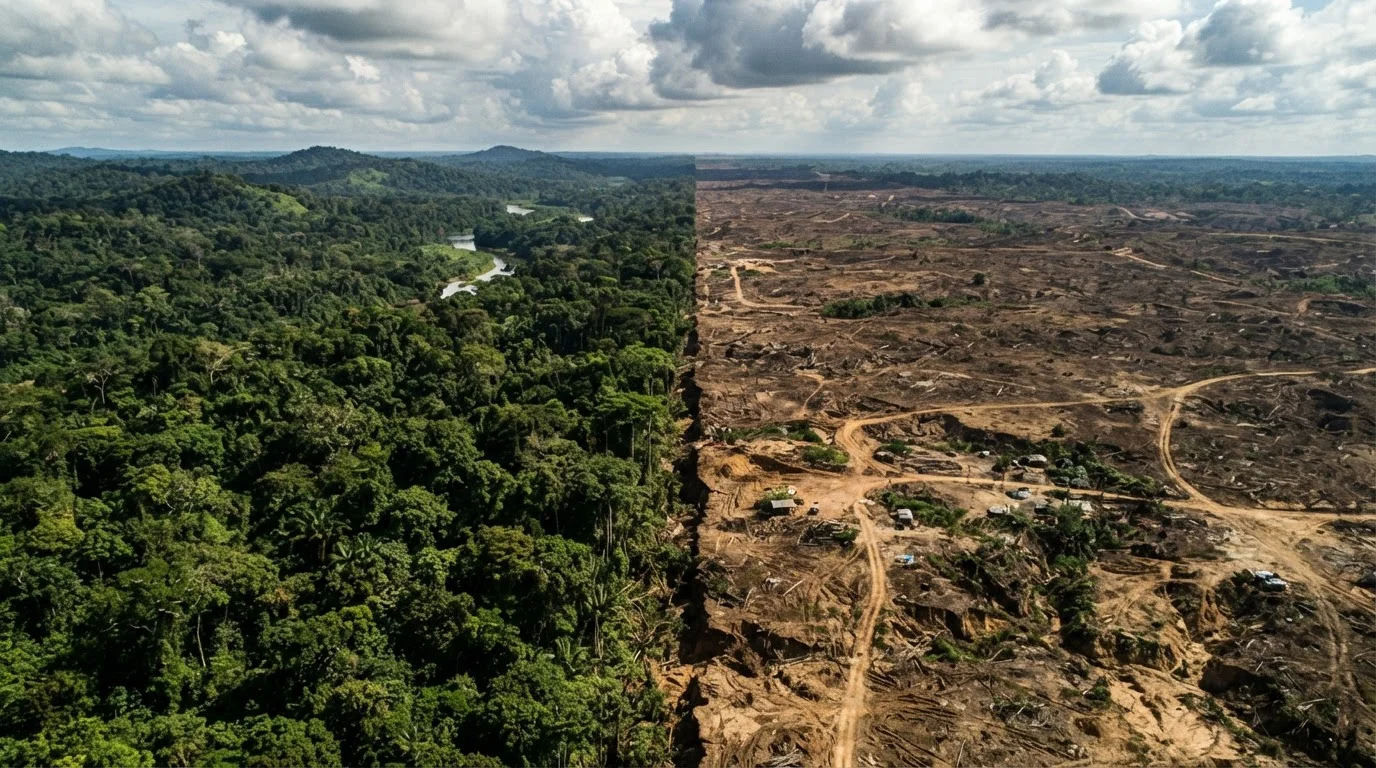
Deforestation doesn't just remove a carbon sink - it actively converts a forest into a carbon source. When trees are burned or left to decompose, stored carbon is oxidized and released. Soil disturbance compounds this effect: forest soils often hold more carbon than the trees above them, and clearing exposes that carbon to microbial breakdown and atmospheric release.
Beyond immediate emissions, deforestation degrades the surrounding ecosystem's ability to recover. Forest fragmentation disrupts humidity and rainfall patterns that support regrowth. Studies of the Amazon have documented a feedback loop where large-scale clearing reduces regional precipitation, further stressing remaining forests and accelerating dieback - a phenomenon researchers call the "savannization" of formerly wet tropical zones.
Reforestation Cannot Offset Rapid Deforestation
A common misconception is that planting trees can fully compensate for forest loss. The science does not support this on relevant timescales. Old-growth forests store carbon accumulated over centuries; a newly planted forest takes generations to rebuild equivalent stocks. Allowing deforestation to continue while banking on future tree planting creates a significant, long-lasting carbon debt that worsens near-term warming.
What Reforestation Can - and Cannot - Do
Reforestation - planting trees on previously forested land - and afforestation - establishing forests on land that lacked them - are widely promoted as climate solutions. The science confirms real benefits, but with important caveats. Young forests do sequester carbon, but they take 40-100 years or more to approach the carbon density of mature ecosystems. A study in Science (2019) estimated that global tree restoration could ultimately store up to 205 gigatons of carbon, though subsequent peer review debate highlighted the complexity of land availability and tree survival estimates.
Critically, not all replanting projects deliver equal climate value. Monoculture plantations - single-species tree farms - sequester less carbon per hectare, support far less biodiversity, and are more vulnerable to disease and fire than complex, multi-species native forests. The most climate-effective reforestation strategies prioritize native species diversity, natural regeneration where possible, and locally appropriate ecological conditions.
Comparing the Climate Impact: Deforestation vs. Reforestation
The comparison between deforestation and reforestation isn't simply a matter of subtracting one from the other. The carbon released by deforestation is immediate and large-scale, while the carbon captured by reforestation accumulates slowly over decades. This temporal gap matters enormously in the context of near-term climate targets, such as the Paris Agreement's 1.5°C threshold.
Protecting existing old-growth and primary forests - those that have never been significantly disturbed - represents the highest-value climate action because it preserves carbon stocks that took centuries to accumulate and cannot be quickly replaced. According to research from the Global Forest Watch and institutions such as the Woodwell Climate Research Center, primary forests store roughly three times more carbon per hectare than planted secondary forests of comparable age.
The Bigger Picture: Biodiversity, Water, and Regional Climate
Carbon storage is only one dimension of what forests provide. Tropical and temperate forests regulate the water cycle through transpiration, returning moisture to the atmosphere and sustaining rainfall patterns across entire continents. Deforestation in one region can reduce precipitation thousands of miles away - a dynamic documented between the Amazon and agricultural regions of South America.
Biodiversity is equally at stake. Forests are home to an estimated 80% of terrestrial species. Deforestation drives habitat loss and extinction at rates that undermine ecosystem resilience - the very resilience that makes forests effective, durable carbon sinks. Reforestation that incorporates native plant diversity helps restore these functions, while monoculture approaches largely do not.
The science points to a complementary strategy rather than a binary choice: aggressively protecting remaining old-growth forests while scaling up ecologically sound reforestation on degraded lands. Neither approach alone is sufficient - both are necessary components of a credible climate response.