

Key Takeaways
Ocean Acidification
Ocean acidification is the ongoing process by which seawater becomes more chemically acidic as it absorbs carbon dioxide (CO₂) from the atmosphere. When CO₂ dissolves in seawater, it forms carbonic acid, which then breaks down into hydrogen ions and bicarbonate - raising the concentration of hydrogen ions and lowering the ocean's pH. This shift in ocean chemistry has wide-ranging consequences for marine life and ecosystems.
pH is measured on a logarithmic scale from 0 to 14; pre-industrial ocean pH averaged approximately 8.2, and surface ocean pH has already declined by about 0.1 units - representing roughly a 26% increase in hydrogen ion concentration.
The Chemistry Behind the Crisis
The ocean has always exchanged gases with the atmosphere - it is one of Earth's most important natural carbon sinks. But since the Industrial Revolution, humans have released CO₂ at a pace that far outstrips natural cycles. The ocean now absorbs an estimated 25-30% of annual anthropogenic CO₂ emissions, according to research published in the journal Science and confirmed by NOAA's ocean carbon monitoring programs.
The chemistry is straightforward: CO₂ dissolves in seawater to form carbonic acid (H₂CO₃). This unstable compound quickly dissociates into bicarbonate ions and hydrogen ions. More hydrogen ions mean a lower pH - the definition of increased acidity. Critically, the same reaction also reduces the availability of carbonate ions, which are the raw material marine organisms use to build calcium carbonate structures like shells and coral skeletons.
25-30%
Annual human CO₂ emissions absorbed by oceans
Estimated by NOAA and corroborated by multiple peer-reviewed global carbon budget assessments.
0.1 pH units
Decline in surface ocean pH since pre-industrial times
This represents approximately a 26% increase in hydrogen ion concentration, per NOAA Ocean Acidification Program data.
~8.1
Current average surface ocean pH
Down from a pre-industrial average of approximately 8.2, based on long-term observational records including the Hawaii Ocean Time-series.
How Scientists Track the Change
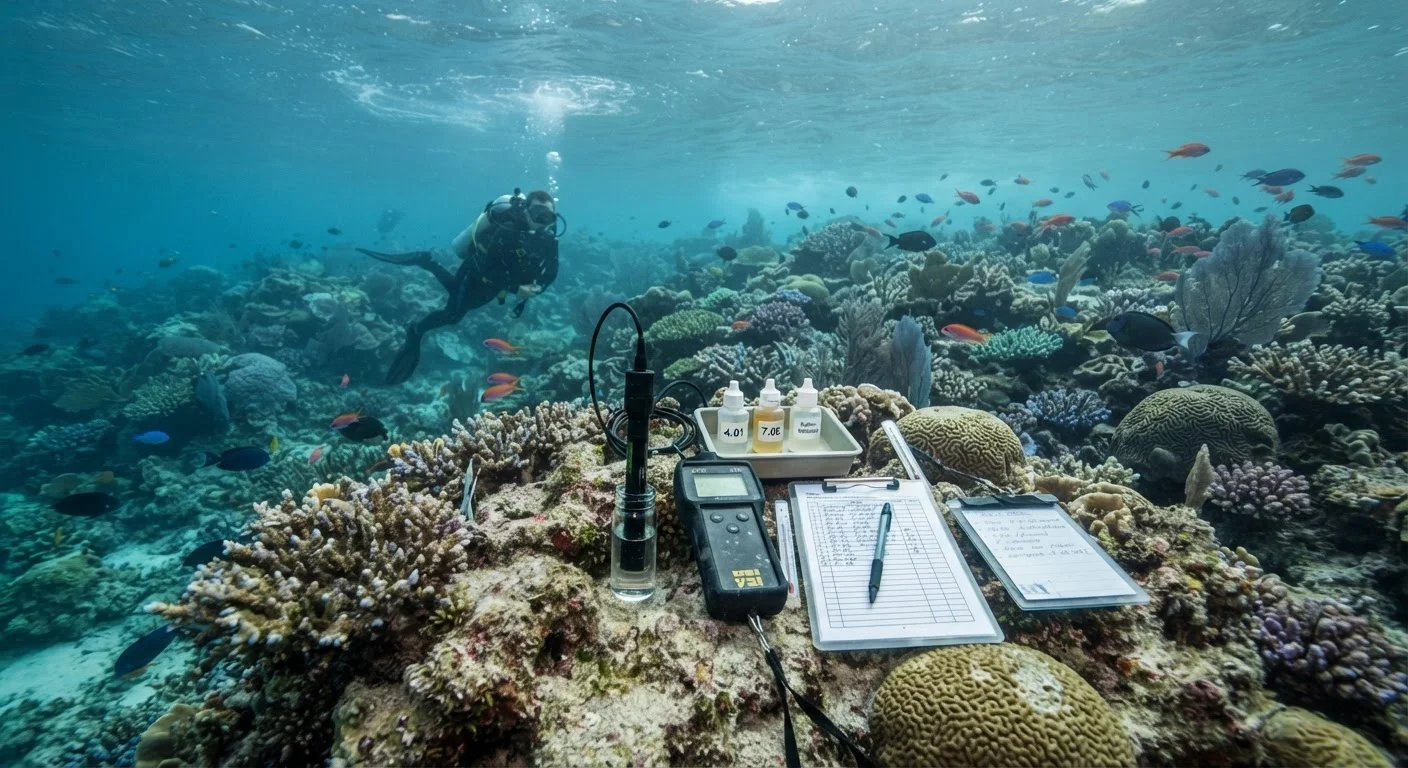
Monitoring ocean chemistry requires a global infrastructure. The Global Ocean Acidification Observing Network (GOA-ON) coordinates data from surface buoys, deep-water Argo floats, ship-based sampling, and coastal sensors across all major ocean basins. These instruments measure pH, dissolved inorganic carbon, total alkalinity, and sea surface temperature - parameters that together paint a detailed picture of ocean carbon chemistry.
Long-term records are particularly valuable. The Mauna Loa atmospheric CO₂ record has a well-known ocean counterpart: the Hawaii Ocean Time-series (HOT), a continuous dataset that began in 1988 and has documented a steady decline in surface ocean pH at that location over decades. Comparable trends have been confirmed across Atlantic, Pacific, and Southern Ocean monitoring sites.
What Acidification Means for Marine Life
The biological consequences of ocean acidification are concentrated among organisms that build calcium carbonate structures. Oysters, mussels, sea urchins, pteropods, and reef-building corals all rely on carbonate ions that become less available as pH falls. Laboratory and field studies have found that under elevated CO₂ conditions, juvenile shellfish show thinner shells, slower growth, and higher mortality rates.
Coral reefs face a compounding challenge: acidification reduces their ability to calcify, while warming ocean temperatures - a separate consequence of greenhouse gas accumulation - trigger bleaching events. Research published in Nature Climate Change and other peer-reviewed journals indicates that many reef systems will struggle to maintain positive net calcification under projected mid-century CO₂ scenarios.
Not all marine species respond the same way. Some algae and certain fish species appear more tolerant of lower pH in controlled settings, though ecosystem-level effects are more complex than single-species studies can capture.
Polar Oceans: Acidifying Fastest
Cold water holds more dissolved gas than warm water - a basic principle of chemistry with significant implications for the Arctic and Southern Oceans. These high-latitude regions are absorbing CO₂ at a faster rate than tropical waters, and their chemistry is shifting more rapidly. Some areas of the Southern Ocean and parts of the Arctic are approaching carbonate saturation states that would make shell formation difficult for key species within decades, based on projections from the Intergovernmental Panel on Climate Change (IPCC) Sixth Assessment Report.
Pteropods - free-swimming sea snails sometimes called the "potato chips of the ocean" for their role in food webs - have already been observed with corroded shells in some Pacific and Southern Ocean surveys, a striking visible indicator of chemical change in real ecosystems rather than laboratory tanks.
The Broader Carbon Connection
Ocean acidification is inseparable from the broader carbon cycle. The ocean's capacity to absorb CO₂ is not unlimited, and there is evidence that its efficiency as a carbon sink may decrease as it warms and acidifies. This creates a feedback dynamic: a less effective ocean sink means more CO₂ remains in the atmosphere, accelerating both warming and acidification simultaneously.
Understanding this connection is essential for interpreting climate projections accurately. Ocean acidification is not a peripheral environmental concern - it is a direct chemical consequence of elevated atmospheric CO₂, measurable today and documented across decades of scientific observation. The science is grounded in well-established chemistry, extensive monitoring networks, and a broad base of peer-reviewed research spanning multiple decades and institutions.