

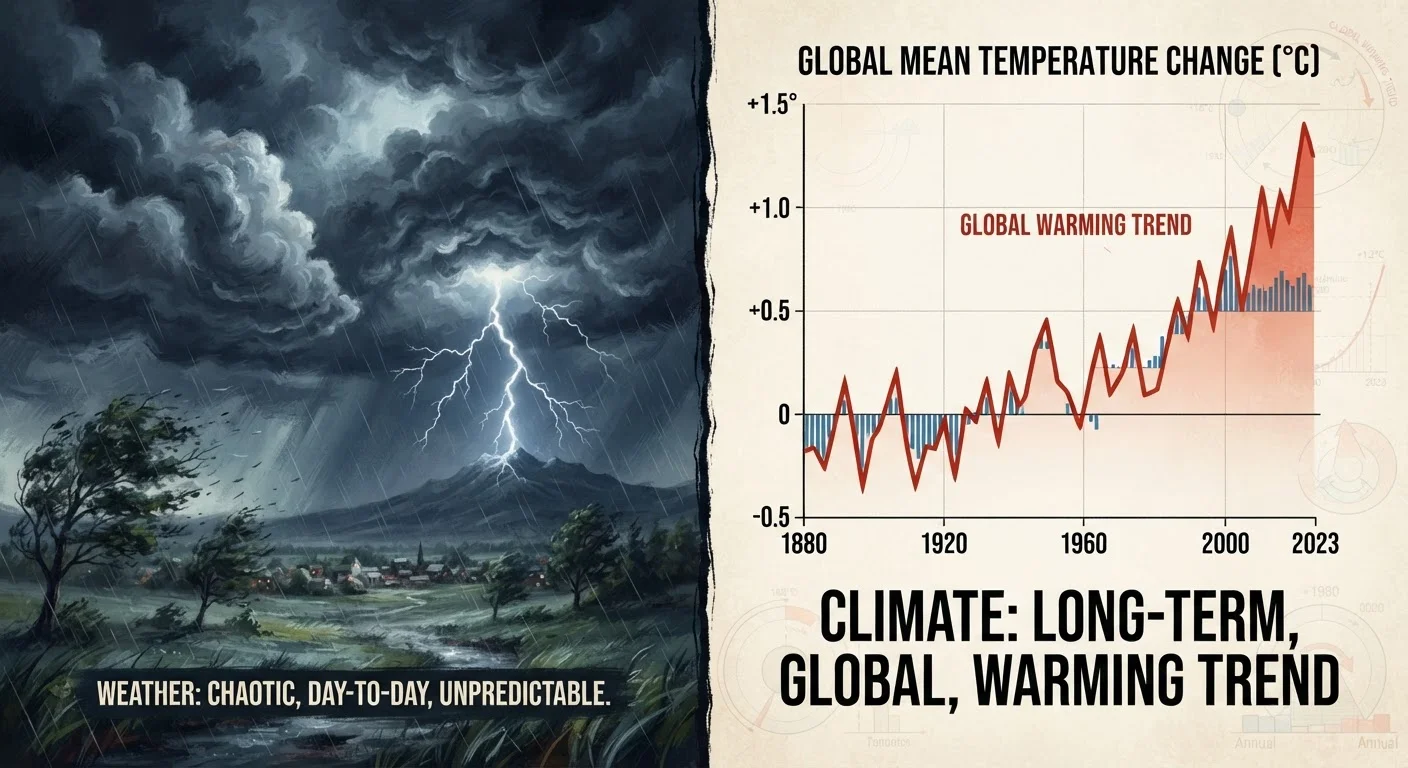
Key Takeaways
Option A
Weather
The short-term, day-to-day state of the atmosphere.
Best for: Understanding what's happening outside right now - temperature, precipitation, wind, and storms at any given moment.
Option B
Climate
The long-term statistical pattern of atmospheric conditions over decades.
Best for: Understanding the baseline conditions a region experiences over time, and how those baselines are shifting.
If you want to know whether to bring an umbrella tomorrow
Weather
Weather forecasts cover hours to about two weeks ahead, giving you actionable short-term atmospheric information.
If you want to understand how Earth's atmosphere is changing over generations
Climate
Climate data spans decades and centuries, revealing trends that no single weather event can confirm or disprove.
If you're evaluating claims that one cold winter disproves global warming
Climate
Such arguments confuse weather variability with climate trends - understanding climate science helps you recognize this reasoning error.
Defining the Terms: What Each Word Actually Means
The clearest way to separate these two concepts comes from a phrase atmospheric scientists commonly use: climate is what you expect; weather is what you get. Weather refers to the current state of the atmosphere at a specific time and place - temperature, humidity, wind speed, cloud cover, and precipitation. It changes hour by hour and is notoriously difficult to forecast beyond roughly two weeks.
Climate, by contrast, is the long-term statistical summary of atmospheric conditions over an extended period. The World Meteorological Organization (WMO) sets the standard reference period at 30 years. When scientists say Phoenix, Arizona, has a hot desert climate, they're describing the average temperatures, rainfall totals, and seasonal patterns observed over multiple decades - not what the thermometer reads today.
This distinction matters because the two operate on fundamentally different timescales. Weather is inherently variable and chaotic. Climate is the underlying signal that emerges only when you zoom far enough out. For a deeper foundation on these ideas, see our introduction to core climate science concepts.
Head-to-Head: How Weather and Climate Compare
Laying the two concepts side by side makes their differences concrete. The table below captures the key dimensions scientists use to distinguish them.
| Criterion | Weather | Climate |
|---|---|---|
| Timescale | Minutes to ~2 weeks | 30 years or more |
| What it measures | Current atmospheric conditions | Long-term statistical patterns |
| Key variables | Temperature, wind, precipitation now | Averages, extremes, seasonal norms |
| Primary tools | Radar, weather stations, models | Ice cores, satellites, ocean buoys |
| Predictability | Useful up to ~14 days | Trends projected decades ahead |
| Variability | High - changes hourly | Low short-term; shifts slowly over time |
| Common misuse | Used to argue against climate trends | Sometimes conflated with any extreme event |
One detail worth noting: climate scientists rely on instruments like ice cores, ocean buoys, tree rings, and satellites to reconstruct and monitor long-term patterns. Weather forecasters depend on real-time atmospheric data fed into numerical models. The toolkits overlap but are not identical - learn more in our overview of how climate data is collected.
Why the Mix-Up Happens - and Why It's Exploited
The confusion between weather and climate is not simply an honest mistake. It is also one of the most frequently used rhetorical tactics in climate misinformation. A cold snap, a major snowstorm, or a cooler-than-average summer gets cited as evidence against long-term warming trends - a logical error sometimes called cherry-picking.
The flaw in that reasoning is scale. A single data point - one storm, one season, one year - cannot describe a multi-decade trend any more than a single test score describes a student's overall academic ability. Climate scientists analyze trends across 30-year baselines precisely to filter out the short-term noise that weather produces constantly.
Understanding this distinction equips readers to evaluate claims more critically. Our article on common climate misinformation patterns goes deeper into how these rhetorical moves are constructed.
What This Means for Understanding Climate Change
Keeping weather and climate distinct is essential for interpreting news about climate change accurately. When scientists report that Earth's average surface temperature has risen by approximately 1.1-1.2°C above pre-industrial levels (according to data from NOAA and NASA), they are describing a climate trend - one built from thousands of measurements across decades, not from any single season or location.
Extreme weather events - heat waves, intense hurricanes, prolonged droughts - are not the same as climate change itself. However, scientists can study whether the probability or intensity of certain weather events has shifted as the climate changes. That field is called extreme event attribution, and it operates at the intersection of both concepts. For context on how scientists distinguish natural variability from human-caused shifts, see our explainer on natural climate variability vs. human-caused warming.
For readers building their climate vocabulary, our climate science glossary is a useful companion. And if you want to understand where long-term climate shifts can lead, our piece on climate tipping points explains what scientists mean when they warn about irreversible change.