

Key Takeaways
Climate Tipping Point
A climate tipping point is a threshold in the Earth system where a relatively small change can trigger a much larger, self-reinforcing shift - one that may be difficult or impossible to reverse. Once crossed, the system can continue changing under its own momentum, even if the original pressure is removed. Think of it like a ball balanced at the top of a hill: a small push sends it rolling, and it doesn't stop just because you take your hand away.
Scientists formally define these as 'tipping elements' - large-scale components of the Earth system that may pass a critical threshold, transitioning to a qualitatively different state. The term originates from dynamical systems theory and does not imply a single catastrophic moment.
Where the Term Comes From
The phrase 'tipping point' entered mainstream climate science vocabulary in the early 2000s, though the underlying concept has roots in dynamical systems mathematics developed decades earlier. Researchers use it to describe specific, identifiable components of the Earth system - not a vague sense of things getting bad. For a solid grounding in the broader framework, see our introduction to core climate concepts.
The scientific literature distinguishes between gradual, linear changes - temperatures rising steadily, rainfall patterns shifting slowly - and non-linear transitions where a system crosses a threshold and reorganizes into a fundamentally different state. Tipping points belong in that second category. Understanding the vocabulary matters; our climate science glossary covers related terms like feedback loops and radiative forcing that are essential context here.
The Leading Candidate Tipping Elements
A landmark 2022 paper in Science by Lenton and colleagues identified 16 potential tipping elements in the Earth system, grouping them by the warming level at which they might be triggered. These are not abstract projections - they are specific, named parts of the planetary machinery.
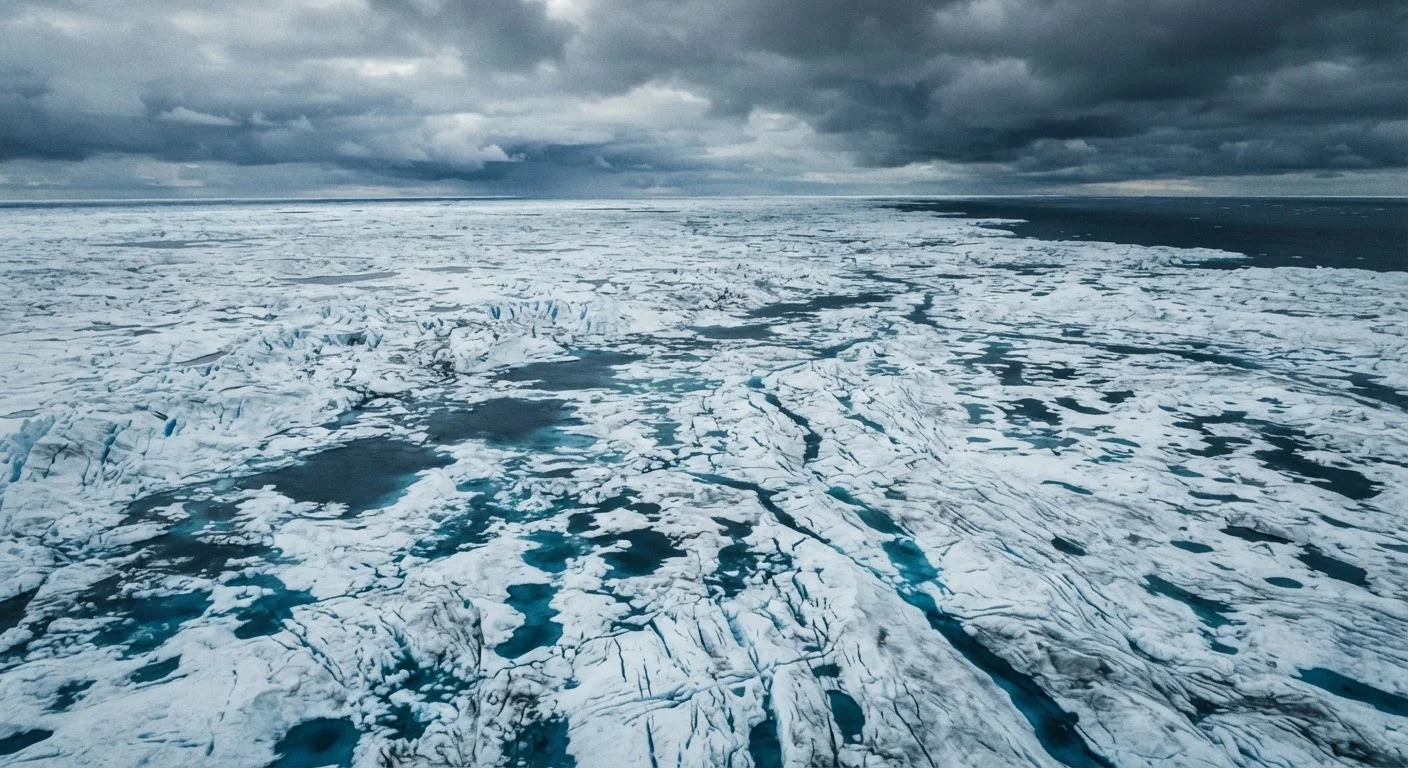
- Greenland Ice Sheet: Sustained warming could trigger irreversible melt, contributing meters of sea-level rise over centuries.
- West Antarctic Ice Sheet: Marine-based glaciers here may be vulnerable to a feedback where melt accelerates once begun.
- Amazon Rainforest: Deforestation combined with warming could push parts of the Amazon toward a drier, degraded savanna state.
- Permafrost (Arctic soils): Thawing permafrost releases stored carbon, which can amplify warming in a self-reinforcing loop.
- Atlantic Meridional Overturning Circulation (AMOC): This major ocean current system could weaken significantly, altering weather patterns across the Northern Hemisphere.
The 2022 study's key finding was that several of these elements may be reachable at 1.5°C of warming - the lower target set by the Paris Agreement - suggesting the margins of safety are narrower than previously understood.
16
Identified potential tipping elements globally
A 2022 study in Science by Lenton and colleagues catalogued 16 tipping elements in the Earth's climate system, from ice sheets to ocean circulation.
1.5°C
Warming level linked to multiple tipping risks
The same 2022 research found that several tipping elements could potentially be triggered at or near 1.5°C of global warming above pre-industrial levels.
~9
Tipping elements potentially interacting in cascades
Research published in PNAS has suggested up to nine tipping elements may be interconnected, meaning triggering one could increase risk across others.
Why Cascades Amplify the Concern
Individual tipping points are concerning on their own. What makes researchers particularly attentive is the possibility that crossing one threshold increases the probability of triggering another - a process sometimes called a 'tipping cascade.' Permafrost thaw, for instance, releases greenhouse gases that warm the planet further, which in turn stresses ice sheets and forests. These interactions are not purely theoretical; they emerge from coupled climate models and paleoclimate records.
This interconnectedness also helps explain why scientists are cautious about framing tipping points as distant, improbable events. The uncertainty cuts both ways: we don't know exactly where thresholds lie, but that means they could be closer than current best estimates suggest, not only farther away. For a broader look at how to evaluate scientific uncertainty honestly, see our piece on how climate misinformation is constructed.
“We may be much closer to tipping points than we thought. This is not a reason for despair, but it is a reason for urgency.”
— Timothy Lenton, Professor of Climate Change and Earth System Science, University of Exeter
What Tipping Points Do Not Mean
The term is sometimes misused in public discourse in ways that either exaggerate or minimize the science. A tipping point is not a single moment where 'everything collapses overnight.' Most transitions in the Earth system play out over decades to centuries, even if the triggering event occurs quickly. Similarly, tipping points are not a reason to conclude that action is futile - the difference between 1.5°C and 2°C of warming could determine whether several of these thresholds are crossed at all.
Equally, dismissing tipping points because we can't pinpoint their exact location misreads how science works under uncertainty. Scientists cannot always tell you the precise temperature at which a system tips, but they can tell you the direction of risk and the mechanisms involved. That is meaningful, actionable knowledge. The attribution science that helps researchers distinguish gradual shifts from threshold behavior is explored further in our article on natural variability versus human-caused warming.