

Key Takeaways
Where Stars Begin: The Nebula
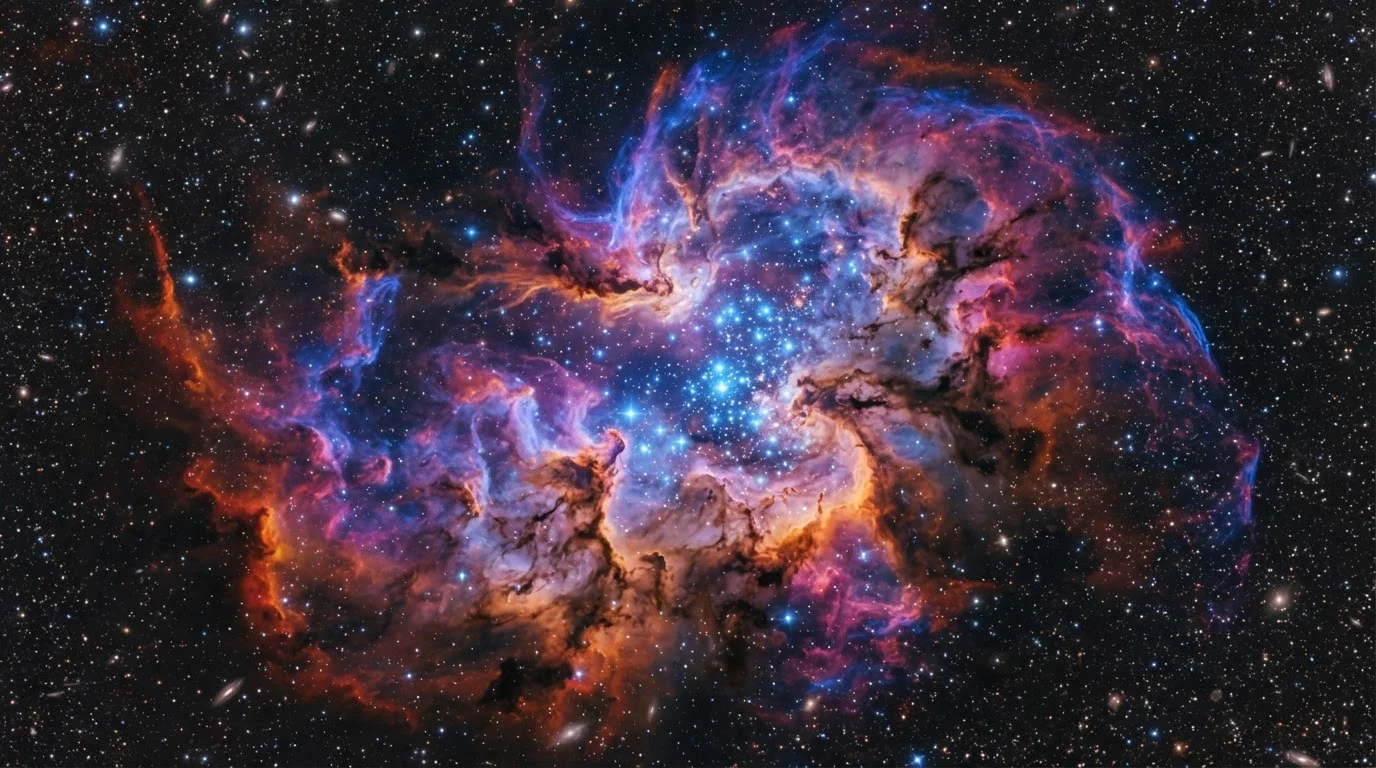
Every star in the night sky began as a cold, diffuse cloud of gas and dust called a nebula - a term derived from the Latin word for mist or cloud. These interstellar clouds are composed primarily of hydrogen and helium, with trace amounts of heavier elements left over from earlier generations of stars. For a helpful primer on these and other terms, see our astronomy glossary.
Star formation begins when a region of a nebula becomes dense enough for gravity to overcome the outward pressure of the gas. A trigger - such as a nearby supernova shockwave or galactic collision - can compress the cloud and set this process in motion. As the cloud contracts, it fragments into clumps. Each clump draws material inward, heating as it goes, and forms a rotating disk of gas around a dense central object called a protostar.
Over hundreds of thousands of years, the protostar continues to accrete material and heat up. When core temperatures reach roughly 10 million degrees Celsius, nuclear fusion ignites: hydrogen nuclei begin fusing into helium, releasing enormous amounts of energy. A new star is born.
The Main Sequence: A Star in Its Prime
Once fusion is underway, a star enters what astronomers call the main sequence - a stable phase defined by the balance between gravity pulling inward and radiation pressure pushing outward. This equilibrium, called hydrostatic equilibrium, can persist for millions to tens of billions of years depending on the star's mass.
Our own Sun has been on the main sequence for about 4.6 billion years and is expected to remain there for another 5 billion. More massive stars burn through their fuel far more quickly; a star 10 times the Sun's mass may live only 20 to 30 million years before exhausting its hydrogen supply. Smaller, dimmer stars called red dwarfs can sustain fusion for trillions of years - far longer than the current age of the universe.
~10 billion years
Sun's expected main-sequence lifespan
NASA estimates the Sun entered the main sequence approximately 4.6 billion years ago and has roughly 5 billion years remaining.
~20-30 million years
Lifespan of a 10-solar-mass star
More massive stars exhaust their nuclear fuel far more rapidly; stellar models from ESA and NASA place massive star lifetimes in the tens of millions of years.
>1 trillion years
Potential lifespan of a red dwarf star
Low-mass red dwarf stars fuse hydrogen so slowly that theoretical models suggest they could remain on the main sequence far longer than the current age of the universe.
Astronomers classify stars on the main sequence by surface temperature and luminosity using the Hertzsprung-Russell (H-R) diagram, a foundational tool of stellar astrophysics. Stars are grouped into spectral types - O, B, A, F, G, K, and M - from hottest and most massive to coolest and least massive. The Sun is a G-type, or yellow dwarf, star.
How Mass Determines a Star's Fate
Mass is the master variable of stellar evolution. It determines how hot a star burns, how long it lives, and - most critically - how it dies. This makes intuitive sense: a more massive star has more fuel, but its much stronger gravity forces that fuel to fuse far more rapidly, resulting in a shorter and more spectacular life.
Broadly, astronomers divide stars into two categories for the purposes of their end states:
- Low- to intermediate-mass stars (roughly 0.08 to 8 times the Sun's mass): These end their lives relatively quietly, shedding their outer layers and leaving a compact remnant.
- High-mass stars (greater than about 8 solar masses): These detonate in violent explosions and leave behind extraordinarily dense objects.
Understanding the boundary between these outcomes is one of the central questions of modern stellar astrophysics, and ongoing observations continue to refine that threshold.
The Death of a Sun-Like Star
When a star like the Sun exhausts the hydrogen in its core, fusion slows and gravity wins - temporarily. The core contracts and heats up, causing the outer layers to expand dramatically. The star becomes a red giant, swelling to hundreds of times its original size. In the Sun's case, this expansion is expected to engulf the inner planets.
Inside the red giant, helium in the core begins fusing into carbon and oxygen. Eventually this fuel runs out too. Without enough mass to proceed further, the star's outer layers drift away into space, forming a glowing shell of ionized gas known as a planetary nebula - a misleading name coined by early telescopic observers who thought they resembled planets. The exposed core that remains is a white dwarf: an Earth-sized, extraordinarily dense object that gradually cools over billions of years.
To explore what happens inside these remnants in more detail, see our article on stellar endpoints.
The Death of a Massive Star: Supernovae and Beyond
High-mass stars follow a far more violent path. After exhausting hydrogen, they fuse progressively heavier elements - helium, then carbon, neon, oxygen, and silicon - in a series of nested shells. Each fusion stage is shorter and less efficient than the last. When an iron core accumulates, fusion effectively stops: iron cannot release energy through fusion under normal stellar conditions.
With no outward pressure to resist it, the core collapses catastrophically in less than a second. The infalling outer layers rebound off the suddenly rigid core and are expelled in a colossal explosion: a supernova. For a brief moment, a single supernova can outshine its entire host galaxy.
The Iron Core Collapse: Point of No Return
When a massive star builds an iron core exceeding roughly 1.4 solar masses (known as the Chandrasekhar limit), no known physical process can halt gravitational collapse. The resulting implosion and rebound happen in milliseconds - one of the most violent events in the observable universe. This threshold is not a theoretical abstraction; it is one of the most rigorously tested predictions in astrophysics, supported by both observation and nuclear physics.
What remains depends on the core's final mass. Cores between roughly 1.4 and 3 solar masses become neutron stars - city-sized objects so dense that a teaspoon of their material would weigh billions of tons. Cores above about 3 solar masses collapse further into black holes, regions of spacetime where gravity is so extreme that not even light can escape.
The debris ejected by the supernova seeds surrounding space with heavy elements, which may eventually be incorporated into new nebulae, new stars, and new planetary systems.
Why Stellar Remnants Matter to Us
Stellar evolution is not merely an abstract astronomical phenomenon - it is the origin story of the material universe as we experience it. Nearly every element heavier than hydrogen and helium was synthesized inside a star or during a stellar explosion. The calcium in your bones, the iron in your blood, the oxygen in every breath: all of it was forged in stellar cores and distributed through space by stellar deaths.
As the late astronomer Carl Sagan observed, we are made of star stuff - a statement that is not poetry but literally accurate chemistry. When you look up at the night sky, the stars you see are not just distant suns; they are active participants in a vast, ongoing cycle of creation and transformation that has continued for nearly 14 billion years.
If you want to connect this science to the sky you can actually observe, our guide on reading a star map can help you identify stellar types and clusters visible from your location.
The life cycle of a star - from nebular collapse to glowing remnant - is one of the best-understood sequences in all of astrophysics, a testament to decades of observation, theory, and computational modeling. And it is a story that, in the most literal sense, includes each one of us.