

| Distance: Earth to Sun | 1 AU (~93 million miles) (International Astronomical Union) |
| Length of a light-year | ~5.88 trillion miles (NASA) |
| Parsec in light-years | ~3.26 light-years (International Astronomical Union) |
| Age of the universe | ~13.8 billion years (Planck Collaboration, 2018) |
| Confirmed exoplanets | 5,000+ (NASA Exoplanet Archive) |
| CMB temperature | ~2.725 Kelvin (COBE satellite data, NASA) |
Why Space Terminology Matters
Reading about astronomy without knowing a handful of key terms is a bit like following a sports broadcast without knowing the rules. You'll catch the excitement, but miss the meaning. Whether you're scanning headlines about a newly discovered exoplanet, watching a documentary on black holes, or considering your first telescope, a basic vocabulary turns passive curiosity into genuine understanding.
This reference covers the most important terms across astronomy and cosmology - organized not as a dry dictionary, but as a practical map of the concepts that keep coming up. For those curious about other scientific vocabularies, our climate science glossary applies the same approach to Earth's atmospheric systems. And if you're ready to move from terminology to observation, see our guide to amateur astronomy equipment for what to look for in your first setup.
Units of Distance Can Be Confusing
Astronomical units, light-years, and parsecs all measure distance, but they apply at different scales. AUs are most useful within our solar system; light-years and parsecs are used for interstellar and intergalactic distances. Knowing which unit applies to a given context helps you interpret numbers you'll encounter in science reporting.
Measuring the Universe: Distance and Scale
One of the biggest conceptual hurdles in astronomy is sheer scale. Everyday units like miles or kilometers become unwieldy when describing the cosmos, which is why astronomers use specialized distance measurements.
| Distance: Earth to Sun | 1 AU (~93 million miles) (International Astronomical Union) |
| Length of a light-year | ~5.88 trillion miles (NASA) |
| Parsec in light-years | ~3.26 light-years (International Astronomical Union) |
| Age of the universe | ~13.8 billion years (Planck Collaboration, 2018) |
| Confirmed exoplanets | 5,000+ (NASA Exoplanet Archive) |
| CMB temperature | ~2.725 Kelvin (COBE satellite data, NASA) |
The astronomical unit (AU) anchors the solar system: Neptune orbits roughly 30 AU from the Sun. Step beyond the solar system, and you need light-years or parsecs. The nearest star system, Alpha Centauri, sits about 4.24 light-years away. Galaxies are measured in megaparsecs - millions of parsecs - while the observable universe spans about 93 billion light-years in diameter. Understanding which unit a source uses tells you immediately what scale is being discussed.
Parallax connects these abstract numbers to something measurable: by observing how a nearby star appears to shift against more distant background stars as Earth orbits the Sun, astronomers can calculate its distance geometrically. This technique underpins the entire cosmic distance ladder.
Stars, Galaxies, and the Expanding Universe
Stars spend most of their lives on the main sequence, steadily converting hydrogen to helium. The Sun has done this for 4.6 billion years and will continue for roughly another 5 billion. When stars exhaust their fuel, they evolve into white dwarfs, neutron stars, or - for the most massive - black holes. The boundary surrounding a black hole from which no light escapes is called the event horizon.
Between stars lie nebulae - vast clouds of gas and dust that serve as stellar nurseries. The Orion Nebula, visible to the naked eye, is actively forming new stars today.
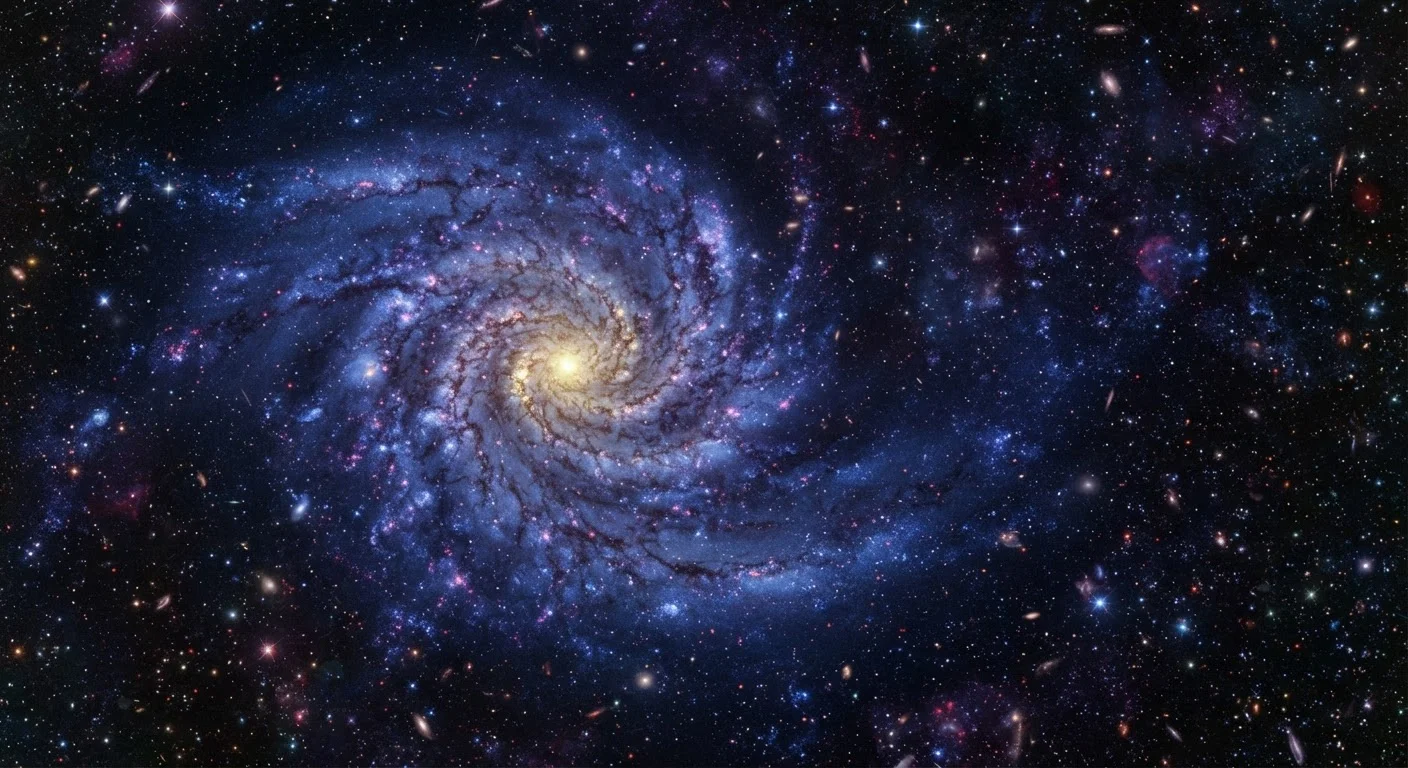
On the largest scales, the universe is expanding. Redshift is how we know: as distant galaxies move away, their light is stretched to longer wavelengths. Edwin Hubble's 1929 observations of galactic redshift provided the first direct observational evidence that the universe is not static. The cosmic microwave background (CMB) adds further confirmation - it is the faint thermal echo of the Big Bang itself, detected in every direction we look.
5,000+
Confirmed exoplanets discovered
According to the NASA Exoplanet Archive, this milestone was crossed in 2022, with thousands more candidates awaiting confirmation.
13.8 billion
Years since the Big Bang
Derived from measurements of the cosmic microwave background by the ESA's Planck mission, published in 2018.
~2.725 K
Temperature of the CMB today
Measured by NASA's COBE satellite, this near-uniform temperature is one of the strongest pieces of evidence for the Big Bang model.
Much of the universe's mass appears to be composed of dark matter, detectable only through its gravitational influence on visible matter and galactic rotation curves. Its true identity remains an active area of research. For a closer look at what conditions might allow life elsewhere, our article on what the habitable zone actually means explores what this term covers - and where it falls short.
Essential Reference: Core Terms Defined
The glossary below covers the terms you'll encounter most often in astronomy and cosmology writing. Each definition is written for general readers, with enough precision to hold up under further reading.
Brightness is another concept worth understanding clearly. Magnitude runs counterintuitively: the brighter an object, the lower (or more negative) its magnitude. The full Moon sits around magnitude −12.7; the faintest stars visible to the unaided eye are around magnitude 6. Telescopes extend this range dramatically, which is part of what makes them so scientifically valuable. If you're exploring what different instruments can reveal, our equipment overview breaks down the trade-offs between different telescope types.