

Key Takeaways
Our Verdict
No single stellar endpoint is 'better' than another - each represents a different physical outcome governed by mass. White dwarfs are the most common fate, while neutron stars and black holes are rarer but more extreme. Understanding these differences helps illuminate both the life cycle of stars and the fundamental physics of gravity and matter.
| Best for | Recommended |
|---|---|
| Readers curious about our own Sun's eventual fate | White Dwarf |
| Those fascinated by extreme density and exotic matter states | Neutron Star |
| Readers drawn to the most extreme physics in the universe | Black Hole |
Why Mass Is the Master Variable
When a star exhausts the nuclear fuel in its core, the balance between outward radiation pressure and inward gravitational pull collapses. What happens next is almost entirely determined by the star's initial mass - specifically, how much mass remains in its core at the moment of collapse. Astronomers use solar masses (M☉, where 1 M☉ equals our Sun's mass) as the standard unit for these comparisons.
For a fuller picture of how stars evolve before reaching these endpoints, see our guide to the full stellar life cycle. And if terms like event horizon or degenerate matter are unfamiliar, our astronomy glossary provides quick, plain-language definitions.
| White Dwarf | Neutron Star | Black Hole | |
|---|---|---|---|
| Progenitor star mass | Up to ~8 M☉ | ~8-20 M☉ | Greater than ~20 M☉ |
| Remnant mass range | Up to ~1.4 M☉ | ~1.1-2.3 M☉ | Greater than ~3 M☉ |
| Approximate size | Earth-sized (~8,000 mi) | ~12-15 miles across | Defined by event horizon |
| Supported by | Electron degeneracy pressure | Neutron degeneracy pressure | Nothing - complete collapse |
| Observable signature | Fading optical/UV glow | Pulsars, X-ray, gravitational waves | Accretion disk, lensing, jets |
| Commonality | Most common remnant type | Rarer; ~billions in Milky Way | Rarest stellar remnant |
| Death mechanism | Planetary nebula ejection | Core-collapse supernova | Core-collapse supernova |
White Dwarfs: The Common, Quiet Ending
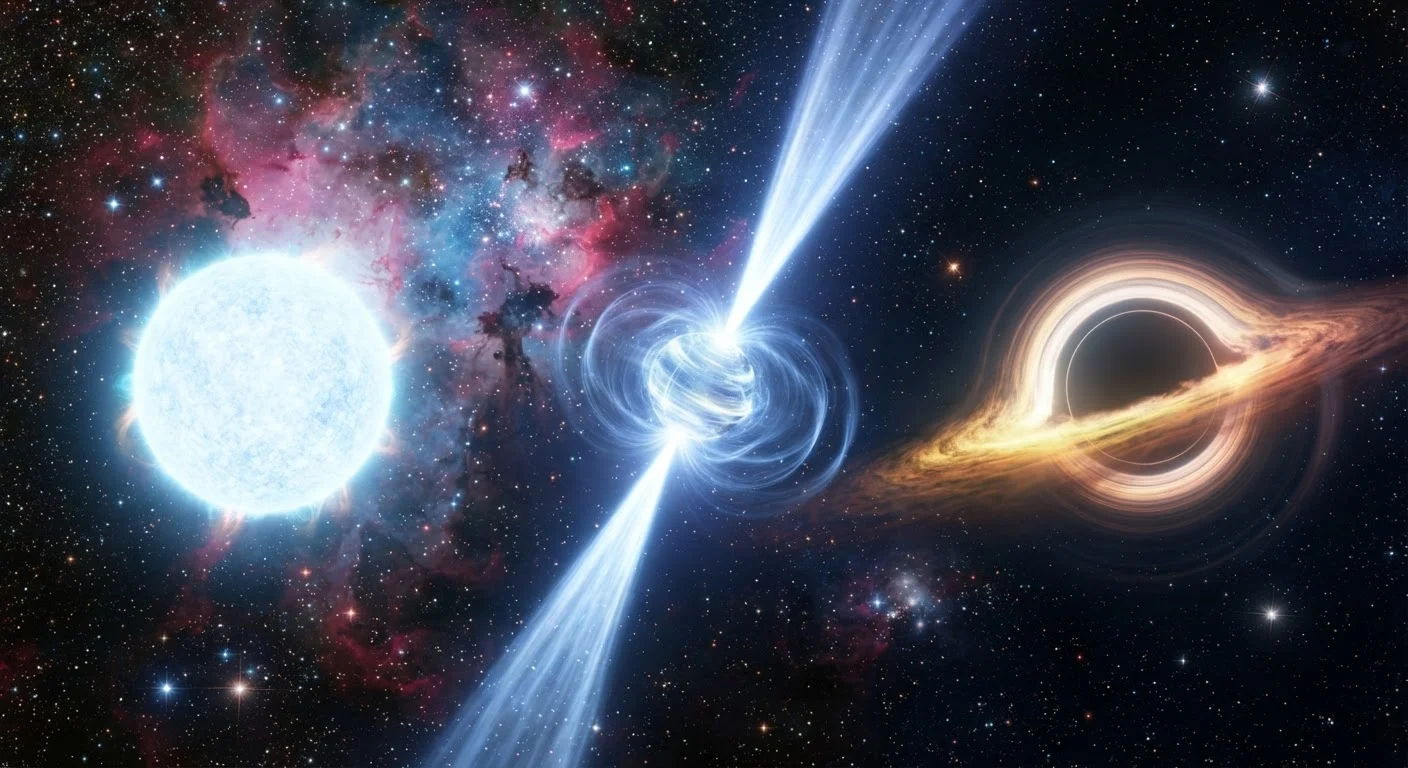
Stars with initial masses up to roughly 8 M☉ - including our own Sun - spend their final active phase as red giants or asymptotic giant branch stars, puffing out their outer layers into a planetary nebula. What remains is the hot, Earth-sized core: a white dwarf.
White dwarfs are supported not by nuclear fusion but by electron degeneracy pressure, a quantum mechanical force arising because electrons resist being compressed into the same energy state. They contain roughly half a solar mass packed into a volume comparable to Earth. Over billions of years, they gradually cool and fade - a process so slow that no white dwarf in the observable universe has yet cooled completely to a theoretical 'black dwarf' state. The Chandrasekhar limit (~1.4 M☉) defines the maximum mass a white dwarf can sustain; above this, gravity wins catastrophically.
Neutron Stars: Exotic, Dense, and Rapidly Spinning
When a star's core mass exceeds the Chandrasekhar limit at the moment of collapse - typically from stars with initial masses between roughly 8 and 20 M☉ - electron degeneracy pressure is not enough. Electrons are forced into protons, producing neutrons and triggering a core-collapse supernova. The outer layers are blasted away, while the core compresses into a neutron star.
Neutron stars are supported by neutron degeneracy pressure and, at higher densities, additional quantum effects. They pack between 1.1 and 2.3 M☉ into a sphere roughly 12-15 miles (20-25 km) across, giving them densities exceeding 1014 grams per cubic centimeter - a teaspoon of neutron star material would weigh hundreds of millions of tons on Earth. Many neutron stars are observed as pulsars, emitting beams of electromagnetic radiation from their magnetic poles as they rotate, sometimes hundreds of times per second.
Black Holes: When Gravity Wins Completely
If the collapsing core's mass surpasses roughly 2-3 M☉ - the Tolman-Oppenheimer-Volkoff limit - even neutron degeneracy pressure cannot halt the collapse. The result is a stellar black hole, a region of spacetime where gravity curves so sharply that nothing, including light, can escape beyond the event horizon.
At the center lies a singularity, a point where our current physical models break down. Black holes are not cosmic vacuum cleaners; objects at safe distances orbit them just as they would any other mass. However, material that strays too close forms a superheated accretion disk and can emit powerful jets of radiation. Stellar black holes formed this way typically range from about 3 to 20 M☉, though more massive varieties - including supermassive black holes at galactic centers - form through different processes.
How Astronomers Tell Them Apart
None of these objects can be directly seen in the conventional sense, so astronomers rely on indirect evidence. White dwarfs emit residual heat detectable in ultraviolet and optical light. Neutron stars are identified through pulsar timing, gravitational wave signals (when they merge), and X-ray emissions from matter falling onto their surface. Black holes are inferred from the motion of orbiting companions, gravitational lensing, X-ray binaries, and - most dramatically - direct imaging of their surrounding emission, as achieved with the Event Horizon Telescope's observations of M87* and Sgr A*.
The distinctions between these objects are not merely academic. They represent the universe's most extreme laboratories for testing the physics of gravity, quantum mechanics, and nuclear matter at conditions unreachable in any Earth-based experiment.