

Key Takeaways
Why the Mississippi Deserves More Than a Flyover
For many Americans, the Mississippi River is more symbol than destination - a name on a bridge, a line on a map separating East from West. Coastal travel dominates bucket lists, and the desert Southwest draws its own devoted following (see our thoughtful guide to the Southwest for comparison). But the river corridor - nearly 2,350 miles of layered American history, dramatic bluff country, and living cultural tradition - rewards the traveler willing to slow down and actually follow it.
The Great River Road, a federally designated scenic byway system, traces both banks through ten states from Minnesota to Louisiana. You can drive sections, bike stretches, or hop between towns by car. What you'll find isn't a polished theme-park version of America; it's an unfiltered look at the country's interior: river pilots' mansions in Natchez, lock-and-dam engineering in Iowa, juke joints in Mississippi, and bald eagles perched over frozen backwaters in Wisconsin. If you're drawn to small cities with real character, this corridor is full of them.
Galena, Illinois: A Preserved River Town Frozen in the 1800s
Tucked into the hilly lead-mining country of northwestern Illinois, Galena looks almost untouched by the 20th century. Its downtown is lined with Italianate brick storefronts and Victorian mansions - a visual record of the wealth that flowed through the region during the 19th-century lead-mining boom. Ulysses S. Grant's home sits here, preserved as a state historic site. The town is small but genuinely walkable, with independent galleries, local restaurants, and river-view overlooks that cost nothing to enjoy. It's one of the most intact examples of a mid-19th-century American commercial streetscape anywhere in the country.
Galena's streetscape is one of the most intact mid-19th-century commercial districts in the United States.
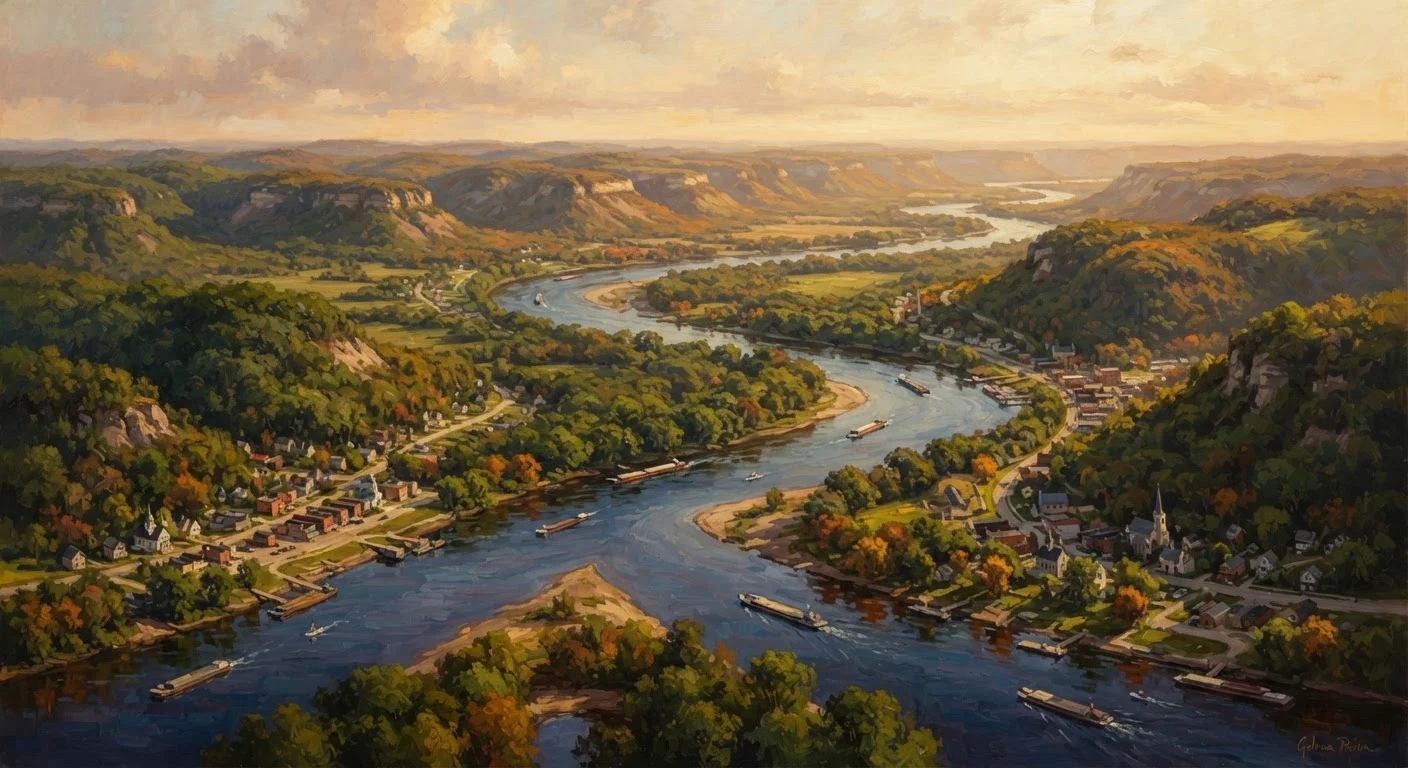
The Great River Road Bluffs of Wisconsin and Minnesota
The Upper Mississippi cuts through dramatic driftless topography - an area glaciers largely bypassed, leaving behind steep limestone bluffs, coulees, and spring-fed streams. Towns like Alma and Trempealeau in Wisconsin, and Winona in Minnesota, sit below ridgelines that rise several hundred feet above the river. Pull off at almost any overlook and you're looking at one of the genuinely underappreciated scenic corridors in the American Midwest. Winona also has a strong collection of stained-glass windows by local artists - an unexpected cultural draw in a town of about 25,000 people.
The driftless bluff country of Wisconsin and Minnesota offers dramatic scenery that rivals better-known American landscapes.
Vicksburg, Mississippi: Civil War History on an Honest Scale
The Vicksburg National Military Park preserves the site of a 47-day siege in 1863 that was a turning point in the Civil War - splitting the Confederacy and giving Union forces control of the river. The park is expansive and genuinely moving, with miles of roads through earthworks, monuments, and a restored Union gunboat, the USS Cairo. The city of Vicksburg itself has a complicated history worth engaging with honestly; local museums and historic sites don't shy away from the full story of slavery and the war. Visiting here is a more substantive experience than many purely scenic stops along the corridor.
Vicksburg's military park offers one of the most substantive Civil War experiences in the American South.
The Mississippi Delta: Birthplace of the Blues
West of the river, in the flat agricultural land of the Mississippi Delta, the Mississippi Blues Trail marks more than 200 historical markers connecting the region's musical heritage. Towns like Clarksdale, Cleveland, and Indianola are small, often economically struggling, but culturally irreplaceable. The Delta Blues Museum in Clarksdale is modest in size but serious in depth. Live music - real juke joint music, not a tourist facsimile - still happens here on weekends. Approach this region with curiosity and respect; the Blues emerged from African American experience under brutal conditions, and that history deserves thoughtful engagement, not casual consumption.
The Mississippi Delta's blues heritage is a living cultural tradition, not a museum exhibit - treat it accordingly.
Natchez, Mississippi: Antebellum Architecture and Its Full Story
Natchez sits high on a bluff above the river and holds one of the largest concentrations of antebellum plantation houses in the United States. These homes are architecturally significant, but Natchez has also worked to build out interpretation that doesn't romanticize plantation life - the Natchez National Historical Park's Forks of the Road site tells the story of what was once one of the largest slave markets in the Deep South. Visiting Natchez thoughtfully means holding both things at once: the architectural grandeur and the human cost behind it. It's a historically layered destination that benefits enormously from context.
Natchez rewards travelers who engage with its architecture and its difficult history in equal measure.
Effigy Mounds and Indigenous History in the Upper Corridor
Near Marquette, Iowa, Effigy Mounds National Monument protects more than 200 prehistoric earthen mounds, some built in the shapes of bears and birds by Indigenous peoples over a period spanning roughly 2,500 years. It's a site that asks visitors to slow down and reckon with the depth of human history on this continent long before European contact. The trails are quiet, the views over the Mississippi are stunning, and the interpretive materials - developed in collaboration with affiliated tribes - are among the most thoughtful at any NPS site in the region. For more parks that don't make the usual highlight reels, our guide to underrated national parks is worth a read.
Effigy Mounds National Monument is one of the most undervisited and historically significant sites in the American Midwest.
Plan Wisely Before You Go
Break the Corridor Into Manageable Sections
Trying to drive the entire Great River Road in one trip is overwhelming for most travelers. Instead, pick one region - the bluffs of Wisconsin, the delta of Mississippi - and go deep rather than wide. Many of the most rewarding experiences here come from lingering in a single town rather than rushing between highlights. A long weekend focused on a 100-mile stretch will likely feel more satisfying than a frantic full-length drive.
Distances along the full corridor are significant - a complete drive from Lake Itasca in Minnesota to the Gulf of Mexico is roughly 2,500 road miles. Most travelers do the corridor in regional sections: the Upper River (Minnesota through Iowa), the Middle River (Illinois through Missouri and Tennessee), and the Lower River (Mississippi, Arkansas, and Louisiana). Each section has its own personality and is perfectly satisfying on its own. Entry requirements, road conditions, and seasonal flooding can affect access to certain areas, so check current conditions with state transportation departments and local visitor bureaus before you set out. And if the delta region pulls you all the way south, a dedicated visit to New Orleans is worth planning separately - our first-timer's guide to New Orleans covers far more than the French Quarter.
Travel conditions, road access, and local business hours along the Great River Road vary by season and can change without notice. Always verify information with official state and local sources before traveling.