

Key Takeaways
Our Verdict
College and professional sports fandom aren't competing philosophies - they're parallel expressions of a deeply American impulse to belong to something bigger than oneself. College fandom leans into tradition, institutional pride, and shared memory, while pro fandom channels civic identity, transactional realism, and the drama of the highest athletic stage. Both are rich, meaningful ways to follow the game.
| Best for | Recommended |
|---|---|
| Fans who value tradition, ritual, and a deep sense of place | College Sports Fandom |
| Fans who follow elite competition and city-based civic pride | Professional Sports Fandom |
| Fans who want the highest level of athletic spectacle | Professional Sports Fandom |
| Fans seeking community identity tied to alma mater or regional heritage | College Sports Fandom |
Where Loyalty Comes From
Ask a die-hard Alabama fan why they bleed crimson, and the answer usually goes back years - to a parent, a childhood Saturday ritual, or the simple geographic fact of growing up in Tuscaloosa. College sports fandom is frequently inherited and institutional. The school itself is the anchor, and that anchor often holds for life regardless of coaching changes or losing seasons.
Professional sports loyalty draws from a different well. It's largely civic - you root for the team that represents your city. That sense of place is real and powerful, as explored in how sports fandom shapes local identity in American cities. But pro teams also move (the Raiders relocated twice), and rosters churn constantly, which forces fans to make a more conscious, sometimes renewed, choice to stay committed. College fans rarely face that same test of faith.
Atmosphere and Ritual: The Stadium Experience
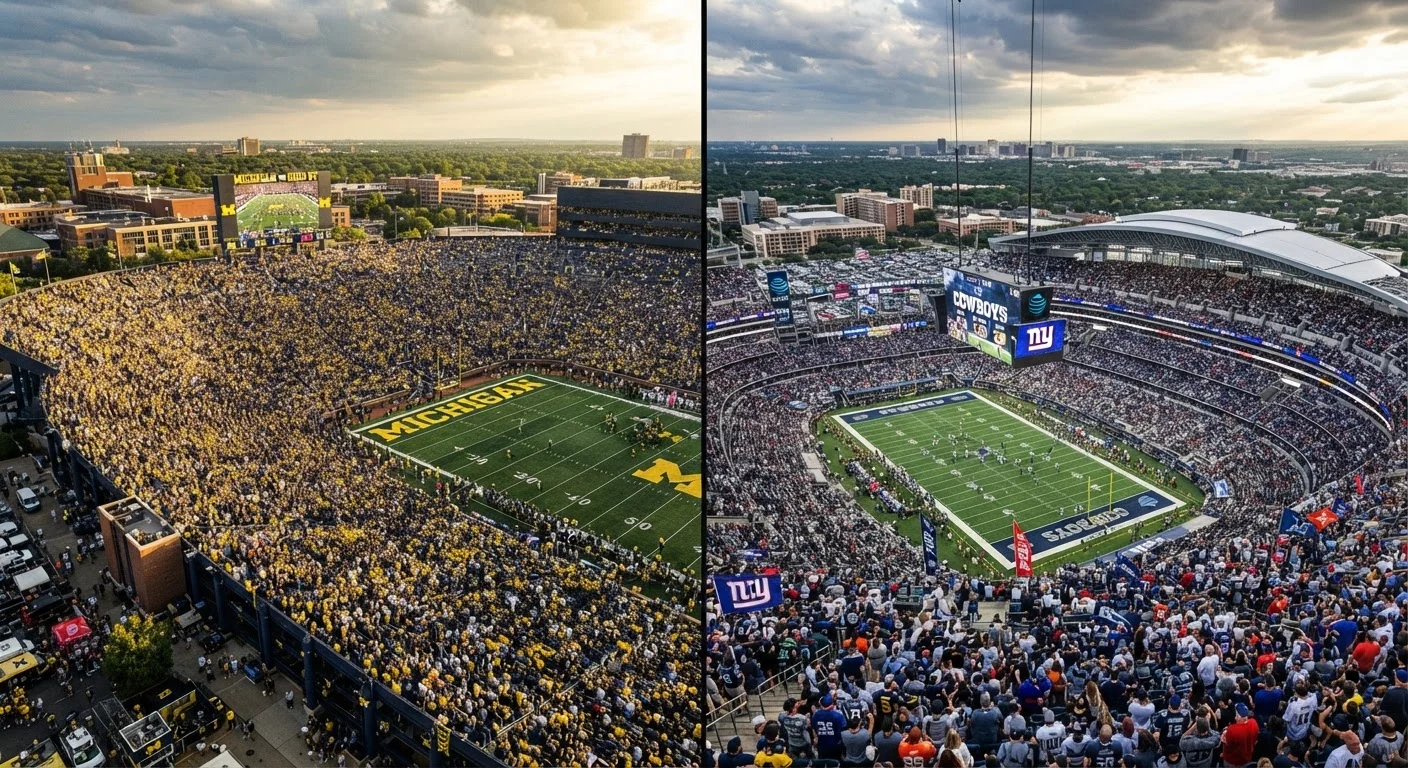
Walk into Michigan Stadium - the largest in the country, seating over 107,000 fans - on a fall Saturday, and what strikes you first is the noise, the synchronized traditions, and the unmistakable feeling that everyone present shares a common story. Fight songs, student sections, marching bands, and decades-old cheers form a thick cultural fabric that even first-time attendees can feel. For a primer on navigating that environment, what first-time attendees should know offers helpful context.
NFL stadiums are spectacular in their own right - the production values, the sight lines, the pregame shows - but the atmosphere often feels more curated than organic. Professional franchises invest heavily in entertainment infrastructure partly because season-ticket holders span a wide demographic spectrum beyond the fired-up student section. The result can be an impressive but occasionally more reserved crowd, particularly in markets where fair-weather support rises and falls with win totals.
| College Sports Fandom | Professional Sports Fandom | |
|---|---|---|
| Primary loyalty anchor | School or regional institution | City or franchise |
| Atmosphere style | Tradition-driven, ritualistic | Produced, entertainment-focused |
| Roster stability impact | Low - loyalty outlasts player cycles | High - stars leaving reshapes fandom |
| Fantasy/betting influence | Minimal for most fans | Very significant for many fans |
| Intergenerational transmission | Strong - often tied to alma mater | Moderate - tied to geography |
| Rivalry intensity | Deeply personal and institutional | Civic and historical |
The Identity Stakes Are Different
For millions of Americans, college affiliation is identity. Wearing a team's colors isn't just sport preference - it's a statement about where you went to school, where you grew up, or what your family stands for. That kind of fandom is deeply personal in a way that overlaps with how fan identity evolves over a lifetime. It's also more likely to be passed down explicitly, as a family tradition - something explored in depth when looking at how sports fandom gets passed down through families.
Professional sports fandom, meanwhile, is increasingly mediated by modern forces: fantasy leagues, sports betting, and the global celebrity of star players. A fan might root for the Chiefs as a team but follow Patrick Mahomes's stats across multiple platforms. That layered engagement reflects a more complex relationship with the sport - one where fantasy leagues and real fandom intersect in ways that don't often infiltrate college fandom to the same degree.
When Passion Tips Into Problem Territory
Both college and professional fandoms carry risks of excess. Intense rivalries - in college, think Ohio State vs. Michigan; in the pros, Bears vs. Packers, a matchup with a history that helped build the NFL itself - can generate genuine hostility. College fandom may actually be more prone to tribalism because the connection to institutional identity feels existential in a way that pro rivalries sometimes don't.
Understanding where healthy passion ends is important for any fan. When fandom crosses into toxic behavior, the community suffers - and that applies equally in the student section and the professional stadium. Passion is the fuel; awareness keeps it from becoming something uglier.
Ultimately, the differences between college and pro sports cultures aren't flaws in either system - they're features. For a broader look at what separates these two worlds beyond the stands, the key structural differences between college and professional leagues provides essential context.