

Key Takeaways
Our Verdict
Each muscle type is precisely engineered for its role. Skeletal muscle offers conscious control and raw power; smooth muscle provides sustained, unconscious regulation of internal functions; cardiac muscle uniquely combines self-generated rhythm with tireless endurance. No single type is superior - they are complementary systems that together keep you alive and moving.
| Best for | Recommended |
|---|---|
| Understanding voluntary movement and exercise physiology | Skeletal Muscle |
| Understanding digestion, blood pressure, and organ function | Smooth Muscle |
| Understanding heart function and cardiac health | Cardiac Muscle |
Why Muscle Types Matter
When most people picture muscle, they imagine the biceps curling a weight. But muscle tissue is far more diverse. The human body contains three distinct types - skeletal, smooth, and cardiac - each with a unique cellular structure, location, and mechanism of control. Understanding these differences helps explain everything from how your heart keeps beating while you sleep to why stomach cramps feel so different from a pulled hamstring.
These tissues also connect to the broader musculoskeletal system. For a deeper look at how muscles work alongside connective tissues, see how tendons, ligaments, and cartilage support movement.
Skeletal Muscle: The Voluntary Powerhouse
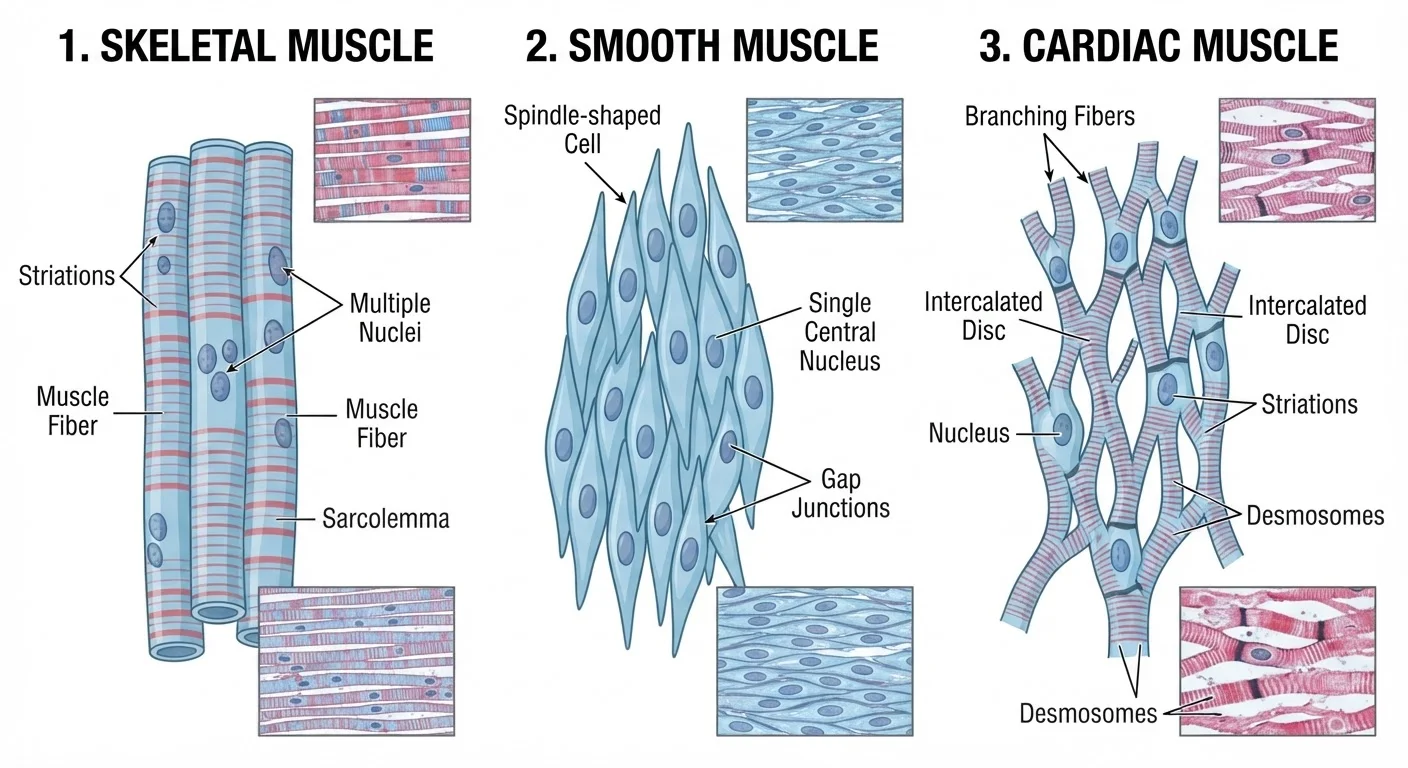
Skeletal muscle is what most people are familiar with - it's the tissue attached to bones via tendons that produces deliberate movement. Under a microscope, skeletal muscle fibers appear striated, meaning they display alternating light and dark bands created by the precise arrangement of two proteins: actin and myosin. Each fiber is a single, extremely long cell containing multiple nuclei, an adaptation that allows the cell to produce the large volume of proteins needed for contraction.
Critically, skeletal muscle is voluntary: it only contracts when the nervous system sends a signal via motor neurons. This gives you conscious control over everything from blinking to sprinting. However, this also means skeletal muscle fatigues - it relies on oxygen and fuel reserves that deplete with sustained effort. Fiber types vary: slow-twitch fibers resist fatigue and power endurance activities, while fast-twitch fibers produce explosive force but tire quickly.
| Skeletal Muscle | Smooth Muscle | Cardiac Muscle | |
|---|---|---|---|
| Location | Attached to bones | Organ walls, blood vessels | Heart only |
| Control | Voluntary (somatic nervous system) | Involuntary (autonomic/hormones) | Involuntary (self-generating rhythm) |
| Cell appearance | Striated, multinucleated | Non-striated, single nucleus | Striated, branched, single nucleus |
| Fatigue resistance | Low to moderate | Very high | Extremely high |
| Contraction speed | Fast | Slow | Moderate, rhythmic |
| Key function | Movement, posture, breathing | Digestion, circulation, excretion | Pumping blood continuously |
Smooth Muscle: The Quiet Regulator
Smooth muscle lines the walls of hollow organs - including the stomach, intestines, bladder, uterus, and blood vessels. Unlike skeletal muscle, its cells are short, spindle-shaped, and contain only a single nucleus. There is no striated banding pattern, which is precisely why it's called smooth.
This tissue is involuntary: it is governed by the autonomic nervous system (the branch that operates without conscious input) as well as by hormones and local chemical signals. Smooth muscle contracts slowly and is highly resistant to fatigue - essential for the rhythmic squeezing of the digestive tract (called peristalsis) that continues around the clock. It can also sustain a prolonged, low-level contraction called tonic contraction, which is how blood vessels maintain consistent pressure.
Cardiac Muscle: The Self-Driven Engine
Cardiac muscle exists in one place only: the heart. Its cells, called cardiomyocytes, are striated like skeletal muscle but branched and interconnected through specialized junctions called intercalated discs. These discs allow electrical impulses to pass rapidly from cell to cell, enabling the heart to contract as a coordinated unit rather than as isolated fibers.
The defining trait of cardiac muscle is automaticity - it generates its own electrical rhythm through specialized pacemaker cells in the sinoatrial (SA) node, without requiring nerve signals to initiate each beat. The autonomic nervous system and hormones like adrenaline can modulate rate and force, but they cannot start or stop the heart on their own. Cardiac muscle is also extraordinarily fatigue-resistant, powered predominantly by aerobic metabolism and a dense supply of mitochondria.
Just as cardiac muscle is a living, dynamic tissue, so are bones - bone remodeling and its role in skeletal health offers a complementary perspective on living structural tissue.
How Calcium Connects All Three
Despite their differences, all three muscle types rely on calcium ions to trigger contraction - a principle called excitation-contraction coupling. When a muscle cell is stimulated, calcium is released from internal stores (primarily the sarcoplasmic reticulum), which activates the actin-myosin interaction that shortens the fiber. The speed, source, and regulation of that calcium signal differs across types, which largely explains why each tissue behaves so differently. Skeletal muscle responds in milliseconds; smooth muscle may take seconds; cardiac muscle cycles at a precise, sustained rhythm calibrated to the body's demands.
This article is for informational and educational purposes only and does not constitute medical advice. Consult a qualified healthcare professional for concerns about your health.