

Key Takeaways
Bone Remodeling
Bone remodeling is the continuous biological process by which old or damaged bone tissue is broken down and replaced with new bone. This cycle happens throughout your entire life, not just during childhood growth. It means your skeleton is a dynamic, living organ - not a fixed, inert framework.
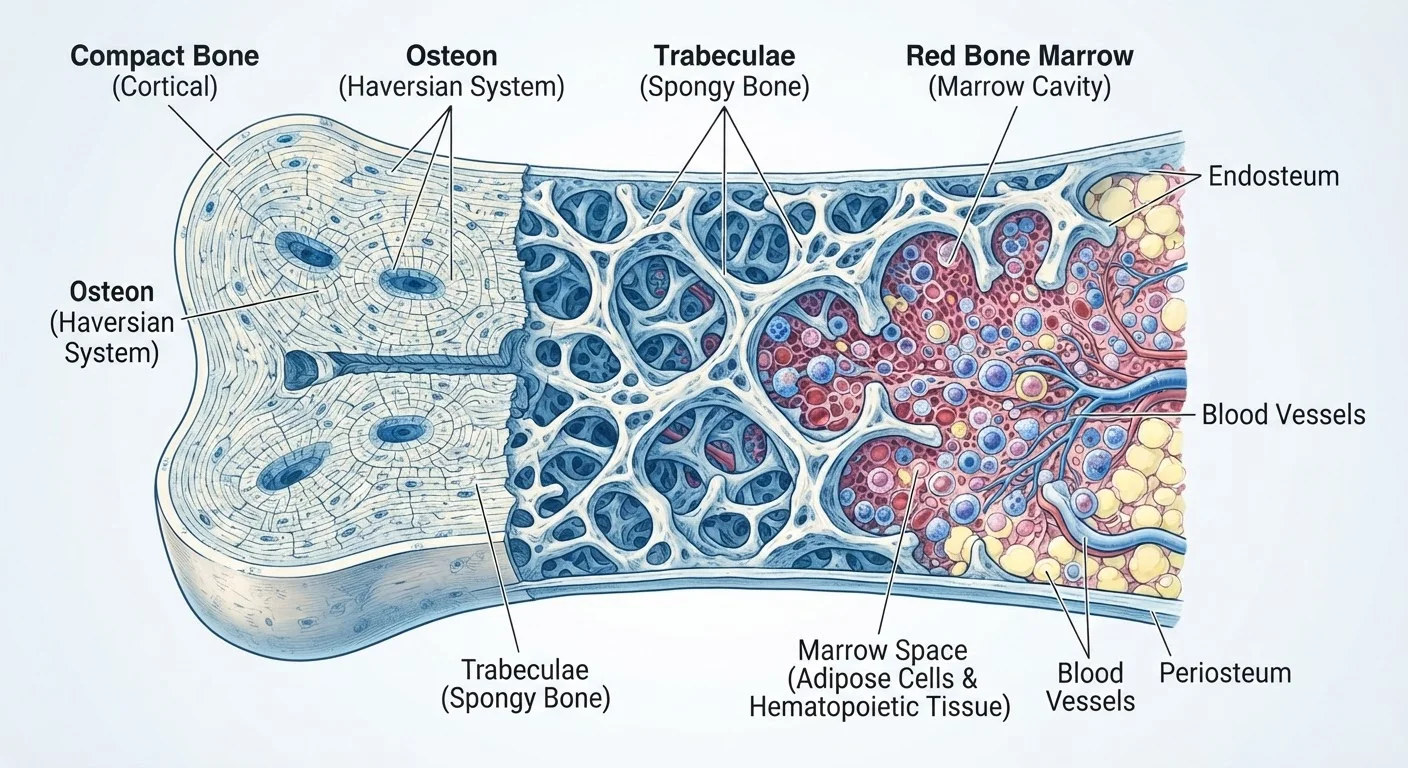
Remodeling is coordinated by two primary cell types: osteoclasts, which resorb (dissolve) bone matrix, and osteoblasts, which synthesize new bone tissue. Their activity is tightly regulated by hormones, mechanical loading, and signaling molecules.
The Persistent Myth of the Static Skeleton
Most people picture a skeleton the way they first saw one - hanging motionless in a classroom, bleached and brittle. That image is misleading in a fundamental way. The bones in a living body are metabolically active tissues supplied with blood vessels and nerves, continuously broken down and rebuilt in response to the body's changing needs.
This misconception matters because it shapes how people think about bone health. If bone were inert scaffolding, there would be little reason to consider nutrition, exercise, or hormonal changes as factors in skeletal integrity. In reality, those factors are central - and misunderstanding that connection contributes to preventable conditions like osteoporosis.
For broader context on how anatomy is sometimes misrepresented, see where anatomy education often goes wrong.
The Cells That Build and Break Down Bone
Bone tissue is maintained by several specialized cell types, each with a distinct role. Osteoblasts are the builders - they synthesize collagen and mineral matrix that hardens into new bone. Osteoclasts are the demolition crew - large cells derived from immune-system precursors that dissolve old bone through a process called resorption. A third type, osteocytes, are mature bone cells embedded within the hardened matrix; they act as sensors, detecting mechanical stress and coordinating the response between osteoblasts and osteoclasts.
In healthy adults, these processes are balanced. When resorption outpaces formation - due to aging, hormonal shifts, or nutritional deficiencies - bone density falls. When formation exceeds resorption - stimulated by exercise or certain hormones - bone becomes denser and more resistant to fracture.
~10%
Bone mass replaced by remodeling per year
Research estimates roughly 10% of the adult skeleton is remodeled annually, meaning skeletal tissue is substantially renewed over years, not decades.
99%
Of body's calcium stored in bone
The National Institutes of Health notes that bone serves as the primary reservoir for calcium, releasing it into the bloodstream as physiological demand requires.
200 billion
Red blood cells produced by marrow daily
Red bone marrow is estimated to produce hundreds of billions of blood cells each day to replace those that naturally reach the end of their lifespan.
Bone Marrow: More Than Empty Space
The interior of many bones is not hollow - it is filled with marrow, one of the body's most important tissue factories. Red marrow produces red blood cells, white blood cells, and platelets through a process called hematopoiesis. In infants, virtually all marrow is red. By adulthood, red marrow is concentrated mainly in flat bones - the pelvis, sternum, ribs, and skull - while yellow marrow, which stores fat, fills the shafts of long bones like the femur and tibia.
Yellow marrow is not a permanent state. Under physiological stress - such as significant blood loss or severe anemia - it can revert to red marrow to ramp up blood cell production. This plasticity underscores that bone is a responsive, adaptive system rather than a passive support structure.
Bone as a Mineral Reservoir and Endocrine Organ
Roughly 99% of the body's calcium is stored in bone, along with most of its phosphate. These minerals are not locked away permanently - they cycle in and out of bone tissue as the body requires. When blood calcium drops, parathyroid hormone triggers osteoclasts to release calcium from bone into the bloodstream, sustaining the tight range needed for nerve transmission and muscle function, including heartbeat.
Research in the past two decades has also established that bone functions as an endocrine organ - meaning it secretes hormones that influence other body systems. Osteocalcin, produced by osteoblasts, has been linked to insulin secretion and sensitivity, muscle function during exercise, and even aspects of brain function, according to research published in peer-reviewed journals including Cell and Nature. These findings continue to evolve, and scientists are still characterizing the full scope of bone's hormonal activity.
What Keeps Bones Healthy Throughout Life
Because bone is living tissue, its health depends on the same inputs that sustain other tissues: adequate nutrition, physical activity, and hormonal balance. Calcium and vitamin D are foundational - calcium provides mineral substrate, while vitamin D enables its absorption from the gut. Mechanical loading from weight-bearing activity is a direct stimulus for bone formation; osteocytes detect the strain of physical stress and signal osteoblasts to reinforce the structure accordingly.
Peak bone mass is typically reached in early adulthood, making the years from adolescence through the mid-thirties especially influential for long-term skeletal resilience. After peak mass is reached, maintaining density becomes the goal. Bone loss accelerates in women following menopause due to declining estrogen, which normally suppresses osteoclast activity.
Bone does not work in isolation. It connects at joints to tissues such as cartilage, tendons, and ligaments - each playing a distinct mechanical role. Understanding those neighboring structures adds important context; tendons, ligaments, and cartilage each do something different and are often confused with one another.
Building Bone Health Across the Lifespan
Weight-bearing activities such as walking, jogging, and resistance training are among the most evidence-supported ways to maintain bone density. Adequate dietary calcium and vitamin D remain foundational. If you have concerns about bone density or fracture risk, speak with a licensed healthcare provider - they can order a bone density scan (DEXA) and advise on appropriate next steps for your individual situation.