

Why Anatomical Vocabulary Exists
Anatomy has its own precise vocabulary for a practical reason: everyday directional words like 'up,' 'down,' 'in front,' or 'behind' are too ambiguous for medicine and science. If a doctor says a nerve runs 'below' another structure, that description changes entirely depending on whether the patient is standing, lying face-down, or positioned on their side. Standardized anatomical terms eliminate this ambiguity by tying every description to a fixed reference - the anatomical position.
Understanding this vocabulary also helps you read health articles, imaging reports, or science writing with greater confidence. Terms like proximal, distal, and sagittal appear constantly in clinical and research contexts. Once you know what they mean, a great deal of biological and medical language unlocks. You may also find it useful to explore common anatomy misconceptions that even well-read readers carry without realizing it.
Why Anatomical Position Matters
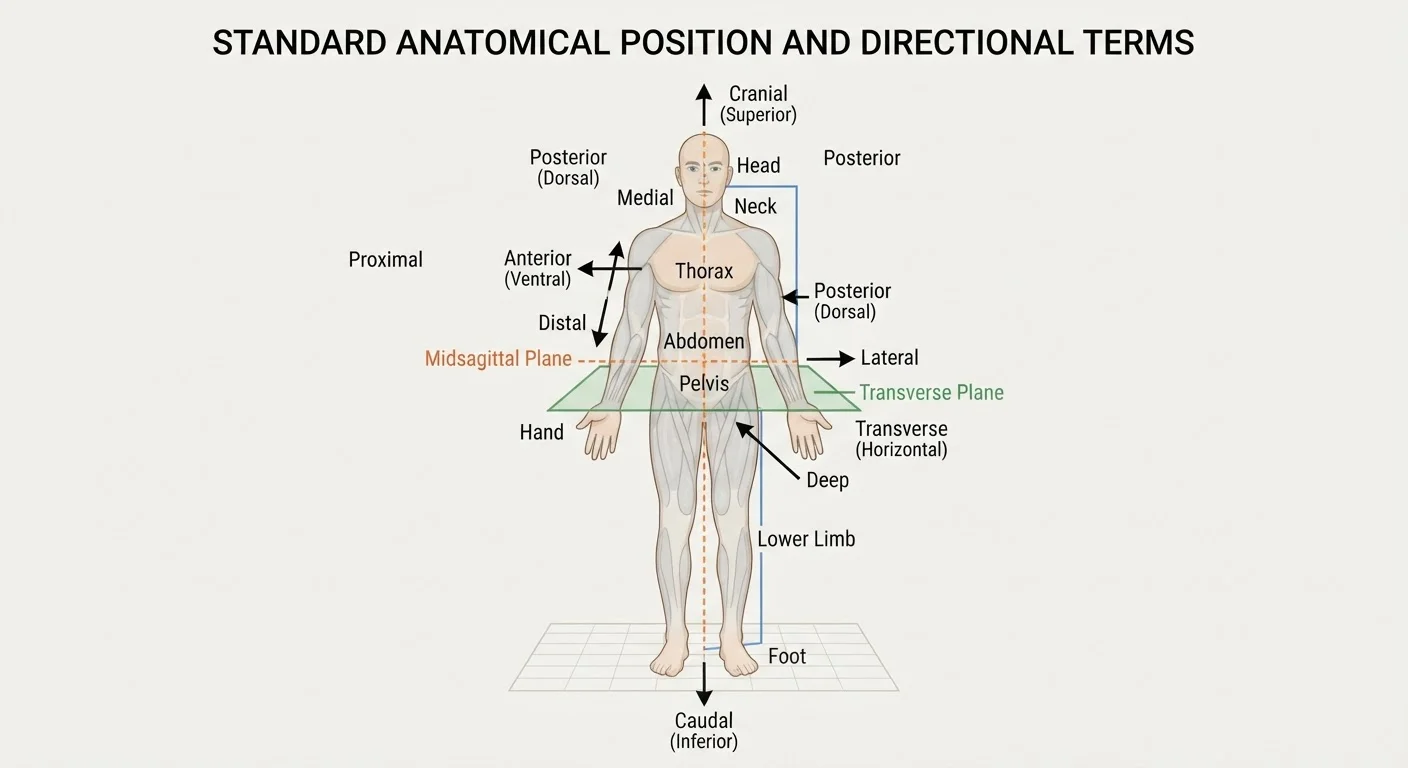
All anatomical directional terms are only meaningful relative to the standard anatomical position - body erect, arms at the sides, palms facing forward. This convention exists so that clinicians, researchers, and students worldwide describe the same spatial relationships consistently. When you read that a structure is 'anterior,' it always means toward the front as defined by this standard posture, regardless of how a patient or specimen is actually oriented during examination.
Directional Terms: The Core Vocabulary
Directional terms describe where one structure is located relative to another. They always come in opposing pairs, and each pair describes a single axis of the body.
These terms are applied to any body structure - organs, bones, vessels, or nerves. For example, in describing the forearm: the radius and ulna run parallel, but the radius is lateral (thumb side) and the ulna is medial (pinky side) when the body is in anatomical position. Proximal and distal are particularly important for limbs and extend to structures like blood vessels and nerves branching away from the trunk.
If you enjoy building reference vocabulary across fields, our astronomy glossary follows the same plain-language approach for the cosmos.
Planes of the Body and Cavity Terms
Anatomists also describe the body using imaginary flat surfaces called planes, which are used to orient cross-sections in imaging (like MRI or CT scans) and in anatomical diagrams.
Body cavities are another organizational concept. The dorsal cavity houses the brain and spinal cord, while the ventral cavity contains the thoracic organs (heart, lungs) and abdominopelvic organs (stomach, intestines, reproductive structures). These cavity divisions help clinicians quickly localize symptoms and structure surgical approaches.
Because anatomy content online varies widely in quality, it is worth knowing what to watch for in anatomy sources before relying on any single resource for health decisions.
This article is for general educational purposes only and does not constitute medical advice. Always consult a qualified healthcare professional for questions about your own health or anatomy.