

Key Takeaways
Why Anatomy Myths Are So Stubborn
Misconceptions about the human body are remarkably durable. They circulate through school curricula, pop-culture references, and well-meaning health advice - often for generations before scientists have a wide enough platform to correct them. Unlike myths about distant galaxies or ancient history, anatomy myths feel personal: they concern a body you live in every day, which makes them feel intuitive even when they are wrong.
Part of the problem is oversimplification. Early anatomy education relies on diagrams and shorthand that sacrifice accuracy for memorability. Once a simplified model is internalized, it can resist correction even in the face of clear evidence. Our guide to anatomy education pitfalls explores how these gaps form and what to look for in reliable sources. The myth-busting below draws on peer-reviewed anatomy research and established medical consensus.
Myth
We only use about 10% of our brains. The rest is dormant, waiting to be unlocked.
Fact
Neuroimaging studies show that virtually all brain regions are active at some point, and many are active simultaneously even during simple tasks.
The 10% myth has no credible origin in neuroscience. Functional MRI and PET scan data consistently show activity distributed across the brain during waking hours. While not every neuron fires simultaneously - that would be a seizure - there is no large dormant region awaiting activation. The brain also consumes roughly 20% of the body's energy despite accounting for only about 2% of body weight, an evolutionary cost that would make little sense if 90% sat idle.
Myth
Your stomach is located behind your belly button, in the center of your abdomen.
Fact
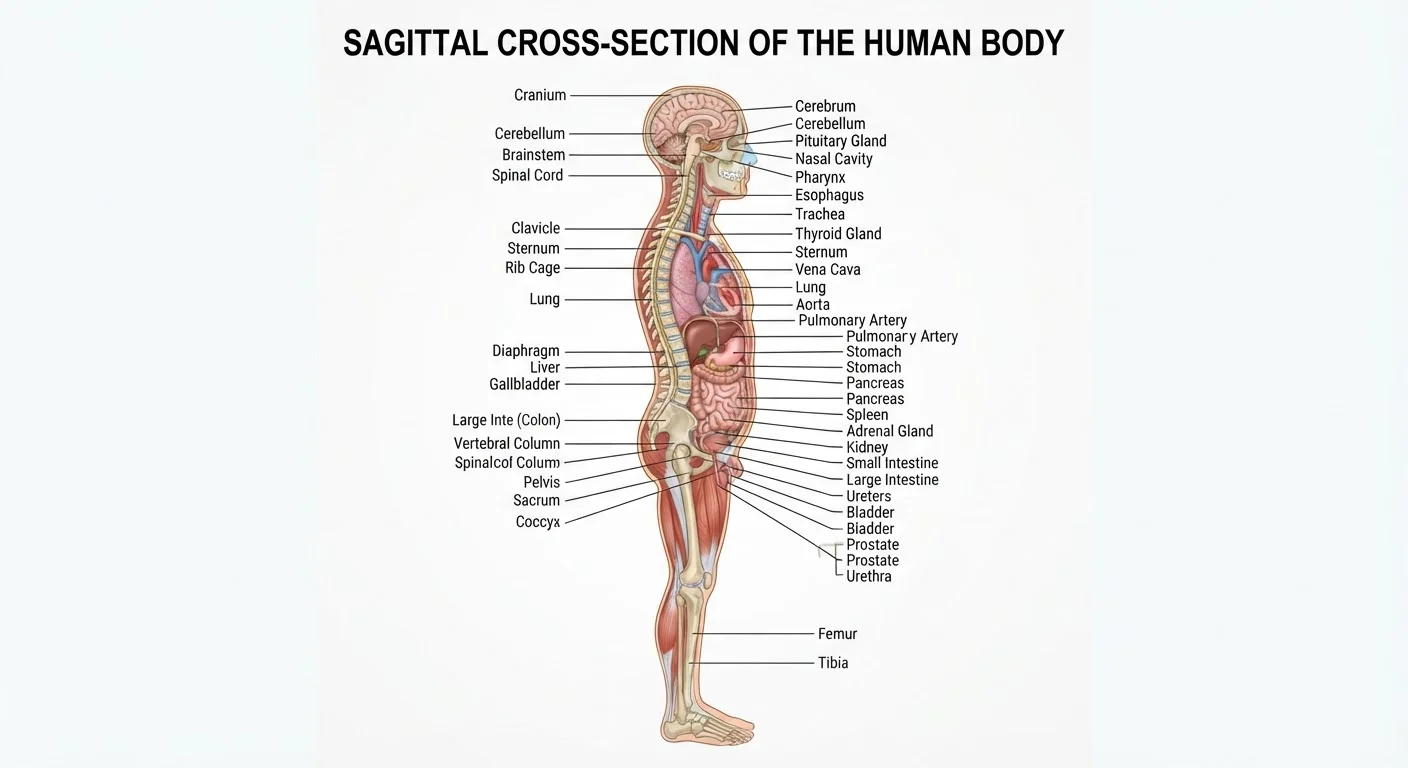
The stomach sits higher than most people expect - largely behind the lower left ribcage, not centrally behind the navel.
When empty, the stomach is roughly the size of a large fist and is tucked under the diaphragm, mostly on the left side of the upper abdomen. The navel region is dominated by the small intestine. This positional misunderstanding can lead people to misattribute upper-left abdominal discomfort - which may actually involve the stomach, spleen, or left kidney - to digestive issues lower in the gut.
Myth
Different regions of the tongue detect different tastes - sweet at the tip, bitter at the back, and so on.
Fact
Taste receptor cells for all five basic tastes - sweet, salty, sour, bitter, and umami - are present across the entire tongue surface.
The tongue map that appeared in countless textbooks originated from a mistranslation of a 19th-century German paper. Subsequent research using electrophysiological recordings has confirmed that taste buds distributed throughout the tongue can detect all taste qualities. Certain areas may show marginal sensitivity differences, but no region is exclusively dedicated to a single taste. The five-zone map has been formally discredited in sensory science for decades.
Myth
Shaving makes hair grow back thicker, darker, and faster.
Fact
Shaving has no effect on hair follicles, which determine growth rate, color, and thickness entirely independently of what happens at the skin surface.
Hair growth is controlled by the follicle, which sits well below the skin surface and is unaffected by a razor blade. What shaving does change is the visible tip of the hair shaft: a freshly shaved hair has a blunt cross-section rather than a tapered one, which makes regrowth feel coarser and appear darker by contrast against the skin. A controlled 1928 study - and multiple replications since - found no measurable change in growth rate or pigmentation after repeated shaving.
Myth
The heart is located on the left side of the chest.
Fact
The heart is a midline organ, positioned slightly left of center, with its apex tilting toward the lower left - but most of its mass sits centrally behind the sternum.
Most people correctly associate the heart with the left side because that is where the strongest heartbeat is felt - the apex of the heart points down and to the left, creating the apical pulse that is easily palpable. However, the bulk of the heart, including the right atrium and right ventricle, lies directly behind the breastbone. A rare condition called situs inversus, in which organs are mirrored, is one reason anatomists are precise about describing cardiac position relative to anatomical landmarks rather than simply saying "left."
What Accurate Anatomy Knowledge Actually Looks Like
Correcting these myths is more than an intellectual exercise. Misunderstanding where your organs sit, how your nervous system works, or what your senses actually do can lead to misinterpreting symptoms, dismissing legitimate health concerns, or placing unwarranted trust in misinformation. Familiarity with key anatomical terms helps readers engage more critically with health content they encounter online.
20%
Share of body energy consumed by the brain
Despite representing roughly 2% of body weight, the human brain accounts for approximately 20% of the body's resting energy use, according to established neurophysiology research.
5
Basic taste qualities detected across the whole tongue
Peer-reviewed sensory science recognizes five primary taste modalities - sweet, salty, sour, bitter, and umami - each detectable across the full tongue surface, not in isolated zones.
Anatomical illustrations are another common source of confusion. Diagrams are stylized for clarity, not realism - organs are color-coded, scaled, and repositioned for visibility. Learning to read an anatomy diagram accurately is a practical skill that reduces the chance of misinterpreting what you see. The human body is more compact, more variable, and far more interconnected than any single diagram can show. Staying curious - and appropriately skeptical - is the best posture any reader can take.
This article is for general informational and educational purposes only and does not constitute medical advice. Consult a qualified healthcare professional for any concerns about your health or symptoms.