

Key Takeaways
Hubble Tension
The Hubble tension is a significant disagreement between two independent methods of measuring how fast the universe is expanding. One method looks at the early universe's light; the other measures nearby galaxies directly. Both are carefully done - yet they produce different answers. Scientists are still working to understand why.
The expansion rate is quantified as the Hubble constant (H₀), expressed in kilometers per second per megaparsec. Current measurements place it between roughly 67 and 73 km/s/Mpc depending on the method used - a statistically significant gap.
Two Ways to Measure an Expanding Universe
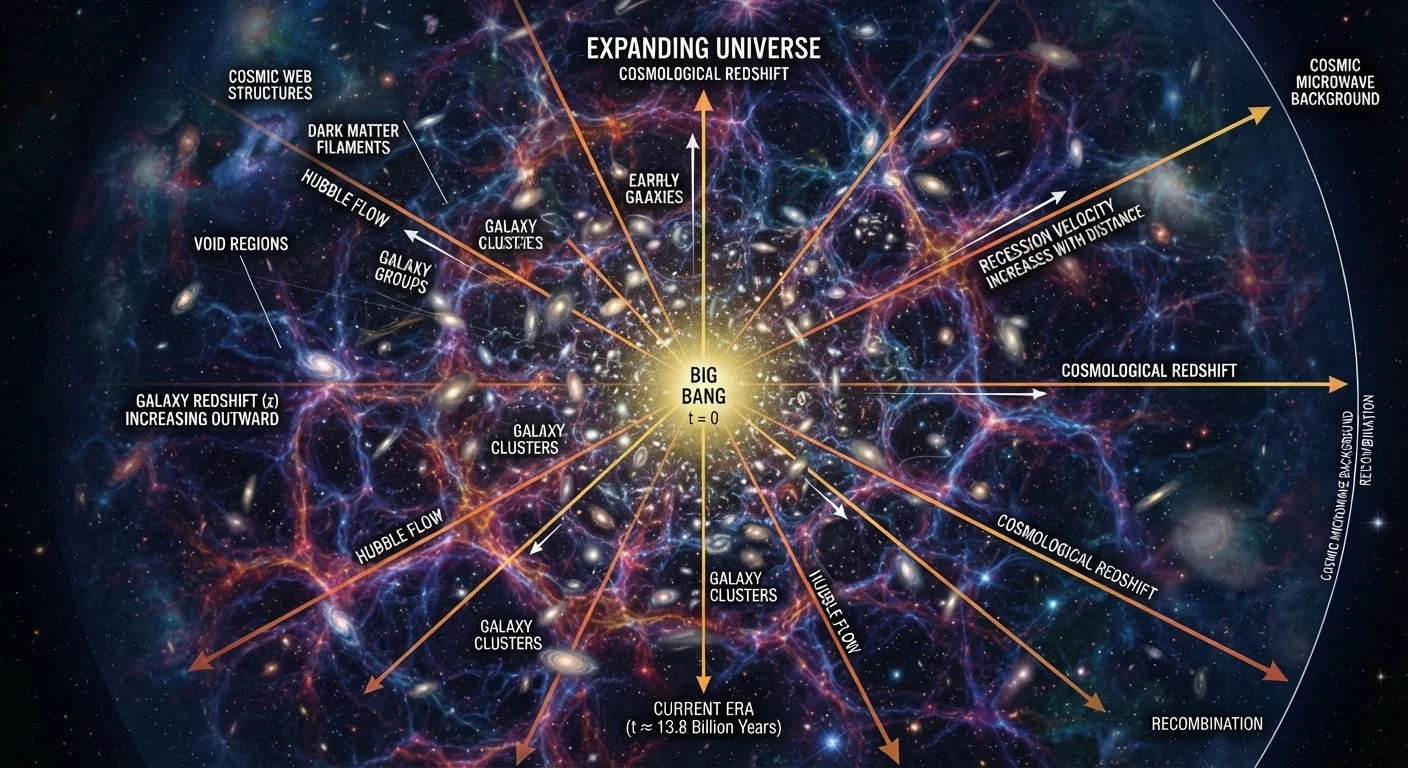
The universe has been expanding since the Big Bang - that much is well established. What scientists disagree on is the precise rate of that expansion, a number known as the Hubble constant (H₀). To understand why the disagreement matters, it helps to know how the two main measurement approaches work.
The first method looks backward in time. Scientists analyze the cosmic microwave background (CMB) - faint light left over from roughly 380,000 years after the Big Bang. By studying the subtle temperature patterns in this ancient light, researchers can reconstruct the early universe's conditions and calculate an expected expansion rate today. Data from the European Space Agency's Planck satellite yields a Hubble constant of approximately 67.4 km/s/Mpc.
The second method measures the universe as it is now. Astronomers use cosmic distance ladders - a chain of overlapping measurement techniques starting with nearby stars called Cepheid variables, whose brightness follows predictable patterns. By calibrating distances step by step, they calculate how fast galaxies are receding from us. This method, led largely by the SH0ES collaboration, consistently returns a value closer to 73 km/s/Mpc. For context on just how vast these distances are, see our look at cosmic distances.
Why the Gap Is a Big Deal
A difference of roughly 6 km/s/Mpc might sound trivial, but in cosmology it is enormous. Scientists measure statistical confidence in units called sigma (σ). A 1-sigma difference can easily be noise. A 5-sigma difference is considered definitive evidence that something real is going on. The Hubble tension currently sits at approximately 5 sigma - meaning the chance it stems from random measurement error is extraordinarily small.
~5σ
Statistical significance of the Hubble tension
A 5-sigma result means the probability the gap is due to chance alone is less than one in a million, according to standard statistical thresholds used in physics.
67.4 km/s/Mpc
CMB-based Hubble constant estimate
Derived from European Space Agency Planck satellite data analyzing the cosmic microwave background.
~73 km/s/Mpc
Distance-ladder Hubble constant estimate
Reported by the SH0ES collaboration using Cepheid variable stars and Type Ia supernovae as distance markers.
Both teams use meticulous methods and independent data sources. The Planck CMB analysis and the SH0ES distance-ladder work have each been scrutinized, peer-reviewed, and replicated. Neither camp has identified a straightforward mistake. That makes the tension genuinely puzzling - and scientifically exciting.
If you want a grounding in the terminology being debated, a glossary of essential cosmology terms can help make sense of the jargon.
What Could Explain It?
Scientists have proposed several possible explanations, though none has yet achieved consensus.
- New physics: The tension may signal that our current best model - the Lambda-CDM model, which incorporates dark energy and dark matter - is incomplete. Some researchers propose an early burst of dark energy before recombination, or modifications to how dark matter behaves.
- Systematic errors: Although both methods are robust, subtle calibration issues - such as how Cepheid variable stars are treated in crowded galactic environments - could still be contributing. NASA's James Webb Space Telescope has been used to independently check some of these calibrations, and while it narrowed some uncertainties, it did not eliminate the tension.
- Exotic particles: Some models invoke hypothetical particles, such as early dark energy or additional types of neutrinos, that could have altered the universe's expansion history in ways not captured by current models.
Understanding the full scale of what's being measured is part of what makes this so difficult - for a sense of how far our observations actually reach, see how far we can actually see into the cosmos.
What Happens Next
Cosmologists are actively working on several fronts. New measurement techniques - including gravitational wave standard sirens, which use the ripples from merging neutron stars to independently estimate cosmic distances - offer a promising third method that sidesteps both the CMB and the distance ladder. Early results are encouraging but not yet precise enough to resolve the debate.
The tension has pushed cosmologists to reexamine foundational assumptions about the universe's composition and history. Whether the resolution turns out to be a subtle calibration fix or a genuinely new chapter in physics, the process itself reflects science working as intended: careful measurement, transparent disagreement, and relentless testing.
It is worth noting that popular media sometimes frames this as a "crisis" in cosmology. That framing can mislead - the standard model of cosmology still explains an enormous range of observations successfully. The Hubble tension is a real and unresolved puzzle, not evidence that everything scientists know about the universe is wrong. For a broader look at how Hollywood distorts space science, see which space myths the movies got wrong.