

Key Takeaways
The Observable Universe
The observable universe is the spherical region of space from which light has had enough time to reach Earth since the Big Bang. It is not the entire universe - just the portion we can, in principle, detect. Everything beyond its boundary remains invisible to us, not because nothing exists there, but because its light hasn't reached us yet.
The observable universe has a current proper radius of approximately 46.5 billion light-years, despite the universe being only about 13.8 billion years old - a result of cosmic expansion stretching space during the journey of that light.
Why 13.8 Billion Years Doesn't Give You the Full Picture
Most people's first instinct is logical: if the universe is 13.8 billion years old, the farthest light we can see must have traveled 13.8 billion light-years. That math seems clean - but it misses a critical piece of physics.
Space itself is expanding. When a distant galaxy emitted light billions of years ago, that light began its journey across a much smaller universe. As the photons traveled, the space they were crossing kept stretching. By the time that light reaches our telescopes, the galaxy that produced it has been carried far beyond its original position. Today, the most distant sources we can detect are now approximately 46.5 billion light-years away - giving the observable universe a diameter of roughly 93 billion light-years.
This isn't a trick or a paradox. It's a direct consequence of how general relativity describes an expanding cosmos. For a deeper look at just how staggering these distances are in practical terms, see The Scale of the Universe: Numbers That Are Hard to Believe.
~93 billion
Diameter of observable universe in light-years
This figure comes from applying the standard ΛCDM cosmological model to account for expansion since the Big Bang, per established cosmology research.
13.8 billion
Age of the universe in years
Determined through measurements of the cosmic microwave background by missions including NASA's WMAP and ESA's Planck satellite.
~2 trillion
Estimated galaxies in the observable universe
A 2016 study published in The Astrophysical Journal Letters, led by Christopher Conselice, revised earlier estimates upward dramatically using deep-field galaxy data.
The Cosmic Horizon and the Oldest Light We Can See
The boundary of the observable universe is called the particle horizon - the maximum distance from which particles (including photons of light) could have traveled to reach us given the age of the universe and the history of its expansion. Beyond this horizon, no signal of any kind has had time to arrive.
The oldest light we can actually detect is the cosmic microwave background (CMB), a faint glow of microwave radiation permeating all of space. It originated roughly 380,000 years after the Big Bang, when the universe cooled enough for electrons and protons to combine into neutral hydrogen atoms, allowing photons to travel freely for the first time. Before that moment, the universe was opaque - a dense plasma that trapped light. The CMB represents our observational limit in time, even if not quite in distance.
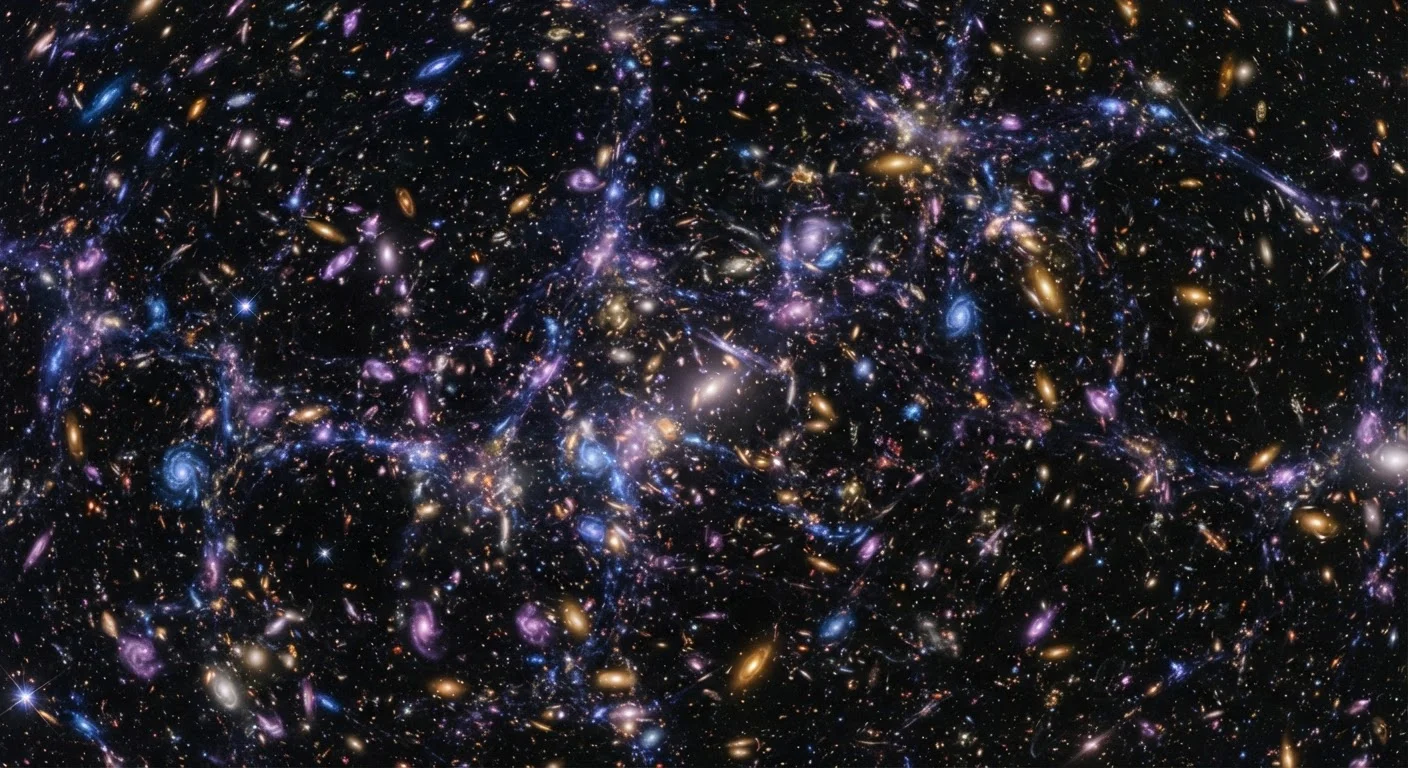
Everything we know about the large-scale structure of the universe - galaxy filaments, cosmic voids, and superclusters - exists within this observable shell. Beyond it lies an unknown expanse that physics cannot currently probe.
Expansion, Acceleration, and a Shrinking Horizon
Here's a counterintuitive consequence of modern cosmology: even as the universe ages and light from farther regions has more time to reach us, the accelerating expansion of space is working against us. Galaxies beyond a certain distance - called the Hubble radius - are receding faster than light can cross the gap. This doesn't violate relativity; no object moves through space faster than light, but space itself can expand at any rate.
This acceleration, attributed to dark energy, means that light from some regions currently beyond our horizon will never reach us, no matter how long we wait. In the very long-term future, our observable universe may appear to shrink as distant galaxies redshift into invisibility. Why the Universe Appears to Be Expanding Faster Than Expected explores the ongoing scientific debate over precisely how fast this expansion is occurring.
What we observe today is therefore a snapshot - a window shaped by both the universe's age and the accelerating expansion that is steadily pulling some regions beyond our reach.
What This Means for Astronomy and Our Place in the Cosmos
Understanding the observable universe reframes how we interpret everything astronomers detect. When a telescope images a galaxy 10 billion light-years away, it is seeing that galaxy as it existed 10 billion years ago - not as it is today. Looking across distance is literally looking back in time.
This time-delay effect is one of the most powerful tools in observational cosmology. By cataloging galaxies at different distances - and therefore different epochs - scientists can reconstruct the history of star formation, galaxy evolution, and the large-scale structure of the cosmos. The same principle underlies the search for planets around other stars; see how astronomers find worlds orbiting distant stars for more on that frontier.
The 93-billion-light-year boundary is not a wall in space. It is a horizon imposed by physics and time - and it is a reminder that the universe almost certainly extends far beyond what we will ever be able to observe.