

Key Takeaways
Exoplanet
An exoplanet is any planet that orbits a star outside our own solar system. Because they are so far away and so dim compared to their host stars, exoplanets almost never appear as visible points of light - astronomers must use clever indirect methods to infer their existence. As of mid-2020s, NASA's Exoplanet Archive lists more than 5,500 confirmed exoplanets.
Exoplanets are formally distinguished from brown dwarfs and free-floating planetary-mass objects by their orbital relationship to a host star and, in some classification schemes, by their formation pathway.
Why Finding Exoplanets Is So Difficult
Detecting a planet orbiting another star is one of astronomy's most demanding challenges. Stars outshine their planets by factors ranging from millions to billions - imagining spotting a firefly hovering next to a searchlight from across a city gives a rough sense of the problem. Most exoplanets are also separated from us by tens to hundreds of light-years, distances so vast that even our fastest spacecraft would need tens of thousands of years to reach the nearest ones. For context on just how large those scales are, see our explainer on how far the observable universe extends.
Because of these obstacles, astronomers developed a suite of indirect detection techniques - ways of inferring a planet's presence by observing what it does to its host star, rather than seeing the planet itself. Each method has strengths, blind spots, and a different sensitivity to planet size, mass, and orbital distance.
Transit Photometry: Catching a Planet's Shadow
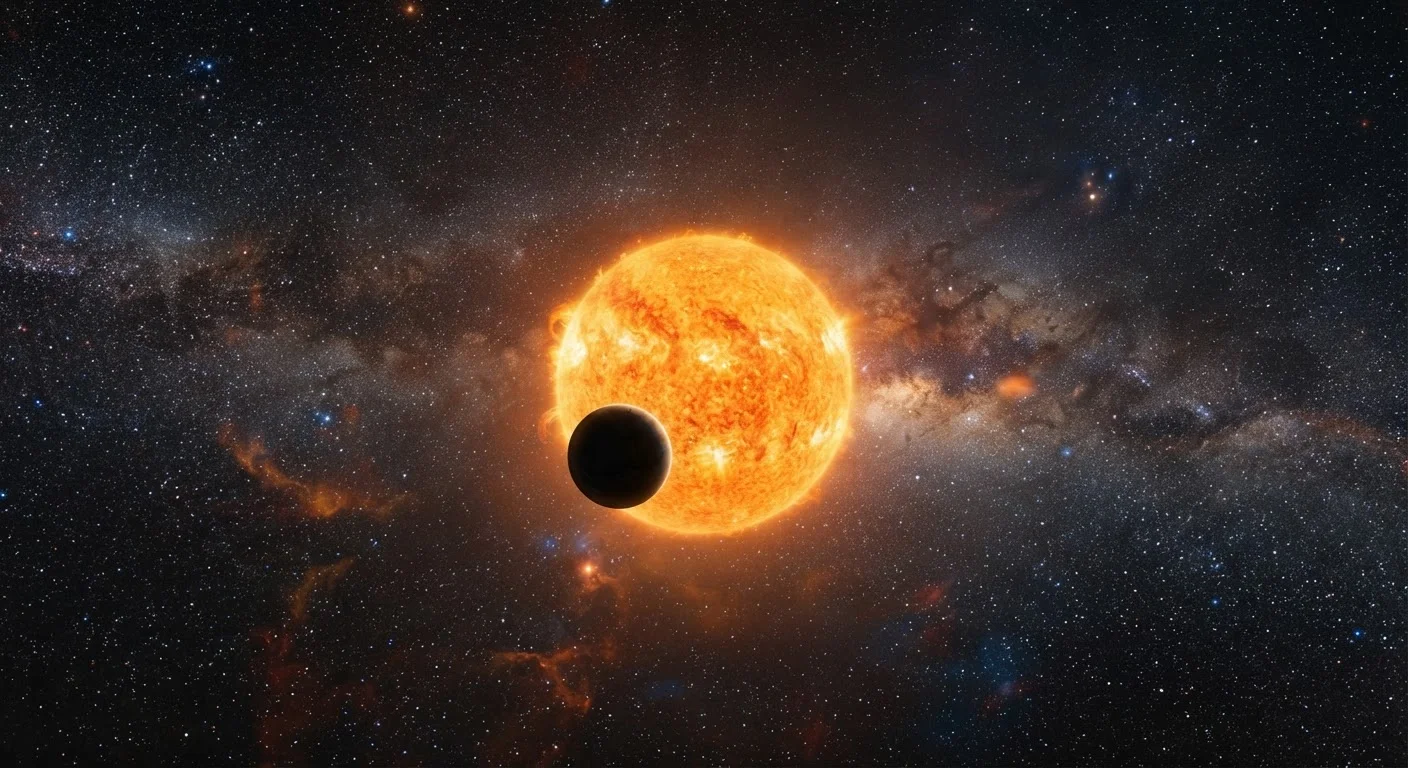
The most productive detection technique to date is transit photometry. When a planet's orbit carries it directly between its star and Earth, it blocks a small fraction of the star's light, causing a brief, measurable dip in brightness. The depth of that dip indicates the planet's size relative to the star; the time between repeated dips reveals its orbital period.
NASA's Kepler Space Telescope (operational 2009-2018) stared at a fixed patch of sky containing roughly 150,000 stars and harvested more than 2,600 confirmed planets using this method. Its successor, the Transiting Exoplanet Survey Satellite (TESS), launched in 2018 and surveys nearly the entire sky, prioritizing nearby bright stars whose planets are more amenable to follow-up study.
5,500+
Confirmed exoplanets as of mid-2020s
According to NASA's Exoplanet Archive, the confirmed count surpassed 5,500, with thousands more candidates under review.
~75%
Share of confirmations from transit photometry
NASA's Kepler and TESS missions account for the dominant majority of confirmed exoplanets, reflecting the power and scalability of the transit method.
4.24 ly
Distance to nearest known exoplanet
Proxima Centauri b orbits Proxima Centauri, our closest stellar neighbor, at approximately 4.24 light-years from Earth.
Transit photometry has a critical limitation: it only works when a planet's orbit is aligned so it passes in front of its star from our vantage point. Planets with tilted orbits are simply invisible to this technique, meaning transit surveys inevitably undercount the true population of planets.
Radial Velocity: Listening to a Star Wobble
A planet doesn't just orbit a star - both objects orbit their shared center of mass. For large planets, this causes the star to wobble slightly. As the star moves toward Earth, its light is compressed to shorter, bluer wavelengths (a Doppler blueshift); as it moves away, the light stretches to redder wavelengths. The radial velocity method measures these spectral shifts with extraordinary precision - modern spectrographs can detect stellar motions as slow as about one meter per second, roughly walking pace.
This technique naturally favors detecting massive planets on tight orbits, because they induce the largest wobbles in the shortest time. It was the dominant discovery method before transit surveys took over, and it played a central role in confirming early landmark discoveries such as 51 Pegasi b in 1995 - the first exoplanet confirmed around a Sun-like star.
Radial velocity also yields a planet's minimum mass, since the technique cannot determine how the orbit is tilted relative to the line of sight. Combining it with transit data, however, allows scientists to calculate both true mass and density - enough to distinguish rocky worlds from gas giants.
Direct Imaging and Other Techniques
Direct imaging - capturing actual light from a planet - is possible only in special circumstances: the planet must be very large, very young (and therefore still radiating heat from formation), and orbiting far enough from its star to be spatially separated in the telescope's view. Instruments called coronagraphs block the star's glare to reveal faint companions. This approach is exciting but rare; most confirmed directly imaged planets are gas giants many times Jupiter's mass orbiting at great distances.
Gravitational microlensing offers another route: when a foreground star with a planet passes in front of a more distant background star, the gravitational field acts as a lens, temporarily brightening the background star's light. A planet adds a brief secondary spike to the brightening curve. Microlensing is uniquely sensitive to planets at intermediate orbital distances and even free-floating planetary-mass objects, but each event is a one-time observation - there is no follow-up possible once the alignment passes.
Astrometry, the precise measurement of a star's positional wobble on the sky, has long been a theoretical method but became practically powerful with the European Space Agency's Gaia mission, which is expected to yield thousands of planet detections from its high-precision stellar positions.
Each of these worlds, however exotic, contrasts sharply with the familiar planets in our own neighborhood - from gas giants to rocky terrain - as explored in our overview of notable worlds in our solar system.
From Detection to Characterization
Confirming an exoplanet's existence is only the beginning. Astronomers want to know whether these worlds have atmospheres, what those atmospheres contain, and whether any conditions could be hospitable to life. Transmission spectroscopy is the primary tool: during a transit, starlight passes through the planet's atmospheric rim, and specific molecules absorb specific wavelengths. Comparing the star's spectrum during transit to its baseline spectrum reveals chemical fingerprints.
The James Webb Space Telescope (JWST), launched in December 2021, represents a major leap in this capability. Its infrared instruments can detect molecules such as water vapor, carbon dioxide, methane, and sulfur dioxide in exoplanet atmospheres with far greater sensitivity than any previous observatory.
Even with all these tools, characterizing a planet completely remains extraordinarily difficult. Locating a world within the so-called habitable zone - the orbital distance range where liquid water could theoretically exist on a surface - is an important milestone, but it answers only a narrow slice of the habitability question. Our companion article on what the habitable zone actually means explains why location is necessary but far from sufficient.