

Key Takeaways
Why Our Solar System Still Surprises Us
We've sent spacecraft to every planet in our solar system, yet each new mission returns data that upends assumptions and raises fresh questions. For everyday observers, these worlds offer more than spectacle - they're natural laboratories that illuminate how planets form, evolve, and occasionally host the conditions chemistry needs to get complex. If you've ever looked up at a bright planet hanging in the night sky and wondered what's actually going on there, this tour is for you.
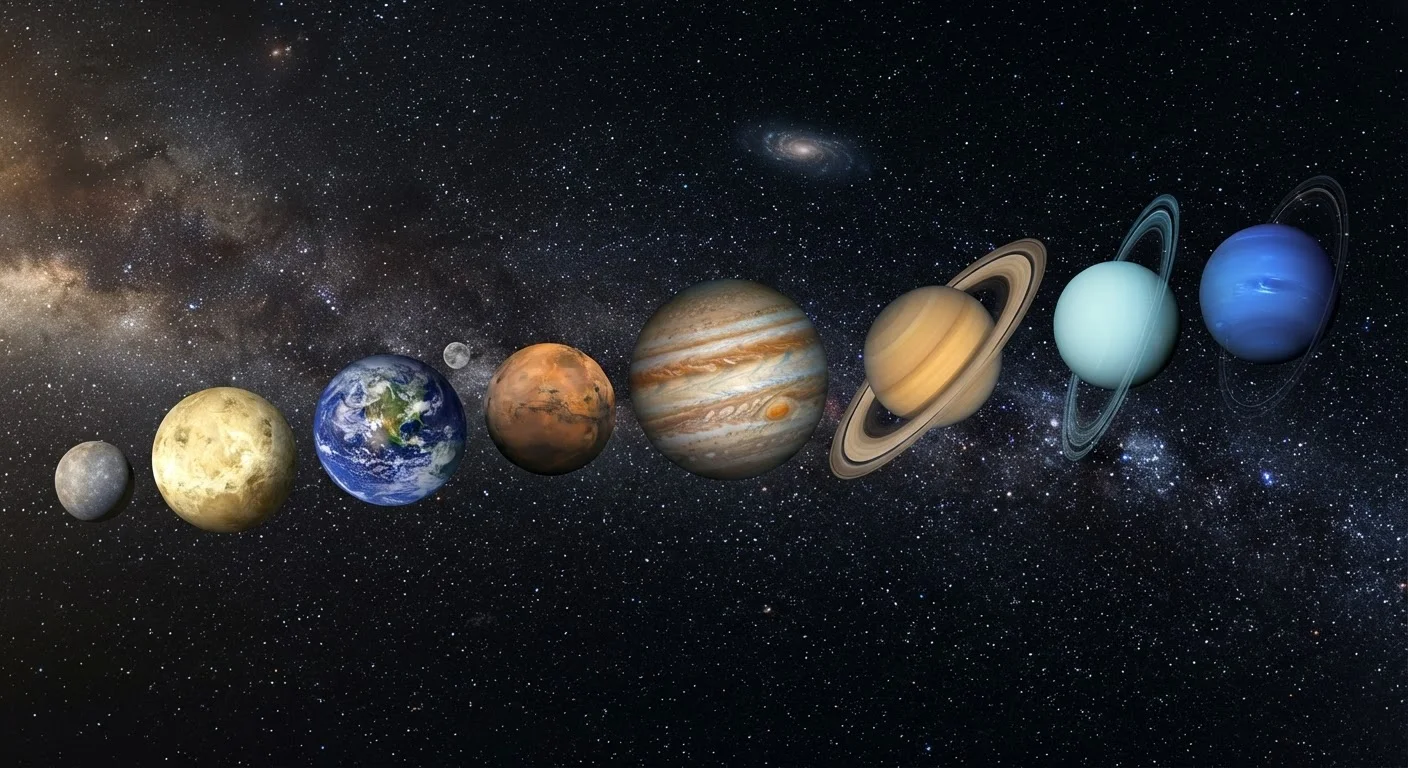
Our solar system contains eight recognized planets (plus a rich population of dwarf planets and moons), but a handful stand out for the sheer scale or strangeness of their features. Each entry below highlights what makes that world scientifically remarkable, grounded in what planetary scientists have established through direct observation and spacecraft data. For a sense of how astronomers hunt for planets around other stars entirely, see our piece on how astronomers find worlds orbiting distant stars.
Jupiter - The Storm King
Jupiter is the solar system's largest planet, with a mass more than twice that of all other planets combined. Its most iconic feature, the Great Red Spot, is an anticyclonic storm wider than Earth that atmospheric scientists have tracked since at least the 17th century. NASA's Juno mission, which began orbiting Jupiter in 2016, revealed that the storm's roots extend roughly 500 kilometers (about 310 miles) into the atmosphere - far deeper than earlier models predicted.
Jupiter also plays a gravitational role in the broader solar system, its massive pull influencing the orbits of asteroids and comets. Its four largest moons - Io, Europa, Ganymede, and Callisto, collectively called the Galilean moons - are individually more interesting than many planets: Io is the most volcanically active body in the solar system, while Europa harbors a saltwater ocean beneath its icy crust, making it a high-priority target in the search for extraterrestrial life.
The Great Red Spot's roots plunge roughly 500 kilometers deep into Jupiter's atmosphere.
Saturn - The Ringed Wonder
Saturn's ring system is among the most visually striking structures in the solar system, yet it is remarkably thin - spanning up to 282,000 kilometers (175,000 miles) in diameter but averaging only about 10 meters thick in some regions. The rings consist primarily of water-ice particles ranging from microscopic grains to chunks the size of houses. Research published using Cassini mission data suggests the rings may be only 10 to 100 million years old - young by solar system standards, possibly formed from a shattered moon or comet.
Saturn's moon Titan is equally compelling: it has a dense nitrogen atmosphere and features lakes and rivers of liquid methane and ethane on its surface. NASA's Dragonfly mission, a rotorcraft lander, is scheduled to explore Titan's surface and chemistry in the 2030s, targeting organic molecules that may mirror early Earth chemistry.
Saturn's rings may be only 100 million years old - a cosmic eyeblink in the 4.5-billion-year solar system.
Mars - The Geological Record-Holder
Mars punches well above its size when it comes to geological extremes. Olympus Mons, a shield volcano, rises approximately 21.9 kilometers (13.6 miles) above the Martian surface - nearly three times the height of Mount Everest above sea level. The Valles Marineris canyon system stretches roughly 4,000 kilometers (about 2,500 miles) in length, dwarfing the Grand Canyon.
Mars once had liquid water flowing across its surface, evidenced by ancient riverbeds, deltas, and mineral deposits identified by orbiters and rovers. Its thin carbon dioxide atmosphere and lack of a global magnetic field mean that solar radiation now reaches the surface at levels hostile to known life. Understanding why Mars lost its atmosphere - while Earth retained one - remains a central question in comparative planetology.
Olympus Mons is nearly three times taller than Everest, making it the tallest volcano in the solar system.
Venus - Earth's Cautionary Twin
Venus is almost identical to Earth in size and mass, yet its surface environment is among the most hostile in the solar system. Average surface temperatures hover around 465°C (869°F) - hot enough to melt lead - sustained by a dense carbon dioxide atmosphere that traps heat through an extreme greenhouse effect. Atmospheric pressure at the surface is roughly 92 times that of Earth at sea level, equivalent to being about 900 meters underwater.
What makes Venus particularly valuable scientifically is that it likely started with conditions more similar to Earth's before undergoing a dramatic climate transformation. Determining whether Venus ever had liquid water, and what caused its runaway warming, could offer crucial context for understanding climate dynamics on Earth and on exoplanets.
Venus's surface is hotter than Mercury's despite being farther from the Sun - a product of its extreme greenhouse atmosphere.
Uranus and Neptune - The Ice Giants
Often grouped together as the solar system's "ice giants," Uranus and Neptune are composed primarily of water, methane, and ammonia ices beneath hydrogen and helium outer layers. Uranus is distinctive for its extreme axial tilt of approximately 98 degrees - it essentially orbits the Sun on its side, likely the result of a massive collision early in its history. This creates the solar system's most extreme seasonal variations: each pole experiences about 42 Earth-years of continuous sunlight followed by 42 years of darkness.
Neptune, though slightly smaller than Uranus, radiates more heat than it receives from the Sun, suggesting an internal heat source not yet fully understood. Its largest moon, Triton, orbits in a retrograde (backward) direction relative to Neptune's rotation, strongly implying it was captured from the Kuiper Belt rather than forming alongside the planet.
Triton's retrograde orbit strongly suggests it was captured from the Kuiper Belt rather than born around Neptune.
Putting These Worlds in Perspective
Studying our planetary neighbors does more than satisfy curiosity - it informs our understanding of what conditions make a world habitable. Mars, for instance, once had liquid water and a thicker atmosphere, making it a key case study in planetary climate change. Venus, meanwhile, shows what a runaway greenhouse effect looks like at full scale. Understanding these outcomes shapes how scientists interpret data from planets orbiting other stars. If you want to dig deeper into what "habitable" really means scientifically, our explainer on what the habitable zone actually means is a useful companion read.
For readers who want to observe some of these planets directly - Jupiter, Saturn, and Mars are all visible to the naked eye and spectacular through even a modest telescope - our stargazing preparation checklist can help you plan a productive session. The solar system rewards patience and attention, whether you're reading about it or watching it move across the sky.
Observe Planets with Basic Equipment
Jupiter's cloud bands and four Galilean moons are visible through a pair of standard 10x50 binoculars. Saturn's rings become clearly distinguishable with a small telescope at 30x magnification or higher. Mars appears as a distinctly reddish disk through binoculars and shows surface detail through even a modest backyard telescope during opposition, when it is closest to Earth.