

Key Takeaways
Our Verdict
Urban, suburban, and rural properties each build equity through different mechanisms - density and liquidity, community infrastructure and space, or land ownership and lower entry costs. Understanding which forces apply to your specific location is more useful than assuming any one setting always wins. Owners in all three settings benefit from tracking local market data, maintaining their property proactively, and consulting a qualified real estate professional before making major decisions.
| Best for | Recommended |
|---|---|
| Those prioritizing liquidity and price appreciation in high-demand markets | Urban |
| Owners seeking a balance of space, community amenities, and stable long-term value | Suburban |
| Buyers focused on land ownership, lower entry prices, and self-sufficiency | Rural |
How Location Type Shapes the Value Equation
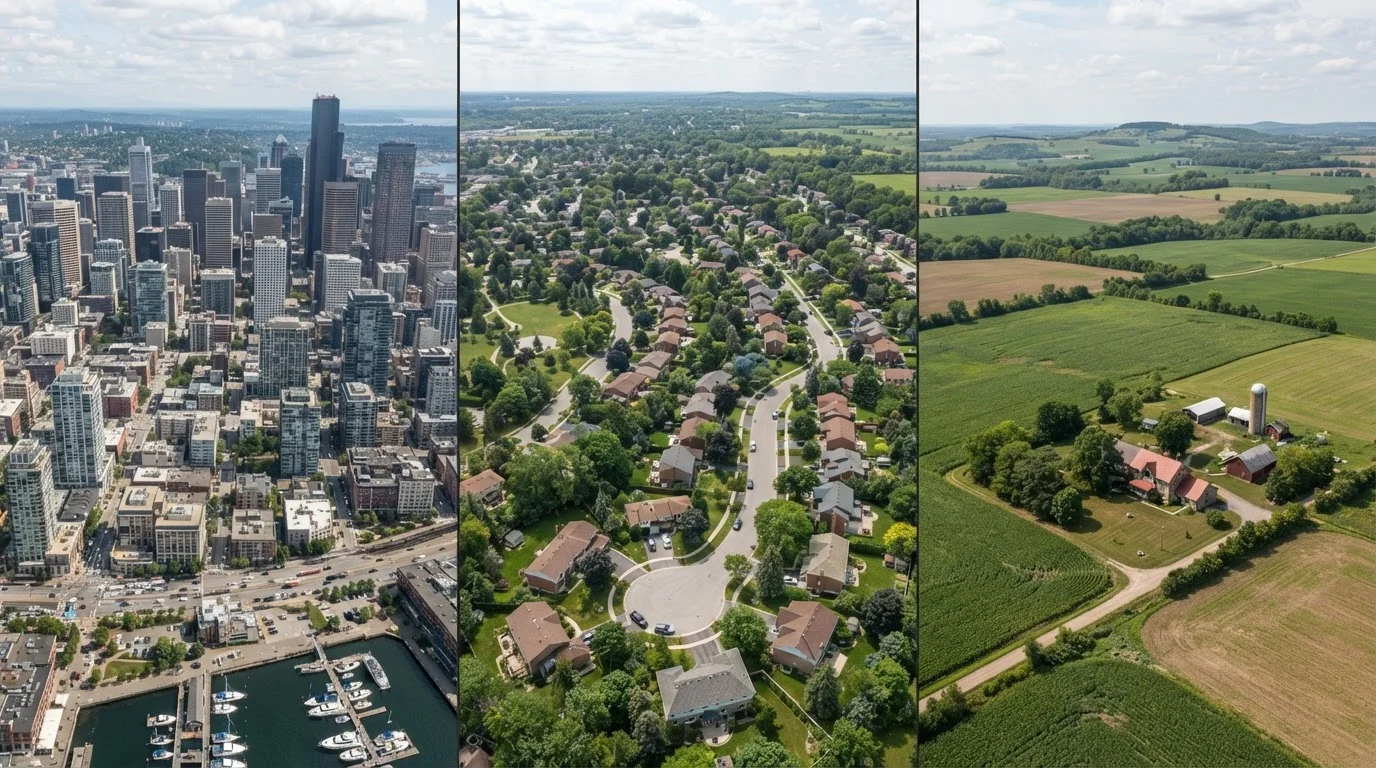
Where your home sits on the urban-to-rural spectrum affects more than your commute. It shapes how your property is priced, how quickly it sells, how much it costs to maintain, and how reliably it builds equity over time. As the forces that push values higher or lower make clear, location is rarely just one variable - it's a bundle of economic, demographic, and infrastructure factors that interact differently depending on density.
For current owners, the practical question isn't which setting is abstractly superior. It's how your location type affects your ongoing costs and your equity position, and what you can reasonably expect going forward.
| Urban | Suburban | Rural | |
|---|---|---|---|
| Typical price-per-sq-ft | Highest | Moderate | Lowest |
| Buyer pool / liquidity | Deep, faster sales | Broad, steady demand | Thin, longer time on market |
| Property tax burden | Often high | Varies by municipality | Generally lower |
| Infrastructure costs to owner | HOA/building fees common | Standard utilities, larger lots | Private well, septic, utilities |
| Appreciation pattern | Volatile, demand-driven | Steady, regionally tracked | Uneven, hyperlocal |
| Land component of value | Minimal per unit | Moderate lot value | Significant - often primary |
| Comparable sales availability | Abundant | Moderate to abundant | Scarce, wider variance |
Urban Properties: Density, Demand, and the Liquidity Premium
Urban real estate is typically defined by high density, proximity to employment centers, and robust transit infrastructure. These characteristics fuel demand, which historically supports strong price-per-square-foot figures - even as the actual square footage of individual units remains modest compared to suburban or rural homes.
For owners, the advantages include a deeper buyer pool when it's time to sell, making urban properties generally more liquid than those in lower-density markets. However, higher assessed values translate to higher property tax bills, and maintenance in older urban housing stock - common in many American cities - can be significant. Condo or co-op owners also face homeowner association or building fees that directly reduce the equity they retain.
Urban values can be highly sensitive to local economic conditions. Shifts in employment bases, transit investment, or neighborhood safety perceptions can move prices sharply. The neighborhood-level trends that shape perceived worth matter intensely in urban markets, where blocks - not zip codes - can define value boundaries.
Suburban Properties: The Infrastructure Advantage
Suburban markets have long attracted buyers seeking more interior and exterior space relative to price, combined with access to school districts, retail corridors, and highway networks. For current owners, this translates into a relatively stable demand base that tends to hold up across economic cycles better than highly specialized urban or rural markets.
Maintenance costs per square foot are often lower than in dense urban buildings, though larger lot sizes introduce their own upkeep demands - landscaping, driveways, and exterior systems that urban condo owners don't manage directly. Property taxes vary widely by municipality, and many suburban jurisdictions tie school funding to local tax revenue, which can support values in well-regarded districts while pressuring affordability.
Equity-building in the suburbs is often steadier rather than spectacular - appreciation tends to track broader regional economic health. Owners who invest in targeted improvements should be aware that many popular assumptions about what adds value don't hold up uniformly across all suburban contexts.
Rural Properties: Land Value, Thin Markets, and Long-Term Considerations
Rural properties typically offer the lowest price-per-acre entry point and the greatest land-to-structure ratio. For owners, land itself is a meaningful component of total property value - in some cases, more meaningful than the structure. Agricultural zoning, water rights, and timber value can all factor into what a rural parcel is ultimately worth.
The equity-building challenge in rural markets is liquidity. Buyer pools are narrower, meaning properties can sit on the market longer, and pricing is more sensitive to hyperlocal conditions with fewer comparable sales available for appraisers to reference. Understanding the difference between appraised, assessed, and market value - explained in depth in our guide to the three value numbers - is especially important in rural settings where those figures can diverge significantly.
Infrastructure costs are another material factor. Rural homeowners frequently manage private wells, septic systems, and longer utility runs, all of which require capital reserves for maintenance and eventual replacement. These ongoing costs, if underestimated, can quietly erode the equity gains that lower entry prices appeared to offer. Avoiding that outcome means being proactive - which connects directly to the common maintenance and upkeep errors that compound over time regardless of location type.
This article is intended for general informational and educational purposes only. It does not constitute personalized financial, legal, or real estate advice. Consult a licensed real estate professional familiar with your local market before making decisions about buying, selling, or improving your property.