

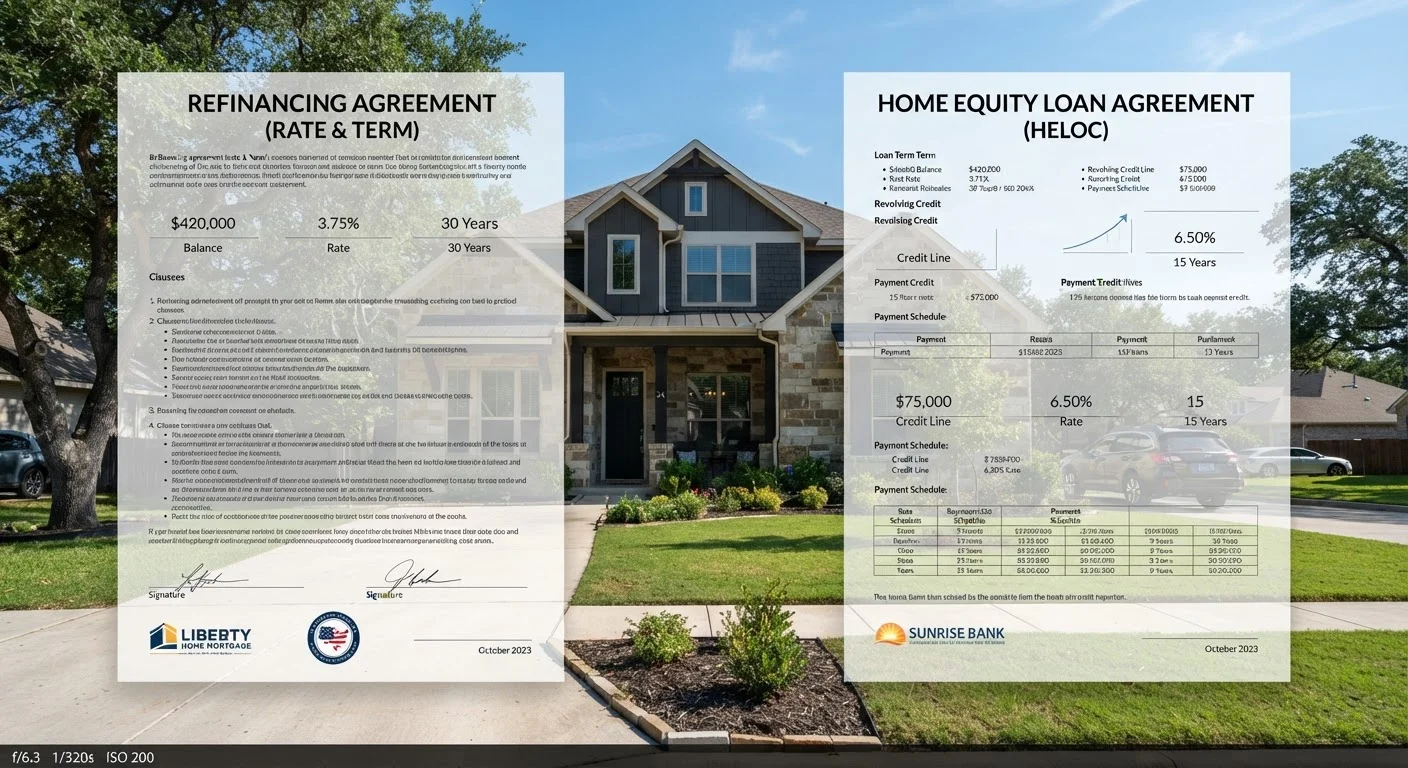
Key Takeaways
Option A
Cash-Out Refinance
Replace your existing mortgage with a larger one and pocket the difference.
Best for: Homeowners who can secure a lower interest rate than their current mortgage while also accessing equity.
Option B
Home Equity Loan
A separate second loan against your home's equity, leaving your first mortgage intact.
Best for: Homeowners who want a lump sum at a fixed rate without disturbing a favorable existing mortgage.
If your current mortgage rate is higher than today's rates
Cash-Out Refinance
Refinancing lets you lower your rate and access equity in one move, potentially reducing your monthly payment while funding your goal.
If you have a low-rate mortgage you don't want to give up
Home Equity Loan
A home equity loan lets you borrow against your equity without touching your existing favorable mortgage terms.
If you need a predictable, fixed monthly payment on the funds you borrow
Home Equity Loan
Home equity loans are typically fixed-rate and fixed-term, making budgeting straightforward and stable.
If you want to consolidate your debt into a single monthly payment
Cash-Out Refinance
Rolling all your debt into one refinanced mortgage simplifies your payment structure, though it extends the time your home secures that debt.
How Each Option Works
When homeowners build equity - either by paying down their mortgage principal or by benefiting from rising property values - that equity can be converted into cash. Two of the most common ways to do this are a cash-out refinance and a home equity loan. While both tap the same underlying resource, they function quite differently.
A cash-out refinance replaces your existing mortgage entirely with a new, larger loan. The difference between what you currently owe and the new loan amount is paid to you at closing. Your old mortgage is gone; you now have one new loan - ideally at a competitive interest rate - covering both your remaining balance and the cash you extracted.
A home equity loan, by contrast, sits on top of your existing mortgage. You keep your current loan exactly as it is and take out a separate second loan secured by your home's equity. You receive the funds as a lump sum and repay the home equity loan on its own fixed schedule. Because it's a secured form of debt, your home serves as collateral here just as it does with your primary mortgage.
| Criterion | Cash-Out Refinance | Home Equity Loan |
|---|---|---|
| Effect on existing mortgage | Replaces it entirely | Leaves it intact |
| Number of payments | One (new mortgage) | Two (original + second loan) |
| Typical interest rate | Generally lower (first-lien) | Generally higher (second-lien) |
| Loan term impact | Often resets loan term | Separate, shorter term |
| Closing costs | Applied to full new loan | Applied to second loan only |
| Rate structure | Fixed or adjustable | Typically fixed |
| Best rate environment | When rates are at or below your current rate | When your current rate is low |
Costs, Rates, and What You'll Actually Pay
Both products come with closing costs - typically ranging from 2% to 5% of the loan amount - so neither is a cost-free way to access your equity. For a cash-out refinance, those costs apply to the entire new loan balance, which is often substantial. For a home equity loan, closing costs apply only to the second loan amount, which may be meaningfully smaller.
Interest rates tell a different story. Because a cash-out refinance results in a first-lien mortgage - meaning that lender has first claim on your home if you default - rates are generally lower than those on a home equity loan, which holds a second-lien position. Lenders charge more for that added risk.
However, the rate comparison is only part of the picture. If you refinance a 30-year mortgage you've been paying for ten years, you may be resetting to another 30-year term. Even at a lower rate, paying interest over an extended period can mean you spend more in total than if you had kept your original mortgage and taken a home equity loan at a higher rate. Running a full amortization comparison - or working with a licensed mortgage professional - is essential before deciding. You may also find it useful to review how fixed and adjustable rate structures differ when evaluating your refinancing options.
2%-5%
Typical closing cost range for both products
Closing costs on mortgage-related products generally fall in this range as a percentage of the loan amount, according to Consumer Financial Protection Bureau guidance.
80%
Maximum combined loan-to-value most lenders allow
Most lenders cap total borrowing - primary mortgage plus equity loan - at around 80% of appraised home value, though some programs differ.
2nd lien
Home equity loan's claim position
Because a home equity loan holds a second-lien position behind the primary mortgage, lenders typically charge higher interest rates to compensate for greater default risk.
Risks Both Options Share - and Where They Diverge
The most important risk common to both products is this: your home is the collateral. If you cannot make payments - on either the refinanced mortgage or the home equity loan - you could face foreclosure. Tapping equity is not a risk-free transaction, and borrowing more than you can comfortably service is a genuine danger regardless of which structure you choose.
Beyond that shared risk, the two options diverge. With a cash-out refinance, you're consolidating all your mortgage debt into one payment, which can simplify your finances - but it also means the entire equity you extracted is now wrapped into your primary mortgage. Missing that single payment has serious implications.
With a home equity loan, you carry two separate obligations: your original mortgage payment and the home equity loan payment. That's more complexity each month, and if your income changes, managing two secured payments can be harder. On the positive side, if you already have a low-rate first mortgage, a home equity loan leaves it untouched - a meaningful advantage in a rising-rate environment.
Homeowners planning to stay in their property long-term should also consider how each option affects equity-building pace over time. Resetting a mortgage to a longer term slows the rate at which you accumulate equity. For a deeper look at how long-term ownership affects your financial position, see our article on owning a home longer than you planned.
This article is for general informational purposes only and does not constitute personalized financial, tax, or legal advice. Mortgage products, rates, and terms vary by lender and borrower circumstances. Consult a licensed mortgage professional or financial adviser before making decisions about your home equity.