

Key Takeaways
Option A
Fixed-Rate Mortgage
The predictable, set-it-and-forget-it home loan.
Best for: Buyers who plan to stay in their home long-term and want consistent monthly payments regardless of market shifts.
Option B
Adjustable-Rate Mortgage (ARM)
The flexible loan that starts lower but carries future uncertainty.
Best for: Buyers who expect to sell or refinance within a few years and want to take advantage of a lower initial interest rate.
If you plan to own the home for 10 or more years
Fixed-Rate Mortgage
Locking in your rate eliminates the risk of payment increases over time, making long-term budgeting far more reliable.
If you expect to sell or refinance within 5-7 years
Adjustable-Rate Mortgage (ARM)
A 5/1 or 7/1 ARM lets you benefit from the lower initial rate while you're in the home, before adjustments begin.
If you're a first-time buyer on a tight monthly budget
Fixed-Rate Mortgage
Predictable payments reduce financial stress and make it easier to plan around other household expenses month to month.
If you anticipate a significant income increase in coming years
Adjustable-Rate Mortgage (ARM)
You can absorb potential rate increases later while benefiting from lower payments now during a tighter financial period.
How Each Mortgage Structure Works
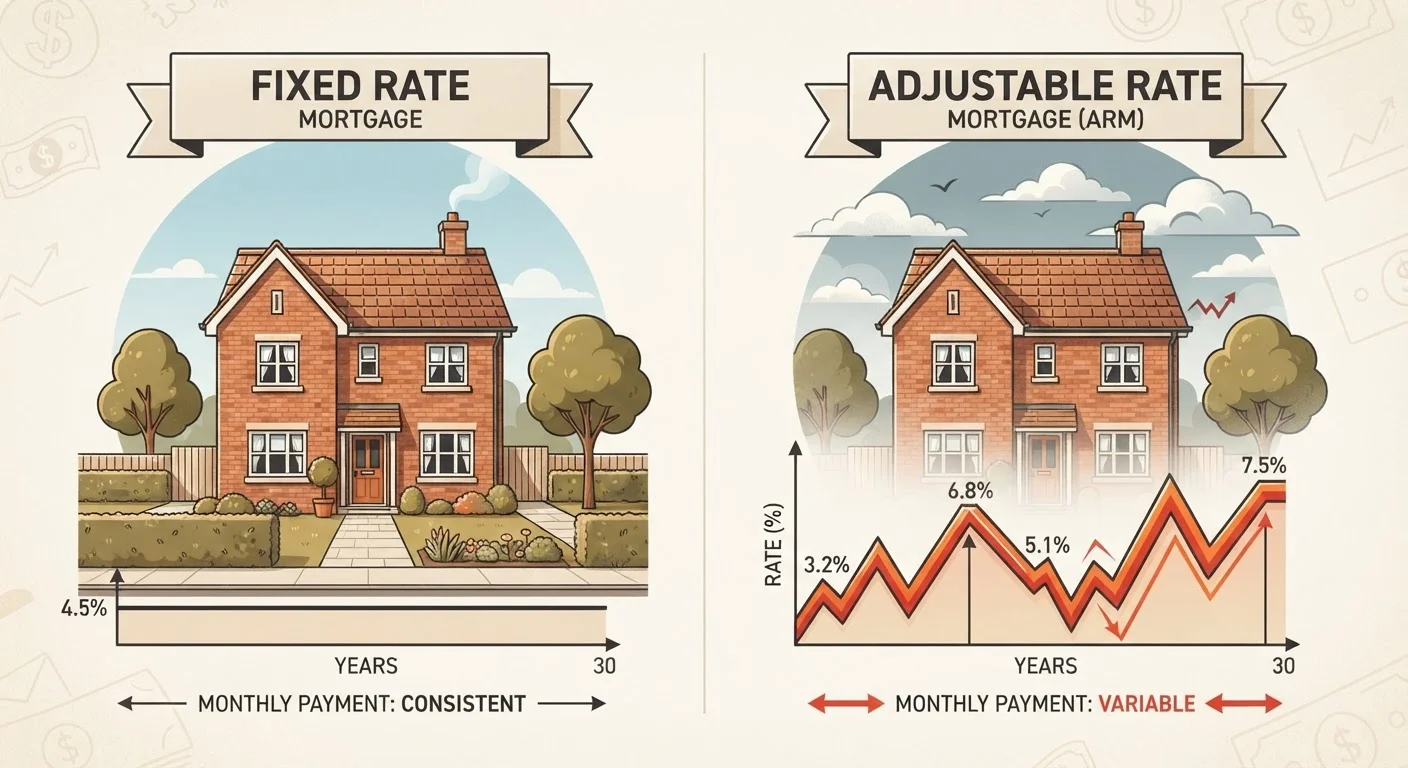
A fixed-rate mortgage carries an interest rate that never changes. Whether you borrow for 15 years or 30, the rate - and therefore the principal-and-interest portion of your payment - stays the same from month one to the final payment. Lenders price fixed-rate loans based on long-term bond market rates, primarily the 10-year U.S. Treasury yield.
An adjustable-rate mortgage (ARM) works differently. It begins with a fixed introductory period - commonly 5, 7, or 10 years - during which the rate is locked. After that window closes, the rate adjusts periodically (typically once per year) based on a benchmark index, such as the Secured Overnight Financing Rate (SOFR), plus a set margin determined by the lender. A "5/1 ARM" means 5 years fixed, then annual adjustments.
ARMs include rate caps that limit how much the interest rate can change at each adjustment and over the life of the loan - but even capped increases can substantially raise your monthly payment. Understanding those caps is essential before signing. For a broader look at how your loan type interacts with rate structure, see our guide to FHA, VA, USDA, and conventional loans.
| Criterion | Fixed-Rate Mortgage | Adjustable-Rate Mortgage (ARM) |
|---|---|---|
| Interest Rate | Locked for entire loan term | Fixed initially, then adjusts periodically |
| Initial Monthly Payment | Higher (reflects long-term risk premium) | Lower during introductory period |
| Payment Predictability | Fully predictable | Uncertain after fixed period ends |
| Rate Risk | None after closing | Can rise or fall with market index |
| Best Loan Horizon | Long-term ownership (10+ years) | Short-to-medium term (5-7 years) |
| Complexity | Simple and straightforward | Requires understanding caps, indexes, margins |
| Refinancing Incentive | Only if rates fall significantly | Often considered before first adjustment |
The Cost Trade-Off Over Time
In a typical rate environment, ARMs open with a lower interest rate than comparable fixed-rate loans - sometimes by a full percentage point or more. On a $400,000 loan, that gap can translate to hundreds of dollars less per month during the introductory period. That's a real short-term advantage.
The long-term picture is less clear. If market rates rise after the fixed period ends, your ARM payment climbs with them. Over a 30-year horizon, a borrower who stays in the home could end up paying considerably more than someone who locked in a fixed rate from day one - though the reverse is also possible if rates fall. Past interest rate trends are not a reliable guide to future movements.
Fixed-rate borrowers pay a premium for certainty. Their rate is typically higher at origination, but they're insulated from whatever happens in financial markets over the following decades. For context on how rate environments affect housing more broadly, our explainer on how interest rates shape what homes are worth lays out the relationship clearly.
It's also worth noting that budgeting for a mortgage isn't just about the rate. Property taxes, insurance, and maintenance costs are all variable - which connects to the broader principle of distinguishing fixed versus variable expenses in any household budget.
Key Risk Factors to Weigh
The central risk with an ARM is payment shock - the sudden, sometimes steep increase in your monthly obligation when the rate adjusts upward. Even with caps in place, a borrower whose rate climbs from 5% to 8% over several adjustment periods faces a meaningfully different payment than the one they started with. Before choosing an ARM, model out what your payment would look like at the maximum allowable rate.
Fixed-rate mortgages carry their own form of risk: opportunity cost. If you lock in a high rate and rates fall substantially later, you're paying more than necessary - unless you refinance, which involves closing costs and qualification requirements all over again. Our article on refinancing vs. home equity loans walks through when tapping your equity makes sense.
One often-overlooked risk factor: your own timeline. If there's a real chance you'll relocate within five years, locking into a 30-year fixed rate may cost you more in early-period interest compared to an ARM that front-loads lower payments while you're actually in the home.
Understanding ARM Rate Caps
ARMs typically include three types of caps: an initial cap (limits how much the rate can change at the first adjustment), a periodic cap (limits changes at each subsequent adjustment), and a lifetime cap (the maximum the rate can ever rise above the starting rate). For example, a 2/2/5 cap structure means the rate can rise no more than 2% at first adjustment, 2% at each later adjustment, and no more than 5% total over the life of the loan. Always ask your lender to walk through the worst-case scenario before committing.
This article is for general informational purposes only and does not constitute personalized financial or mortgage advice. Consult a licensed mortgage professional or financial adviser for guidance specific to your situation.