

Key Takeaways
Savings Buckets
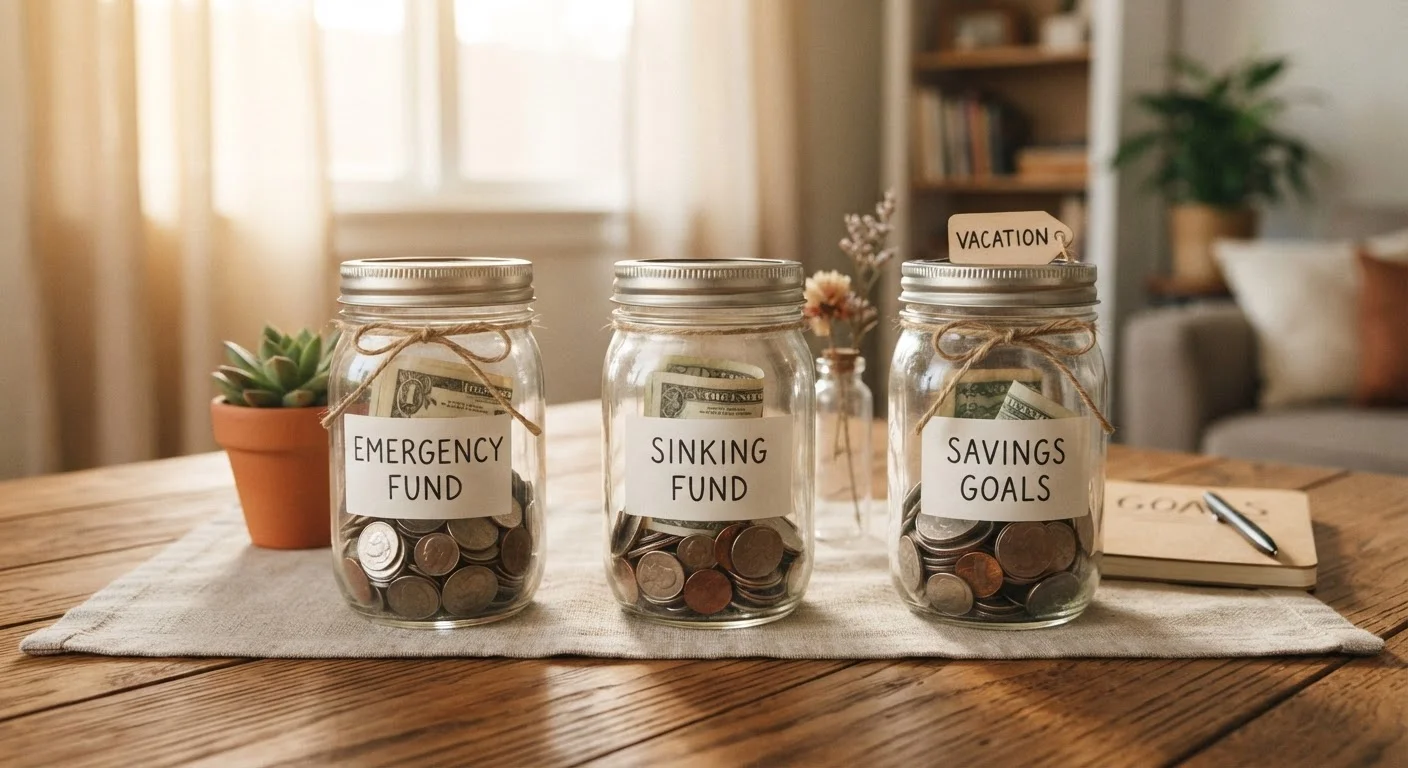
A "savings bucket" is a designated pool of money set aside for a specific purpose within your budget. Most personal finance frameworks distinguish three core buckets: an emergency fund for unexpected crises, sinking funds for planned future expenses, and savings goals for longer-term aspirations. Each serves a different function and should be treated separately.
In practice, these buckets can live in the same high-yield savings account or in separate sub-accounts - what matters is that the mental (or actual) separation is maintained so funds are not accidentally commingled.
Why Savings Needs More Than One Purpose
Many budgeters treat savings as a single category - a pile of money that sits in reserve for whenever it's needed. But lumping all savings together creates a hidden problem: when an unexpected car repair hits, it drains the same account you were building for a family vacation or a home down payment. Without clear separation, every financial disruption feels like a setback to every goal.
The solution is to think in buckets: distinct categories of savings, each with its own purpose, target amount, and timeline. This isn't just an organizational trick - it's a foundational principle of effective budgeting. As part of any solid budget structure, understanding how these buckets differ helps you make deliberate choices about where each dollar goes. For a broader look at how savings fits alongside spending categories, see how needs, wants, and savings interact in a budget.
The Emergency Fund: Your Financial Safety Net
An emergency fund is money reserved exclusively for genuine, unexpected financial shocks - a sudden job loss, an urgent medical expense, or a major home repair that can't wait. The defining characteristic is that it is not for expenses you could have anticipated. Touching it for a known annual cost, like car registration, defeats its purpose.
Because an emergency fund must be available at a moment's notice, it's typically held in a liquid account - one where you can access the money quickly without penalties. The goal is stability and accessibility, not growth.
~57%
Americans who cannot cover a $1,000 emergency from savings
According to Bankrate's annual emergency savings report, a majority of U.S. adults would need to borrow or use credit to cover an unexpected $1,000 expense.
3-6 months
Recommended emergency fund coverage of essential expenses
Most financial educators and consumer finance organizations cite three to six months of essential living expenses as a general target for emergency fund size.
1 in 3
U.S. adults with no dedicated emergency savings
Federal Reserve survey data has consistently shown a significant share of American households report having no dedicated rainy-day or emergency savings.
Financial educators broadly recommend building an emergency fund before directing money toward other savings goals or investments. The logic is straightforward: without a buffer, a single bad month can force you into debt. For a deeper look at how the emergency fund fits into the broader saving-versus-investing conversation, see when to prioritize an emergency fund over investing.
Sinking Funds: Planning for the Predictable
A sinking fund is savings set aside in regular, small increments for a specific expense you know is coming - even if the exact date is months away. Common examples include holiday gifts, annual insurance premiums, a new set of tires, or quarterly property taxes. These costs aren't emergencies; they're simply irregular, meaning they don't arrive every month and can catch budget-keepers off guard if not planned for.
The mechanics are simple: divide the total expected cost by the number of months until you need it, and set that amount aside each month. If you expect to spend $600 on holiday gifts in December, saving $50 a month from January onward means the money is already there when you need it.
Sinking funds are a practical extension of understanding your fixed and variable expenses - many variable expenses that feel unpredictable are actually foreseeable with a little planning.
Savings Goals: Building Toward a Milestone
A savings goal is money earmarked for a specific future milestone that is larger or longer-term than a typical sinking fund target. Common examples include saving for a home down payment, a major trip, a vehicle purchase, or funding a child's education. The timeline can range from one year to several years, and the target amount is typically significant enough that it can't come from a single paycheck.
Unlike the emergency fund - which you hope never to touch - a savings goal has a clear, positive endpoint. And unlike a sinking fund, which covers a recurring or near-term known cost, a savings goal often requires consistent monthly contributions over a longer stretch of time.
For those working toward homeownership, understanding how much you'll need is an important first step - down payment requirements vary more than many buyers expect. Once a savings goal grows large enough and the timeline permits, some savers explore whether keeping those funds in an investment account makes sense - a decision best made with guidance from a qualified financial professional.
This article is for general informational and educational purposes only. It does not constitute personalised financial, tax, or investment advice. Please consult a qualified financial adviser for guidance tailored to your individual circumstances.