

Key Takeaways
Our Verdict
For most Americans, building at least a starter emergency fund before investing is sound financial practice-it prevents a market downturn or unexpected expense from forcing poorly-timed withdrawals. However, the decision is rarely black and white. Employer match opportunities, high-interest debt, and income stability all create legitimate reasons to adjust the order or do both at once.
| Best for | Recommended |
|---|---|
| Those with no emergency savings and unpredictable income | Emergency fund first |
| Those with employer 401(k) matching and a small starter cushion | Invest up to the match, then build the emergency fund |
| Those with stable income and partial emergency savings | Split contributions between both goals simultaneously |
| Those carrying high-interest debt alongside no savings | Address high-interest debt and starter fund before investing broadly |
Why the Standard Advice Exists
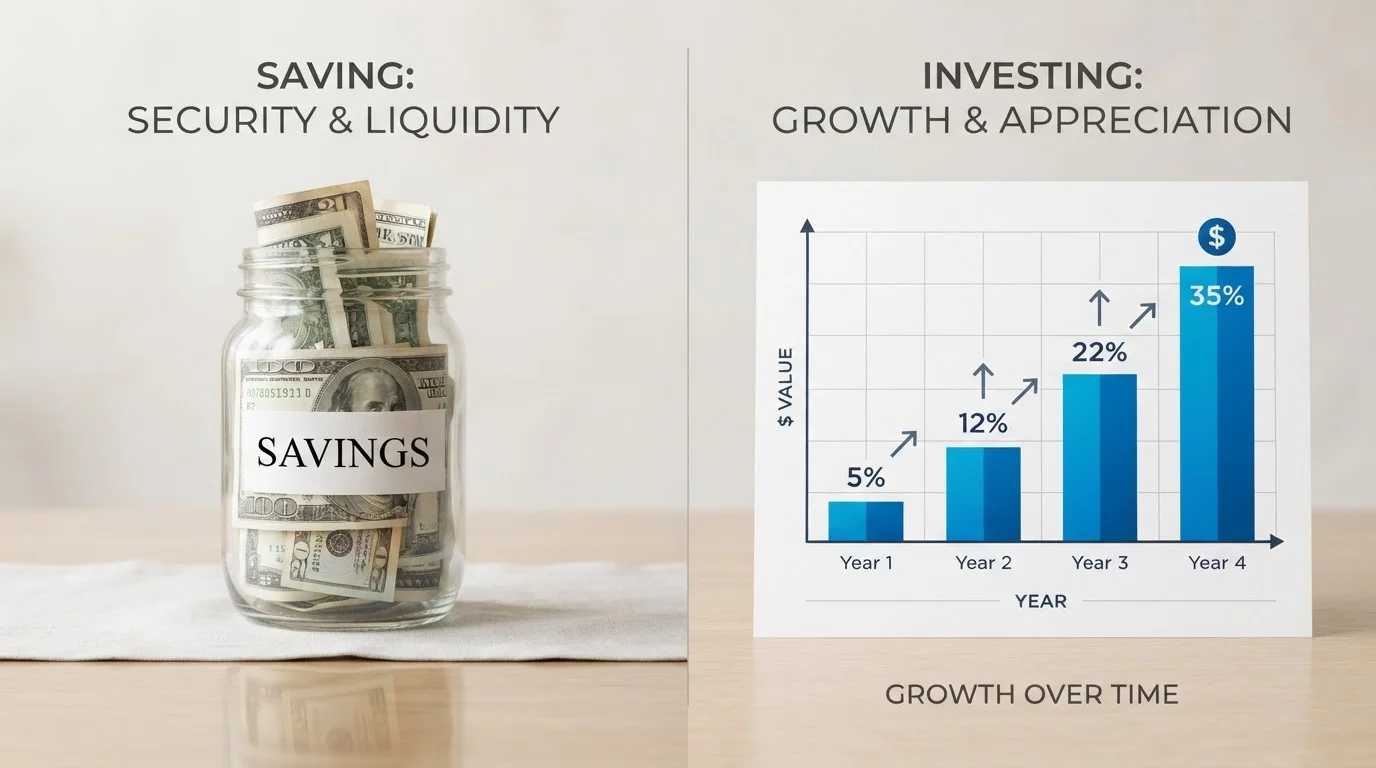
Personal finance educators have long recommended building an emergency fund-typically three to six months of essential living expenses-before directing money toward investments. The logic is straightforward: investments held in market accounts can lose value in the short term, and if a medical bill, job loss, or major repair forces you to sell at the wrong moment, you crystallize those losses. A cash reserve held in a savings account acts as a firewall.
Without that buffer, even a well-constructed investment portfolio can become a liability. Selling stocks or funds during a downturn to cover an emergency is one of the most damaging financial moves a new investor can make. The emergency fund prevents that scenario entirely. It also reduces the psychological pressure that makes people panic-sell during volatile markets.
If you're still working out how much you actually spend each month, building a personal budget first is a natural starting point-knowing your monthly essential expenses is required to set an accurate emergency fund target.
Where the Advice Gets Complicated
The clean rule breaks down in a few common situations. The most significant exception involves employer-sponsored retirement plans that offer matching contributions. If your employer matches, say, 3% of your salary into a 401(k) and you don't contribute at least that amount, you're leaving compensation on the table. That match is an immediate 50%-100% return on your contribution-a benefit no savings account can match. Many financial educators argue that capturing the full employer match takes priority even before the emergency fund is fully funded.
A second complication is high-interest debt. Carrying a balance on a credit card charging 20%+ interest while simultaneously building a savings account earning 4%-5% is a mathematical disadvantage. In this scenario, aggressively paying down high-interest debt often makes more financial sense than investing-though a small starter emergency fund (commonly cited as $1,000) is still worth establishing first to avoid turning every minor setback into new debt.
| Emergency Fund First | Invest First (Match Only) | Split Contributions | Pay Down High-Interest Debt First | |
|---|---|---|---|---|
| Best suited for | Unpredictable income, no savings | Stable income with employer match | Stable income, small cushion in place | High-interest debt holders |
| Risk of forced investment withdrawal | Low - buffer protects investments | Moderate - limited cash reserve | Low to moderate | Low if debt is cleared first |
| Opportunity cost | Delays compounding growth | Captures guaranteed employer return | Balanced - grows both simultaneously | Eliminates guaranteed high-interest drag |
| Time to first investment | Months to years depending on income | Immediate (up to match) | Immediate (partial) | After debt paydown milestone |
| Complexity | Simple, clear priority order | Moderate - requires plan enrollment | Requires budgeting discipline | Moderate - juggling multiple goals |
| Psychological benefit | High security and peace of mind | Motivation from employer reward | Progress on both fronts | Reduces debt stress significantly |
Income stability is another factor. A freelancer or gig worker with variable monthly income faces more unpredictability than a salaried employee with benefits. That asymmetry makes a larger cash cushion more important before taking on investment risk. See how emergency funds fit alongside other savings goals for a fuller picture of how these buckets interact.
The Case for Doing Both Simultaneously
A middle path-splitting available dollars between an emergency fund and investments at the same time-works well for people with stable incomes and at least a modest starter cushion already in place. Rather than delaying all investing until a full six-month fund is built (which could take years on a modest income), you allocate, for example, 60% of monthly savings to the emergency fund and 40% to a retirement account.
This approach acknowledges a real opportunity cost: markets have historically rewarded long-term participants, and time in the market matters. Delaying all investment contributions for two or three years to build a cash reserve means forgoing that period of potential compounding. Past performance does not guarantee future results, but the general principle-that earlier, sustained contributions tend to produce better long-term outcomes-is widely supported in financial literature.
Before committing to any approach, it's worth reviewing key questions to ask before making your first investment, including your time horizon and risk tolerance. And if the idea of investing still feels out of reach, starting from a modest position is more achievable than most people assume.
This article is for general informational and educational purposes only and does not constitute personalised financial, investment, or tax advice. Please consult a qualified financial professional regarding decisions specific to your own circumstances.