

Key Takeaways
Visa-on-Arrival
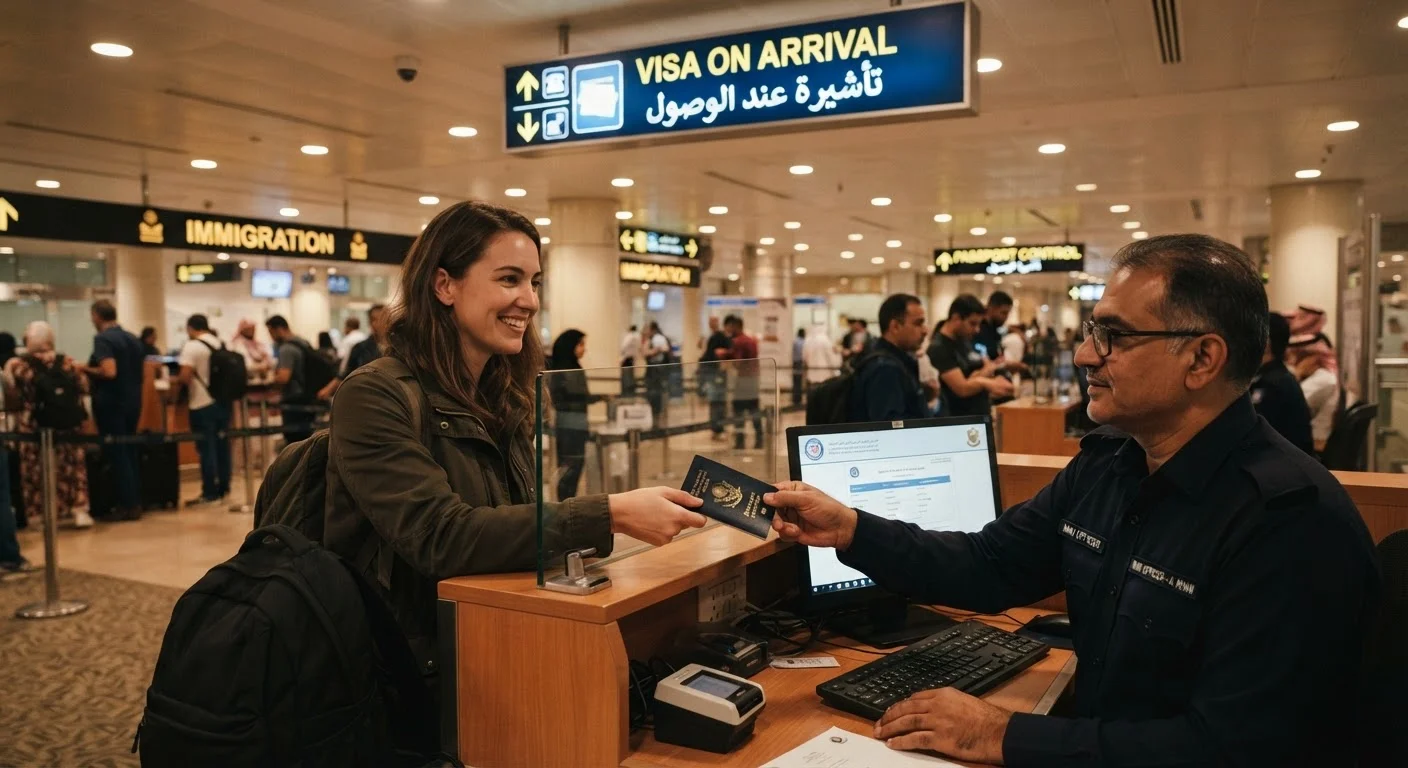
A visa-on-arrival (VOA) is a travel authorization you receive at your destination country's port of entry - typically an international airport - rather than applying in advance through an embassy or consulate. You present your passport, fill out a brief form, pay a fee, and receive a stamp or sticker permitting a defined stay. Not every nationality qualifies at every destination, so eligibility always needs to be confirmed before travel.
Visa-on-arrival is legally distinct from visa-free entry, where no documentation is issued at all, and from an eVisa, which is pre-approved online before departure.
What Actually Happens at the Visa-on-Arrival Counter
Picture this: you've just landed in Bangkok or Bali after a long flight. Instead of heading straight to the regular immigration line, you follow signs for the visa-on-arrival lane. You collect a form from a rack near the counter, fill in your name, passport number, local address, and purpose of visit. You hand over your passport, the completed form, a passport photo (smart travelers keep a couple in their carry-on), and pay the fee - often in U.S. dollars or the local currency. A few minutes later, you walk away with a stamp authorizing your stay.
That's the basic shape of the process, but the details matter enormously. Processing times can vary from a few minutes to over an hour depending on arrival volume, staffing, and the specific airport. Peak travel seasons - major holidays and popular festival periods - can mean longer waits at VOA counters. Building buffer time into your itinerary is simply good planning.
Navigating international airports is its own skill set, and the VOA counter is just one of several friction points worth knowing about before you land.
Who Qualifies - and Why It's Not Always Obvious
American passport holders enjoy relatively broad VOA access globally, but "relatively broad" doesn't mean universal. Countries set their own eligibility rules based on diplomatic agreements, reciprocity, and bilateral relations. A country that welcomes American travelers on VOA today may revise that policy tomorrow.
Common destinations where U.S. passport holders have historically been eligible for VOA include Thailand, Indonesia (Bali), Jordan, Nepal, Cambodia, and several others across Southeast Asia, the Middle East, and beyond. But eligibility is not a permanent status - it should be confirmed each time you plan a trip.
eVisa vs. Visa-on-Arrival: Know the Difference
An eVisa requires you to apply online and receive approval before you travel - it's not the same as VOA even though both sound like simplified options. Some countries have phased out VOA entirely in favor of mandatory eVisa systems. Check which system your destination uses well before your departure date, not at the gate.
There's also an important distinction between VOA and an eVisa. An eVisa is applied for online before you travel, is pre-approved, and lets you go straight to a standard immigration line on arrival. Some destinations have replaced their VOA programs with eVisa systems entirely. Always check which option applies to your destination so you're not caught off guard.
See what entry requirements actually mean for a broader look at how to read and verify the rules before booking.
What You Need to Bring - Don't Leave This to Chance
Even though you're not pre-applying, VOA countries still have requirements you must meet on arrival. Failing to bring the right documents can result in denial of the visa - and potentially being sent back on the next flight at your own expense.
- Passport validity: Most countries require at least six months of remaining validity beyond your intended stay. A passport expiring in three months is a problem even if your trip is only two weeks long.
- Passport-sized photos: Many VOA counters require one or two recent photos. Some airports have photo booths available, but relying on them adds stress and time.
- Exact fee in accepted currency: Research the current fee before departure. USD is widely accepted at many VOA counters, but not universally. Some counters don't give change and may not accept cards.
- Proof of onward travel: A printed or digital return ticket demonstrates you don't intend to overstay. Some officers ask to see it; some don't - but have it ready.
- Accommodation details: A hotel booking confirmation or local address for your first night is commonly requested.
186
Countries accessible to U.S. passport holders
According to the Henley Passport Index, the U.S. passport consistently provides access to over 180 destinations including visa-free, visa-on-arrival, and eVisa options.
6 months
Passport validity commonly required beyond stay
Many countries - particularly those with VOA programs - require a passport valid for at least six months beyond the traveler's planned departure date.
Varies widely
VOA fees by country (USD equivalent)
VOA fees range from roughly $20 to over $100 USD depending on the destination and visa duration; always check the current official fee before departure.
For first-time international travelers, these details can feel overwhelming. Our guide to your first international trip covers the bigger picture of what to expect before and after you land.
Always Verify Before You Fly
This cannot be stated plainly enough: visa rules change. Policies that were in effect when a friend traveled two years ago, or when a travel blog was published last spring, may not reflect current reality. Entry requirements are a living set of rules, not a static list.
The most reliable sources are the official immigration or foreign affairs websites of your destination country and the U.S. Department of State's country-specific travel pages at travel.state.gov. Both should be checked close to your departure date - not just at the time of booking.
If you're building a complex multi-country itinerary, the VOA rules for each stop need individual attention. International trip planning has meaningful layers that domestic travel simply doesn't, and entry requirements are one of the most consequential.
This article provides general educational information about visa-on-arrival processes. Entry rules, fees, and eligibility change frequently. Always verify current requirements with the official immigration authority of your destination country and the U.S. Department of State before traveling.