

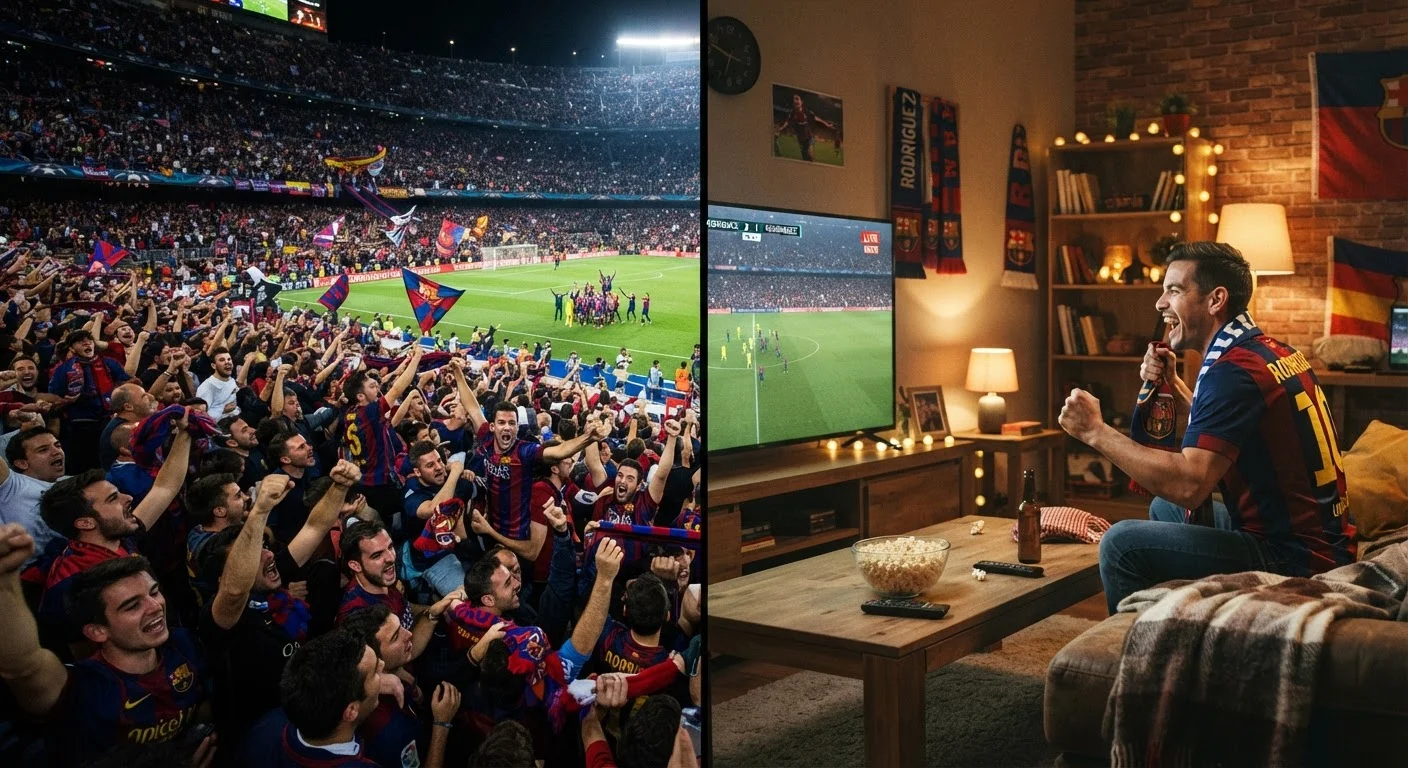
Key Takeaways
Option A
Stadium Fan
The immersive, all-senses-on experience.
Best for: Fans craving atmosphere, tradition, and the electric charge of being physically present for big moments.
Option B
Couch Fan
The informed, comfortable, and flexible option.
Best for: Fans who want in-depth coverage, multiple games, and the freedom to watch on their own terms.
If you want to feel part of something larger than yourself
Stadium Fan
The collective roar of tens of thousands of fans creates an emotional charge that no living room speaker system can reproduce. It's a shared physical experience unlike any other.
If you follow multiple teams or want deep statistical coverage
Couch Fan
Broadcast packages, split-screen options, and real-time stats make home viewing the smarter choice for fans who track the bigger league picture.
If you're attending a marquee event or rivalry game
Stadium Fan
Playoff games, rivalry matchups, and championship bids are the moments that define fandom memories - being there in person elevates the stakes further.
If budget or accessibility is a real concern
Couch Fan
With premium ticket prices and add-on costs for parking and concessions, live attendance can be prohibitive. Home viewing delivers the full game at a fraction of the cost.
If you want to build a lasting family or group tradition
Couch Fan
Consistent home rituals - same snacks, same seats on the couch, same pregame show - can anchor deep bonds over a lifetime of fandom. See our guide to building game day traditions for ideas.
What Each Experience Actually Feels Like
Walk into a sold-out stadium and the atmosphere hits you before you even find your seat. The rumble of crowd noise, the smell of grilled food, the visual spectacle of 60,000 people wearing the same colors - none of that translates through a screen. Stadium fandom is a full-body experience. When your team scores, the sound doesn't just enter your ears; it moves through you.
Home viewing trades visceral intensity for something different: clarity. Broadcasters offer instant replay, slow-motion breakdowns, and expert commentary that gives context to every big play. A couch fan watching a fourth-quarter comeback can pause, rewind, and actually understand the defensive scheme that broke down - something a stadium fan three hundred feet from the action simply can't do. Both perspectives on the same game are genuinely richer for what they offer.
For a first-timer curious about stadium culture, what to expect at your first live game is worth reading before you go.
| Criterion | Stadium Fan | Couch Fan |
|---|---|---|
| Atmosphere | Unmatched, electric energy | Subdued; dependent on setup |
| Replay & Analysis | None in real time | Instant replay, commentary |
| Average Cost | High (tickets, parking, food) | Low (streaming or cable) |
| Comfort | Variable; weather-dependent | High; fully controlled |
| Access to Multiple Games | One game only | Multiple simultaneously |
| Community Feel | Physical, immediate | Digital, watch-party-based |
| Spontaneity | Requires planning ahead | Turn it on anytime |
The Real Costs and Trade-Offs
The financial gap between the two experiences is significant. Across major American sports leagues, average ticket prices have risen considerably over the past two decades, and that's before factoring in parking, concessions, and team merchandise. A family of four attending an NFL game can spend several hundred dollars in a single afternoon - and that's for regular-season tickets, not playoffs.
Home viewing, by contrast, offers access to nearly every game for a fraction of that amount through cable, streaming, or sports packages. That accessibility has real value, especially for fans who follow a team through a full 162-game MLB season or an 82-game NBA schedule. You simply cannot attend every game - and you probably wouldn't want to.
Time is another cost. Live attendance demands travel, arrival windows, and post-game traffic. The couch fan can flip between the Sunday Night game and a West Coast late game without leaving the living room. For fans who follow multiple leagues and franchises, that flexibility matters.
$151
Average NFL ticket resale price
According to StubHub data compiled in recent seasons, the average NFL ticket resale price has consistently exceeded $150, making it one of the most expensive live sports in the country.
65%
Fans who prefer watching at home
A Seton Hall Sports Poll found that roughly two-thirds of American sports fans prefer watching games at home over attending in person, citing cost and convenience as key factors.
82
Regular-season NBA games per team
With 82 regular-season games in an NBA schedule, it's physically and financially impossible for most fans to attend more than a handful - making home viewing the primary medium for most supporters.
Ritual, Community, and What Makes It Meaningful
The best arguments for stadium fandom aren't logistical - they're emotional. Sports fandom is fundamentally about belonging, and stadiums are among the few places in modern life where strangers become temporary family over a shared outcome. The chants, the synchronized crowd reactions, the superstitions passed down through sections of loyal season-ticket holders - this is where sports tradition lives most vividly.
But couch fandom has built its own rich culture. Fantasy leagues, watch parties, social media commentary, and fan forums have created digital communities that feel genuinely connected. How social media reshaped the sports viewing experience traces just how deeply these online spaces have redefined what it means to be a fan together.
Your relationship with both settings is also likely to shift over time. A college student might catch every home game; a parent of young kids might go years watching almost exclusively from home. That evolution is natural. As explored in the reflection on how fan identity changes over a lifetime, devotion doesn't require a particular setting - it endures across both.