

Key Takeaways
Why Product Claims Are Built to Impress, Not Inform
Every product on a store shelf - physical or digital - arrives wearing a costume of carefully chosen words. Phrases like "clinically tested," "up to 3x more effective," or "the last you'll ever need" are designed by professional copywriters and marketing teams whose job is conversion, not disclosure. That doesn't make every claim a lie, but it does mean the language is optimized for persuasion rather than accuracy.
The Federal Trade Commission (FTC) regulates deceptive advertising in the United States, but enforcement is reactive and limited. Many misleading claims occupy legal gray zones - technically defensible, practically confusing. Learning to decode them is one of the most durable consumer skills you can develop. For a structured approach to evaluating any purchase, see our pre-purchase evaluation checklist.
Unqualified Superlatives
Words like "advanced," "superior," "premium," and "professional-grade" appear on products across every price point and category. They sound evaluative but are legally considered "puffery" - subjective promotional language that no regulatory body requires to be substantiated. A $12 kitchen sponge labeled "advanced cleaning technology" has made exactly zero verifiable promises.
The tell: if a superlative has no benchmark (compared to what? tested how? by whom?), it conveys brand intent, not product fact.
Superlatives without benchmarks describe a brand's ambition, not a product's performance.
"Up To" Statistics
"Save up to 40%." "Lasts up to 200 washes." "Up to 3x faster." The phrase "up to" sets a ceiling, not a floor. Under ideal, controlled, or cherry-picked conditions, the claim may be technically accurate - but typical real-world results are under no obligation to approach that number.
The FTC has scrutinized "up to" claims in specific categories, particularly energy savings and internet speeds, but the construction remains widespread. Whenever you see it, mentally replace "up to" with "in the best possible scenario."
"Up to" defines the ceiling of performance, not what most users will actually experience.
Selectively Cited Studies
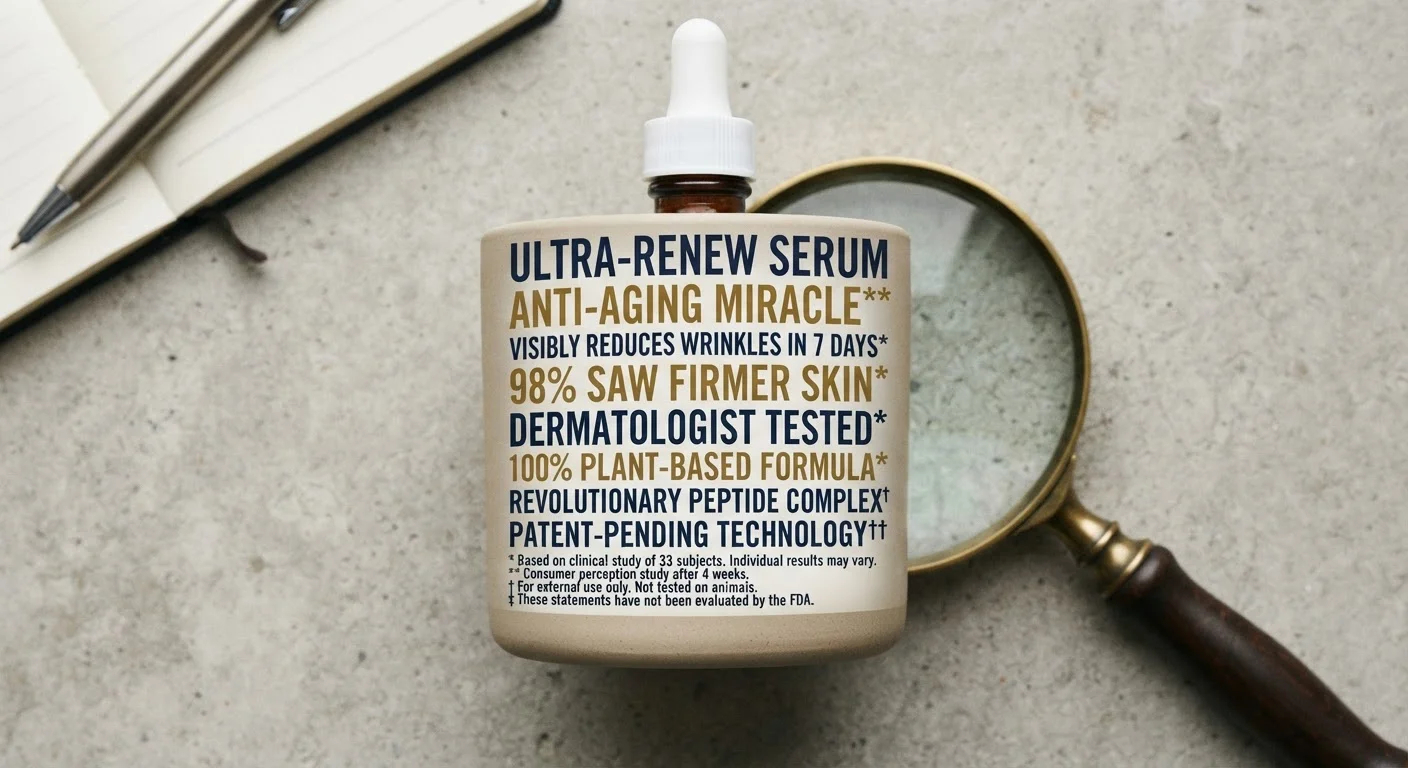
"Clinically tested," "dermatologist recommended," and "studies show" are phrases that borrow scientific authority without necessarily earning it. Key questions: Who conducted the study? Was it peer-reviewed and published independently, or conducted by the manufacturer? How large was the sample? What was the comparison group?
A study of 30 participants, funded by the brand, with no control group, comparing the product to doing nothing - technically qualifies as a "clinical test." The claim isn't false; the framing is misleading. This same dynamic applies to evaluating durability claims, where testing standards vary enormously.
Brand-funded studies with no independent replication should be treated as preliminary signals, not proof.
Invented or Unverifiable Certifications
Seals, badges, and "certified" language carry significant psychological weight. Shoppers tend to trust visual emblems - but many are self-issued or come from organizations with no meaningful accreditation process. A brand can legally create its own certification program, design a seal, and award it to its own products.
Legitimate certifications typically have a verifiable issuing body, publicly documented testing criteria, and third-party auditing. If a certification seal isn't immediately searchable with a clear issuing organization, treat it skeptically.
Many certification seals are self-issued; a legitimate one links to a verifiable, independent issuing body.
Implied Endorsements
"As seen in [publication]" or "featured on [platform]" does not mean the publication reviewed and recommended the product - it may mean the brand placed an advertisement, or a journalist mentioned it once in passing. Similarly, a celebrity's image on packaging does not confirm they personally use or endorse it unless that relationship is explicitly disclosed.
Under FTC endorsement guidelines, paid endorsements must be disclosed, but the line between editorial mention and advertising is often deliberately blurred in marketing materials. This connects to a broader issue covered in our piece on trusting brand reputation over product evidence.
Media appearances are not media endorsements - always distinguish editorial coverage from paid placement.
The Omission Strategy
Perhaps the most effective misleading claim involves what isn't said. A product may advertise that it contains "no artificial preservatives" while still including high sodium levels, refined sugars, or synthetic additives in other forms. A cleaning product might be "plant-based" in its primary ingredient but contain petroleum-derived compounds in others.
Incomplete truth is still incomplete. When a claim highlights one attribute prominently, it's worth asking what the full picture looks like - often found in the fine print, ingredient list, or independent reviews rather than the front of the package.
A claim that highlights one attribute while omitting others can be technically accurate and practically misleading.
Putting It All Together
Misleading product claims rarely involve outright fabrication - they work through selective framing, borrowed authority, and language designed to feel meaningful without committing to anything measurable. Once you recognize these patterns, you'll spot them across categories, from cleaning supplies to electronics to wellness products.
A useful habit: when a claim catches your attention, ask what it would need to prove to be meaningful - and then check whether that proof exists anywhere outside the brand's own materials. Independent testing, consumer watchdog organizations, and verified user reviews are far more informative than packaging copy. See our guide to reading online reviews without getting manipulated for practical approaches to filtering signal from noise.
Also worth remembering: a persuasive claim on the front of the box says nothing about total cost of ownership. Hidden costs built into product ownership - consumables, proprietary parts, subscription tiers - often dwarf the sticker price. And for a broader framework on evaluating any product like a pro, from claims to materials to pricing, that guide covers the full picture.
Build a Quick Verification Habit
Before giving weight to any product claim, run a two-step check: search for the claim plus the word "study" or "test" to find independent coverage, and look up any certification seal's issuing organization. This takes under two minutes and filters out a large share of marketing noise without requiring specialized expertise.