

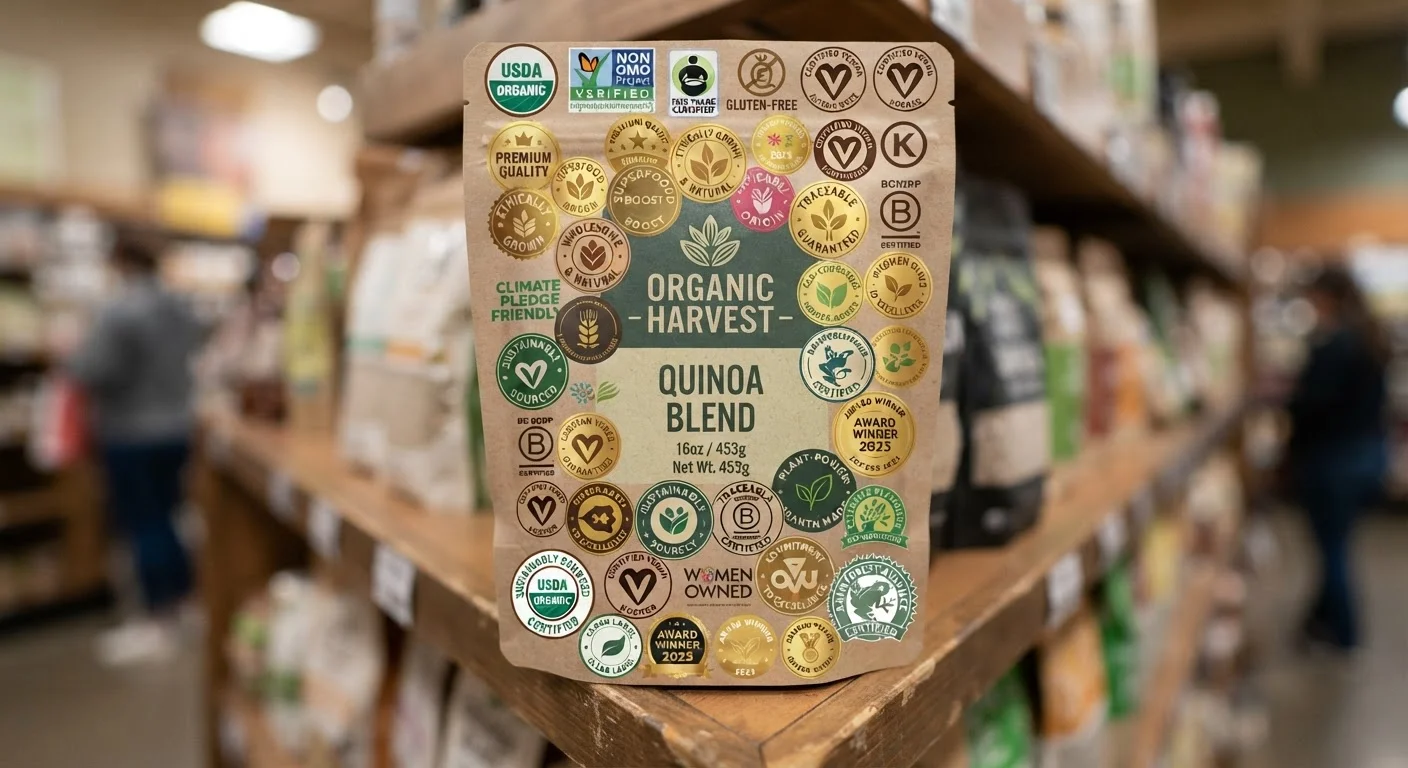
Key Takeaways
Option A
Independent Third-Party Certifications
Verified by organizations with no financial stake in the outcome.
Best for: Shoppers who want meaningful assurance that a product meets defined, externally audited standards.
Option B
Brand-Created Marketing Seals
Self-awarded badges that reflect a company's own claims, not independent verification.
Best for: Recognizing as promotional design elements that signal brand intent, not verified compliance.
If you're buying products where safety compliance matters (electronics, children's items, food)
Independent Third-Party Certifications
Safety-related categories have established bodies whose certifications reflect real testing against defined thresholds. A self-created seal provides no comparable assurance.
If you're evaluating sustainability or environmental claims on packaging
Independent Third-Party Certifications
Environmental marketing is a high-greenwashing-risk area. Independent certifications with published criteria are far more reliable than vague brand badges claiming eco-friendliness.
If you encounter an unfamiliar seal and want to decide quickly whether to trust it
Independent Third-Party Certifications
Apply a simple test: can you find the certifying body independently, with published standards and an auditor list? If not, treat the seal as marketing copy rather than verified fact.
Why the Difference Matters on the Shelf
Walk through any grocery, hardware, or electronics aisle and you'll encounter dozens of badges - circular logos, checkmarks, stars, and official-sounding names stamped across packaging. They're designed to communicate trustworthiness at a glance. The problem is that some are earned through rigorous independent audits, while others are created entirely by the brand selling the product, with no external verification required.
This distinction has real consequences for shoppers. When a product carries a legitimate third-party certification, it means an independent organization - one with no financial interest in whether the product passes or fails - has tested or audited it against published criteria. When a brand invents its own seal, it is, in effect, grading its own homework. There is no standard it must meet beyond its own marketing intentions.
Understanding this gap is one of the most practical skills a shopper can develop. It connects directly to broader habits like separating genuine signals from noise when evaluating products online.
| Criterion | Independent Third-Party Certifications | Brand-Created Marketing Seals |
|---|---|---|
| Who issues it | Independent organization | The brand itself |
| Standards published publicly | Yes, typically | Rarely or never |
| External audit required | Yes | No |
| Verifiable via third-party source | Yes - searchable databases | No independent verification |
| Regulatory backing | Often (e.g., USDA, EPA, FTC) | Generally none |
| Can be revoked | Yes, upon failed audit | No mechanism exists |
| Primary purpose | Compliance and consumer protection | Brand differentiation and marketing |
What Makes a Certification Credible
Credible third-party certifications share several common traits. First, the certifying body is organizationally independent from the manufacturers it certifies - it does not have a commercial relationship that creates incentive to approve products. Second, its standards are publicly documented, so anyone can read what criteria a product must meet. Third, certified products are subject to ongoing audits or testing, not just a one-time review. And fourth, the organization maintains a publicly searchable database of certified products, so claims can be verified.
Examples of well-established certification programs in the U.S. include UL (Underwriters Laboratories) for electrical safety, USDA Organic for food products, ENERGY STAR for appliance efficiency (administered by the U.S. Environmental Protection Agency), and NSF International for water filtration and food equipment. These programs have governance structures, published methodology, and accountability mechanisms.
That doesn't mean every legitimate certification is equally rigorous - standards vary by category and certifying body. But the framework above gives you a baseline for evaluation. If you can't find a certifying organization's independent website, published standards, or auditor information, that's a meaningful signal worth heeding. See also: what meaningful product testing actually looks like.
How Brand-Created Seals Work - and Why They Spread
Brand-created seals typically emerge from a company's marketing department, not a compliance or testing team. They may use language like "Quality Assured," "Our Promise," "Eco-Friendly Certified," or "Premium Grade" - phrases that sound like external validation but describe only the company's own claims about itself. In some cases, companies form small industry associations that issue seals to member brands, creating a veneer of third-party credibility while maintaining control over standards and membership.
These seals spread because they work. Consumers often respond positively to visual cues of authority, and a well-designed badge can create an impression of rigor that influences purchase decisions without any verification occurring. The Federal Trade Commission (FTC) has guidelines around environmental marketing claims specifically - known as the Green Guides - that address misleading eco-seals, but enforcement is limited and the broader landscape of non-environmental self-seals remains largely unregulated.
This doesn't mean every brand-created seal is intentionally deceptive. Some companies use them to communicate genuine internal standards or commitments. But without external verification, a consumer has no way to distinguish a well-intentioned internal standard from pure marketing language. This is closely related to why brand reputation alone can mislead shoppers when evaluating individual products.
A Practical Approach to Evaluating Any Badge
Before letting a seal influence your purchase, run through a short mental checklist. Search the name of the certifying organization independently - not through the brand's own website. Does it have its own web presence, published standards, and contact information? Does it list certified products or license holders? Is it referenced by government agencies, consumer organizations, or journalism, rather than only by the brands it certifies?
If the answers are yes, you have reasonable grounds to treat the seal as meaningful. If the search turns up nothing beyond the brand's own marketing materials, treat it as you would any other unverified marketing claim. This approach fits naturally within a broader framework for evaluating any product like a pro.
It's also worth remembering that the absence of a certification badge doesn't make a product inferior. Many solid products simply haven't sought certification - particularly smaller manufacturers. Certification status is one useful data point among several, not a definitive quality score. For a fuller picture, pair it with evidence of actual performance, rather than packaging alone. The relationship between certification and real value ties directly into how you might approach judging whether a product is actually worth more.