

Key Takeaways
The Greenhouse Effect: Natural, Necessary, and Now Amplified
Earth sits at an average surface temperature of roughly 59°F (15°C). Without the greenhouse effect, that figure would plummet to around -0.4°F (-18°C) - far too cold to support most life as we know it. The greenhouse effect is not a problem invented by modern industry. It is a fundamental atmospheric mechanism that has operated for billions of years.
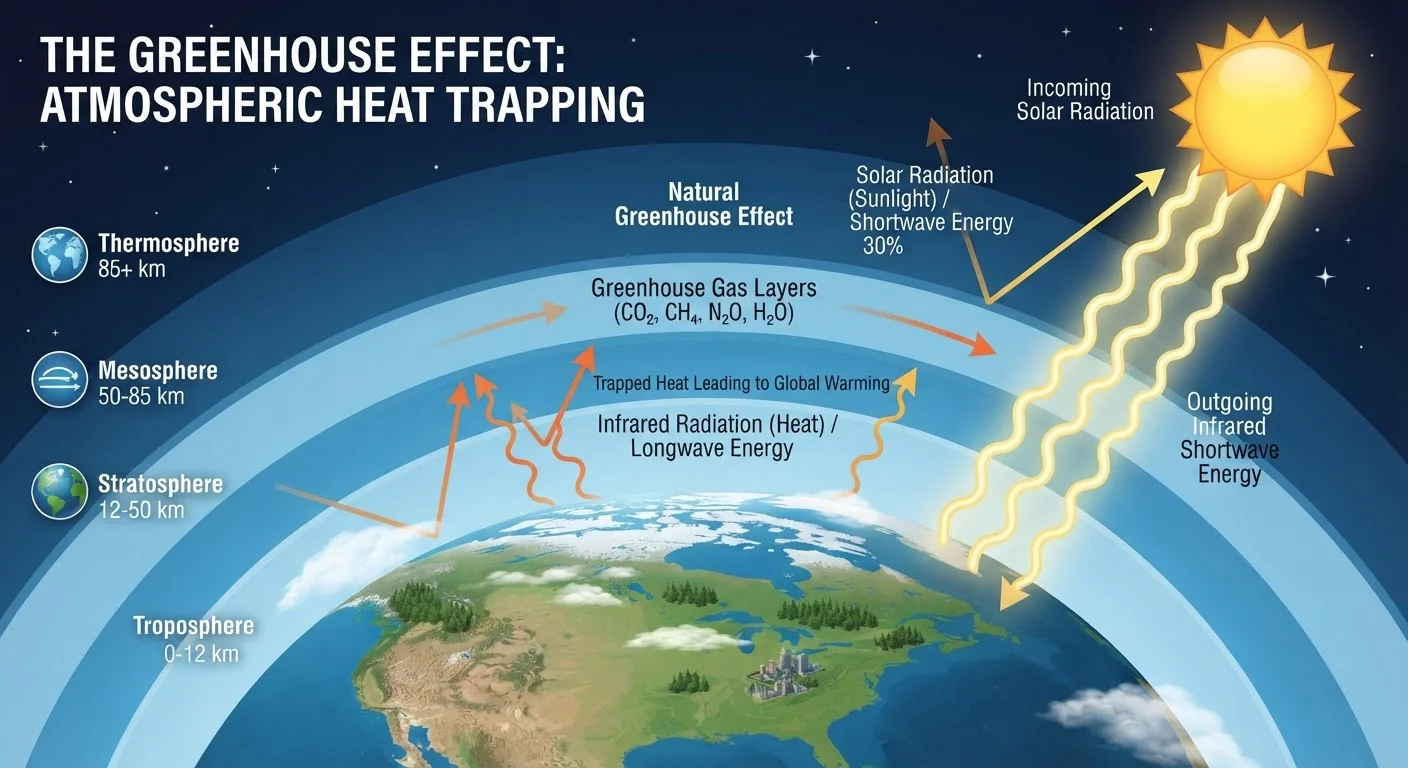
Here is how it works: the Sun emits energy primarily as visible light, which passes relatively easily through the atmosphere and warms Earth's surface. The surface then releases that energy as infrared radiation (heat). Certain gases in the atmosphere - including water vapor, carbon dioxide (CO₂), methane (CH₄), and nitrous oxide (N₂O) - absorb a portion of that outgoing infrared radiation and re-emit it in all directions, including back toward the surface. This cycle keeps the planet warmer than it would otherwise be.
The scientific concern today is not the greenhouse effect itself, but the enhancement of it. Human activities - primarily burning fossil fuels, deforestation, and agriculture - have raised atmospheric CO₂ concentrations from roughly 280 parts per million (ppm) before the industrial era to over 420 ppm today. That additional CO₂ traps more heat, pushing global average temperatures upward beyond what natural variability alone can explain. To understand exactly how scientists distinguish natural climate shifts from human-driven changes, see how scientists attribute recent warming.
Myth
The greenhouse effect is a man-made problem - it didn't exist before industrialization.
Fact
The greenhouse effect is a natural atmospheric process that predates human civilization by billions of years and is essential to life on Earth.
Earth's natural greenhouse gases have maintained a livable temperature range for most of the planet's history. What industrialization has changed is the concentration of those gases - particularly CO₂ and methane - amplifying an existing process rather than creating a new one. The natural greenhouse effect is a feature, not a bug; the enhanced greenhouse effect caused by human emissions is the concern.
Myth
The atmosphere works like a greenhouse - trapping heat under a physical glass ceiling.
Fact
The term 'greenhouse effect' is a metaphor. The actual mechanism involves molecular absorption of infrared radiation, not a physical barrier.
A glass greenhouse keeps air warm largely by preventing convection - stopping warm air from rising and escaping. Earth's atmosphere does not work this way. Greenhouse gases trap heat by absorbing outgoing infrared radiation at specific wavelengths and re-emitting it, including back toward the surface. It is a radiative process, governed by molecular physics, not a sealed container effect. The analogy is useful for intuition but misleading as a literal description.
Myth
The ozone hole is causing global warming - they're the same problem.
Fact
Ozone depletion and the greenhouse effect are distinct phenomena with different causes, different atmospheric layers, and different effects.
The ozone layer exists in the stratosphere (roughly 10-30 miles up) and protects Earth from harmful ultraviolet radiation. Ozone depletion is primarily caused by chlorofluorocarbons (CFCs). The greenhouse effect operates throughout the lower atmosphere (troposphere) and involves infrared heat retention by CO₂, methane, and other gases. While both are genuine environmental issues, conflating them creates confusion about causes, consequences, and solutions. Notably, the global phase-out of CFCs under the Montreal Protocol has allowed the ozone layer to begin recovering - a separate success story from climate mitigation efforts.
Myth
Water vapor is the most important greenhouse gas, so CO₂ doesn't really matter.
Fact
Water vapor is the most abundant greenhouse gas, but CO₂ acts as the primary driver that controls how much water vapor the atmosphere holds.
Water vapor does account for roughly 50% of Earth's natural greenhouse effect, with CO₂ contributing a smaller direct share. However, atmospheric water vapor concentration is largely determined by temperature - warmer air holds more water vapor. CO₂, by contrast, persists in the atmosphere for centuries and directly forces temperature change. When CO₂ rises and warms the atmosphere, more water vapor enters the air, amplifying the warming. This is called a positive feedback loop. CO₂ is the thermostat; water vapor amplifies whatever the thermostat is set to. Removing CO₂ while leaving water vapor unchanged would cause the water vapor to condense out as temperatures dropped.
Myth
Plants absorbing CO₂ will naturally cancel out human emissions.
Fact
Terrestrial and oceanic carbon sinks absorb roughly half of human CO₂ emissions, but they cannot keep pace with current emission rates and face increasing stress.
Forests, soils, and oceans do absorb substantial CO₂ - research published in journals including Nature has estimated that natural sinks currently offset approximately 50% of annual human emissions. However, the remaining 50% accumulates in the atmosphere. Additionally, warming itself stresses carbon sinks: droughts reduce forest absorption, and warmer oceans absorb less CO₂. Deforestation further reduces sink capacity. Natural carbon cycling is a vital buffer, but it is not a self-correcting mechanism capable of neutralizing ongoing large-scale emissions.
Why Misconceptions Persist - and Why They Matter
Misunderstandings about the greenhouse effect are not trivial. When people believe the ozone hole is causing warming, or that CO₂ is irrelevant because water vapor dominates, they are working from a flawed model that leads to flawed conclusions about policy, risk, and personal understanding. Getting the science right is a prerequisite for evaluating any proposed response - including the increasingly discussed but deeply contested field of geoengineering, covered in depth in geoengineering proposals and what remains unknown.
420+ ppm
Atmospheric CO₂ concentration
According to NOAA measurements, atmospheric CO₂ has exceeded 420 parts per million - roughly 50% higher than pre-industrial levels of approximately 280 ppm.
~1.1°C
Global average warming since pre-industrial era
The IPCC Sixth Assessment Report (2021) estimates that human influence has warmed the climate by approximately 1.1°C above pre-industrial baseline temperatures.
97%+
Scientific consensus on human-caused warming
Multiple independent analyses of peer-reviewed climate science literature find that over 97% of actively publishing climate scientists agree that recent warming is primarily human-caused.
The greenhouse effect is one of the most thoroughly studied phenomena in atmospheric physics. The underlying mechanisms were first described mathematically in the 19th century by scientists including Eunice Newton Foote and John Tyndall. The broad scientific consensus today - expressed through bodies such as the Intergovernmental Panel on Climate Change (IPCC) and every major national academy of science - is that the enhanced greenhouse effect is the primary driver of observed warming since the mid-20th century. That consensus rests not on any single study, but on converging evidence from atmospheric measurements, ocean heat content, ice cores, satellite data, and climate modeling.
Understanding what the greenhouse effect actually does - and does not do - equips readers to evaluate claims accurately, recognize misinformation, and engage more confidently with one of the defining scientific questions of our time.