

Key Takeaways
Risk-Return Trade-Off
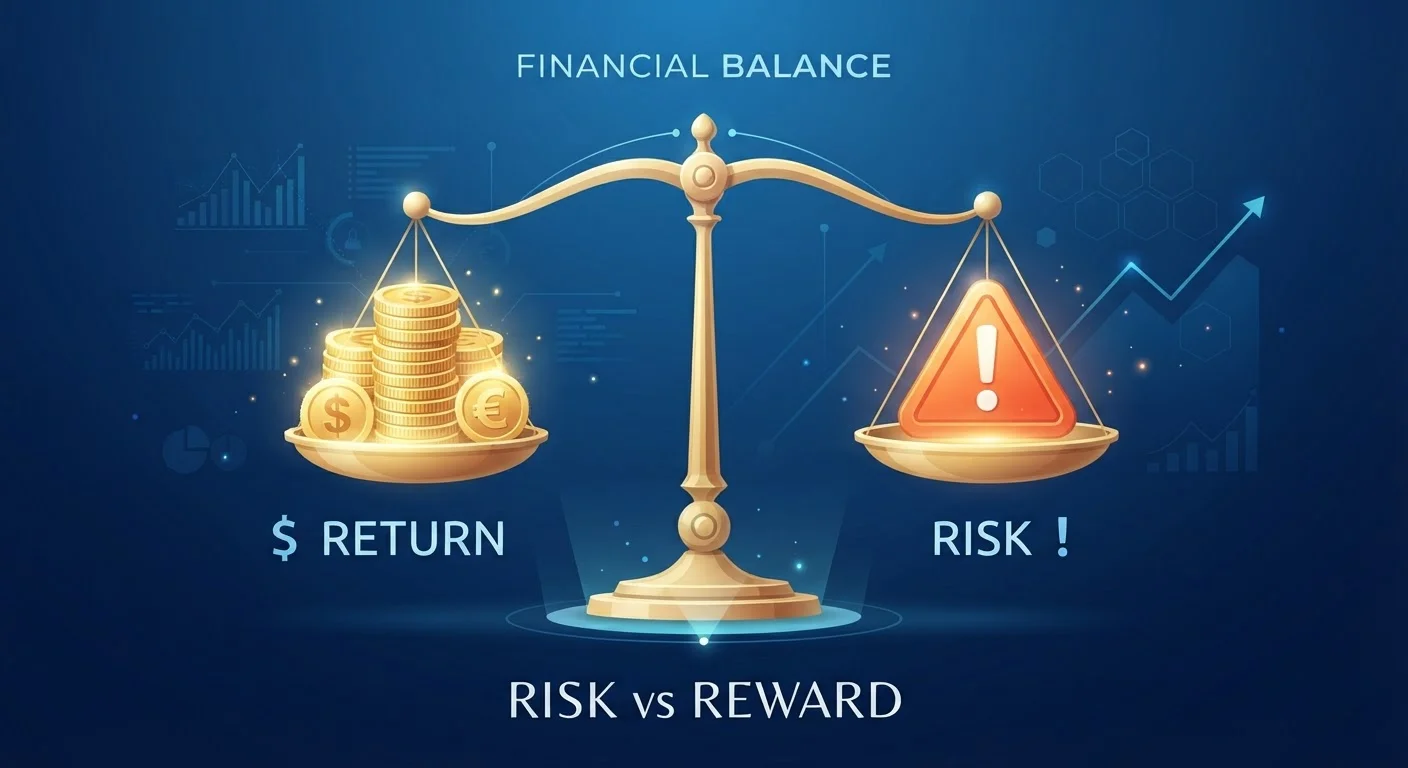
The risk-return trade-off is the fundamental investing principle that higher potential returns generally come with higher potential losses - and lower-risk investments tend to offer smaller gains. In other words, there is no such thing as a high reward with zero risk. Understanding this relationship helps investors make choices that align with their goals and comfort level.
In finance, this relationship is often quantified using metrics such as standard deviation (volatility) and the Sharpe ratio, which measures return relative to risk taken.
The Core Idea: Risk and Return Are Inseparable
One of the most enduring principles in personal finance is deceptively simple: to earn more, you generally have to risk more. This isn't a Wall Street quirk - it's a reflection of basic human behavior. People require an incentive to accept uncertainty. That incentive is the potential for a greater reward.
Think of it as a spectrum. On one end sit ultra-safe options - like a federally insured savings account or a U.S. Treasury bill. These carry very little chance of losing your principal, but they also offer modest returns. On the other end sit higher-volatility investments - like individual stocks or emerging market funds - which can deliver substantial gains but can also fall sharply in value.
The space between those two poles is where most investing decisions get made. Understanding where different investments sit on that spectrum is foundational to building any sound financial plan. Stocks, bonds, and cash each behave differently in terms of risk and return, and most portfolios are built from some combination of all three.
~10%
Average annual return of U.S. stocks (long-term historical)
The broad U.S. stock market has historically averaged roughly 10% annually before inflation, though returns vary significantly year to year and past performance does not guarantee future results.
~0.5%
Typical high-yield savings account rate range
Savings account yields fluctuate with Federal Reserve policy; while higher than standard accounts, they rarely match long-term stock market returns.
3%+
Average annual U.S. inflation rate (historical)
The Bureau of Labor Statistics tracks the Consumer Price Index; historically, U.S. inflation has averaged around 3% annually, highlighting the inflation risk of holding only cash.
Types of Risk Every Saver Should Know
"Risk" in investing isn't one-dimensional. Several distinct types of risk can affect your money, and recognizing them helps you think more clearly about your choices.
- Market risk: The possibility that the overall market declines, pulling down the value of your investments regardless of how good the underlying company or asset is.
- Inflation risk: The danger that your returns don't keep pace with rising prices, eroding your purchasing power over time - a silent threat even to "safe" cash savings.
- Concentration risk: Putting too much money into a single stock, sector, or asset class. If that one bet goes wrong, the damage is amplified.
- Liquidity risk: Some investments can't be quickly converted to cash without taking a loss - real estate and certain private assets are common examples.
Most investors face a combination of these risks at any given time. Diversification is one of the most practical tools for managing concentration and market risk without abandoning the pursuit of returns.
Time Horizon: Your Most Powerful Variable
One factor that dramatically changes how much risk is appropriate for you is time - specifically, how long before you'll need the money you're investing.
If you're investing for a goal 30 years away, short-term market swings matter far less. Historically, markets have recovered from downturns over long periods, though past performance is not a guarantee of future results. A longer runway gives you the ability to ride out volatility rather than being forced to sell at a loss.
Conversely, if you'll need funds in two or three years - say, for a down payment on a home - a sharp market drop right before that date could be genuinely harmful. In those cases, preserving capital may matter more than chasing growth.
This is why financial educators often suggest building an emergency fund before putting money into markets. The reasoning behind that advice goes directly to this point: liquid, stable savings protect you from being forced to exit investments at the wrong time.
Putting It All Together: Making Risk Work for You
Understanding the risk-return relationship doesn't mean chasing the highest possible return - it means making deliberate, informed trade-offs. A few practical principles can help guide that process.
First, be honest about your risk tolerance. This includes both your financial capacity to absorb losses and your emotional response to seeing your account value drop. Both matter. Asking the right questions before you invest is a valuable exercise before committing any money.
Second, don't let fear of risk lead to avoidance of all risk. Keeping all your long-term savings in cash or low-yield accounts carries its own risk - the slow erosion of purchasing power through inflation. Many people stay on the sidelines due to misconceptions about investing, and that caution has a real financial cost over time.
Third, revisit your risk profile as your life changes. A strategy appropriate at 30 may not suit you at 55. Risk tolerance, time horizons, and financial goals all shift.
“Risk comes from not knowing what you're doing. The goal of investing is not to minimize risk - it's to understand it well enough to make informed decisions.”
— Warren Buffett, Investor and chairman of Berkshire Hathaway
This article is for general informational and educational purposes only and does not constitute personalized financial, investment, or tax advice. Consult a qualified financial adviser before making decisions based on your individual circumstances.