

Key Takeaways
What Asset Allocation Actually Means
Asset allocation refers to how you divide your investment portfolio among different asset classes - primarily stocks (equities), bonds (fixed income), and cash or cash equivalents. Each asset class carries different levels of risk and potential return. Understanding how they work individually is a useful starting point; our article on stocks, bonds, and cash covers the fundamentals in depth.
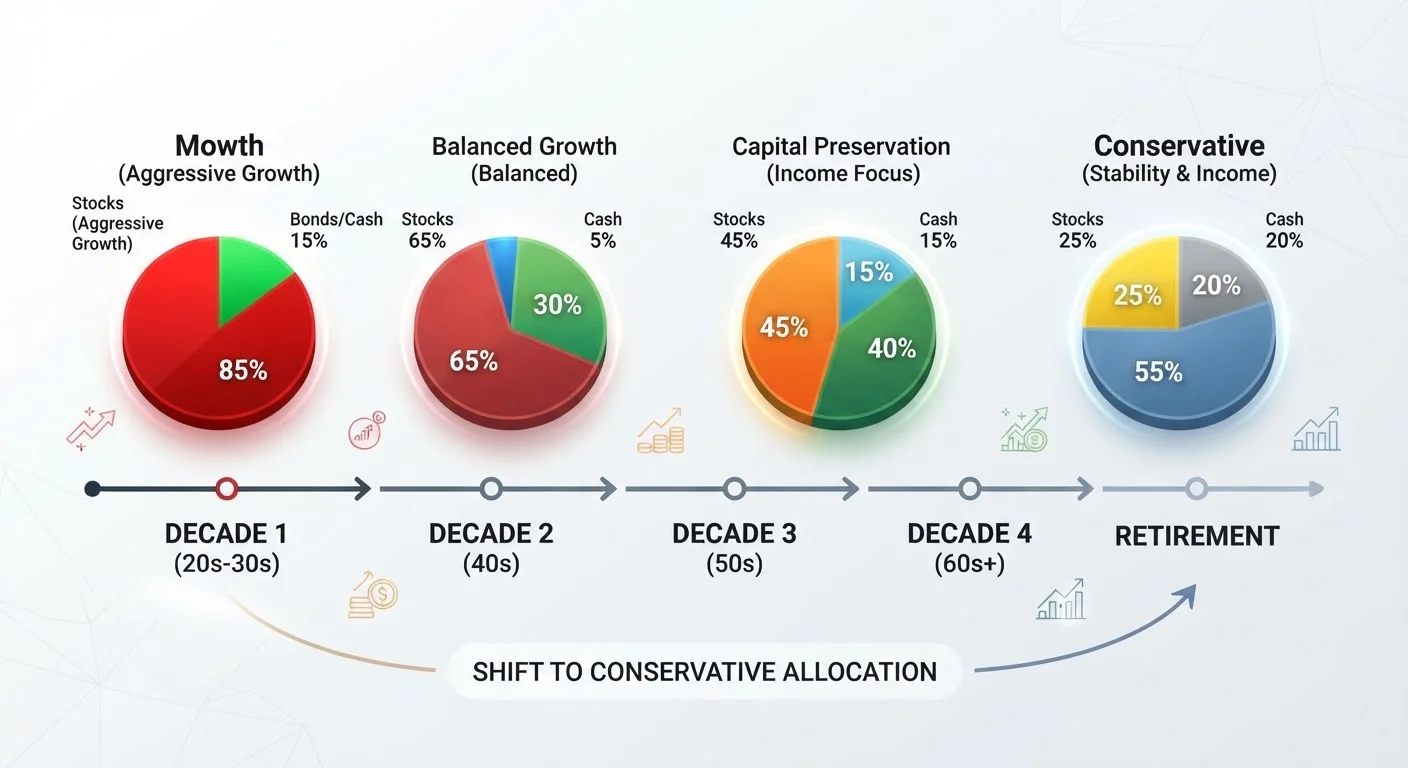
The core idea behind shifting your allocation over time is simple: your ability and willingness to absorb investment losses changes as your life circumstances change. A 28-year-old with 35 years until retirement can ride out a market downturn. A 62-year-old planning to retire in three years generally cannot afford to wait a decade for a recovery. Allocation strategy is, at its heart, a risk management tool.
Allocation Is a Guideline, Not a Formula
Rules of thumb like "age in bonds" are starting points, not universal prescriptions. Factors such as your other income sources (Social Security, pension, rental income), health, family obligations, and personal comfort with risk can all shift what an appropriate allocation looks like for you. These frameworks are useful for framing a conversation with a financial adviser, not replacing one.
Early Career: Prioritizing Growth (Roughly Ages 20-35)
In the early stages of your working life, time is your most valuable financial asset. With decades ahead before you'll need to draw on retirement savings, you have the runway to recover from inevitable market downturns. This is why many financial planners suggest a growth-oriented allocation during this phase - often a higher concentration in equities, which carry more short-term volatility but have historically outpaced bonds over long time horizons.
A common starting framework, sometimes called the "age in bonds" rule, suggests holding a percentage of bonds roughly equal to your age - so a 30-year-old might hold around 30% in bonds and 70% in stocks. This is a rough heuristic, not a prescription. Your individual risk tolerance, job security, emergency fund, and financial goals all matter. If you're also building toward a major purchase, consider how that factors into your overall savings strategy alongside your budgeting framework.
If investing feels out of reach right now, starting small is a legitimate strategy - even modest contributions to a tax-advantaged account can compound meaningfully over time.
Mid-Career: Balancing Growth With Stability (Roughly Ages 35-55)
By mid-career, most people have larger portfolios, higher incomes, and more financial obligations - mortgages, children's education, aging parents. This is the phase where rebalancing becomes an active discipline rather than an occasional afterthought. Markets shift portfolio weights over time; a portfolio that started at 70% stocks may drift to 80% after a bull run, taking on more risk than intended.
Mid-career investors often begin gradually shifting toward a more moderate allocation: introducing more bonds, diversifying into real estate investment trusts (REITs), or adding international exposure to reduce concentration risk. Dollar-cost averaging - consistently contributing fixed amounts regardless of market conditions - remains a disciplined strategy throughout this phase.
Tax-advantaged accounts like 401(k)s and IRAs play a critical role here. Understanding how each account type is taxed helps you decide where to hold different assets. For a clear breakdown, see our guide on tax-advantaged accounts.
Pre-Retirement and Retirement: Capital Preservation Takes Priority
As you enter your late 50s and beyond, the objective typically shifts from growing wealth to protecting it. A significant market decline in the two to five years before or after retiring - sometimes called sequence of returns risk - can have an outsized, lasting impact on your ability to sustain withdrawals throughout retirement.
This doesn't mean abandoning equities entirely. Retirement can last 20-30 years, and a portfolio too heavily weighted toward bonds may not generate enough growth to outpace inflation. The goal is a balanced, income-oriented allocation: enough stability to weather downturns, enough growth to protect purchasing power over decades. Many financial professionals suggest gradually reducing equity exposure as retirement approaches and in its early years, then stabilizing as withdrawal patterns become predictable.
Major life decisions at this stage - including how long you stay in your home - can also shape financial planning. Our piece on owning a home longer than planned explores how housing equity fits into the broader picture. Consult a licensed financial adviser to align your allocation with your specific retirement income needs, tax situation, and risk tolerance.
This article provides general financial education and is not personalized investment advice. Asset allocation decisions depend on individual circumstances; consult a qualified financial professional before making changes to your portfolio.