

Key Takeaways
Kidney Filtration
Kidney filtration is the biological process by which the kidneys continuously remove waste products, excess salts, and extra fluid from the bloodstream. Each kidney contains about one million tiny filtering units called nephrons that work together to clean the blood and produce urine. This process also regulates blood pressure, maintains the body's acid-base balance, and controls fluid volume.
The filtration rate - known as the glomerular filtration rate (GFR) - is a key clinical marker of kidney health; a normal GFR in adults is typically above 90 mL/min/1.73m².
The Scale of the Job
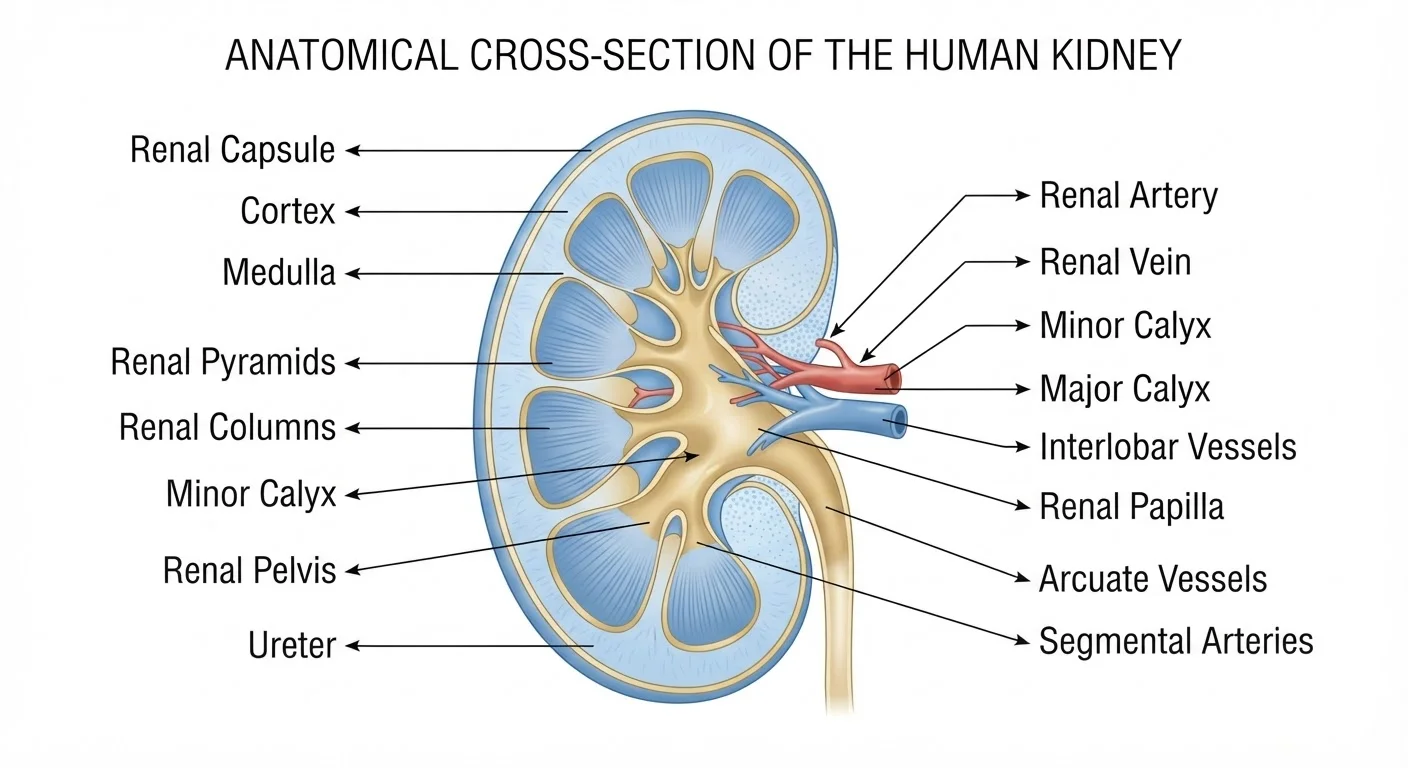
Your kidneys are roughly the size of a fist, yet they perform one of the body's most demanding engineering feats. Every 24 hours, these two bean-shaped organs process approximately 180-200 liters of filtered fluid - a volume equivalent to filling a standard bathtub. The entire blood supply passes through the kidneys roughly 40 times per day.
Despite this extraordinary throughput, the kidneys return the vast majority of what they filter right back to the body. Only 1-2 liters leave as urine. The rest - water, glucose, amino acids, and essential electrolytes - is meticulously reclaimed. Understanding how this works means zooming in to the microscopic level.
Inside the Nephron: Where Filtration Happens
The nephron is the kidney's fundamental working unit. Each kidney contains approximately one million nephrons, and each nephron is a coiled tube with distinct regions that each play a specific role in blood processing.
The journey begins at the glomerulus - a dense knot of tiny capillaries wrapped inside a cup-shaped structure called Bowman's capsule. Blood enters the glomerulus under pressure, and that pressure forces water, salts, glucose, urea, and other small molecules through the capillary walls and into the capsule. Larger molecules like proteins and blood cells are too big to pass through and remain in circulation. This pressure-driven step is called glomerular filtration, and it produces what scientists call the filtrate - a liquid that resembles blood plasma without the large proteins.
200 L
Blood fluid filtered by kidneys daily
The National Kidney Foundation estimates the kidneys process this volume each day, returning the vast majority to circulation.
~1 million
Nephrons per kidney
Each human kidney contains approximately one million nephrons, the microscopic filtration units that collectively clean the blood.
15%
U.S. adults estimated to have CKD
According to the CDC, roughly 37 million American adults are estimated to have chronic kidney disease, most undiagnosed.
40x
Times the entire blood supply passes through kidneys daily
The kidneys receive about 20-25% of cardiac output, cycling the full blood volume through filtration roughly 40 times every 24 hours.
From Bowman's capsule, the filtrate enters a series of tubules. First is the proximal convoluted tubule, where the body recaptures most of the glucose, amino acids, and about 65% of the filtered sodium and water. Next, the loop of Henle dips deep into the kidney's inner layer and plays a critical role in concentrating urine by creating a salt gradient. Finally, the distal convoluted tubule and collecting duct perform fine-tuned adjustments to water and electrolyte balance, guided by hormones like aldosterone and antidiuretic hormone (ADH).
Hormonal Control and Blood Pressure Regulation
The kidneys are not passive filters - they are active regulators. When blood pressure drops, kidney cells release a hormone called renin, triggering a cascade known as the renin-angiotensin-aldosterone system (RAAS). This system causes blood vessels to constrict and signals the kidneys to retain more sodium and water, raising blood volume and pressure back toward normal.
The kidneys also produce erythropoietin, a hormone that stimulates red blood cell production in the bone marrow. When kidney function declines significantly - as in chronic kidney disease - erythropoietin production falls, often leading to anemia.
When Filtration Fails: Kidney Disease
Chronic kidney disease (CKD) develops when the kidneys lose their filtration capacity over months or years. According to the Centers for Disease Control and Prevention (CDC), approximately 15% of U.S. adults - around 37 million people - are estimated to have CKD, and most are unaware of it because early stages cause few symptoms.
Diabetes and high blood pressure are the two leading causes of CKD, together accounting for the majority of cases. As nephrons are damaged, the remaining ones compensate by working harder, but this adaptive response has limits. If GFR falls below 15 mL/min/1.73m², kidney failure requires dialysis or a transplant to sustain life.
Routine screening through blood and urine tests remains the most reliable way to detect CKD early. Anyone with risk factors - including diabetes, hypertension, a family history of kidney disease, or older age - should discuss regular kidney function testing with their healthcare provider.