

Key Takeaways
Permafrost
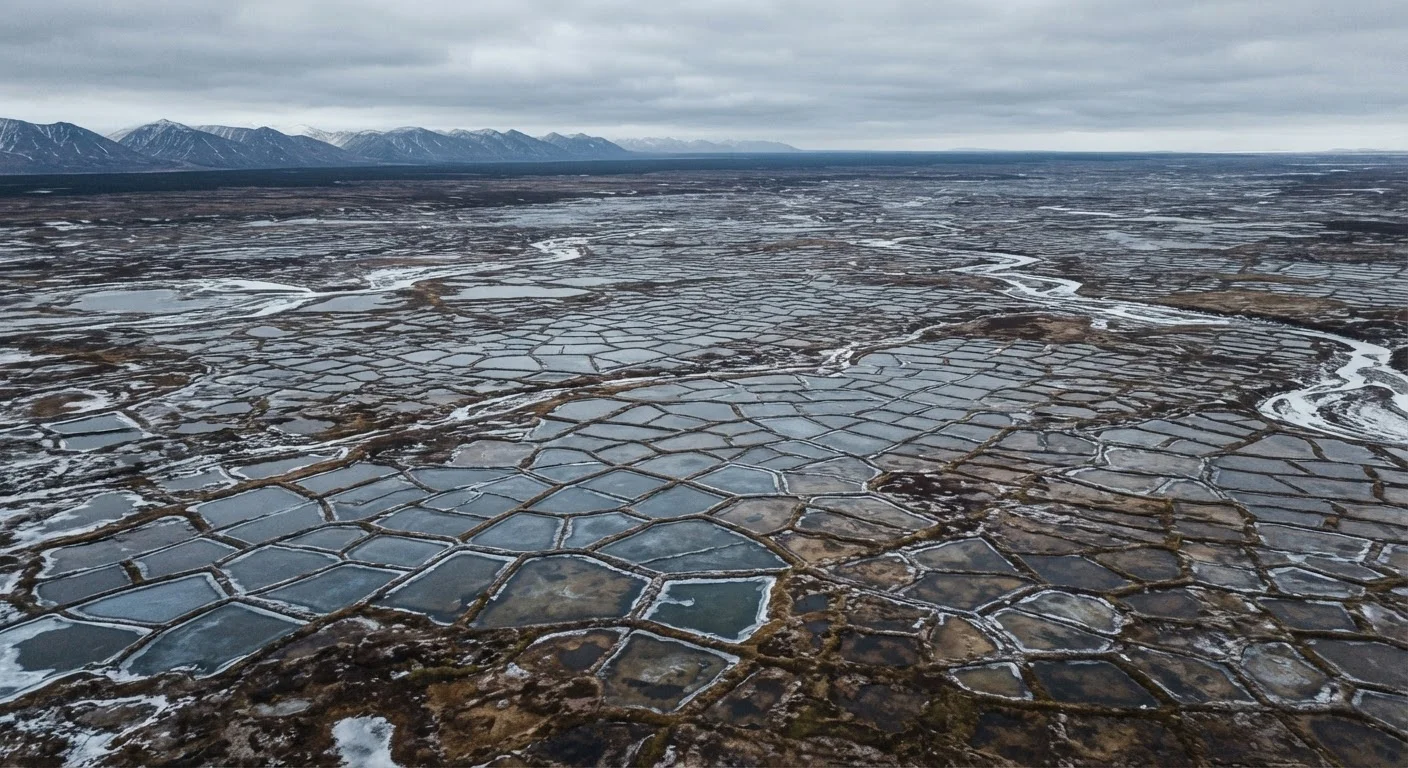
Permafrost is ground - soil, sediment, or rock - that remains frozen at or below 0°C (32°F) for at least two consecutive years. It underlies large portions of the Arctic, subarctic, and some alpine regions worldwide. Unlike seasonal frost that melts each spring, permafrost persists year-round beneath a surface layer that partially thaws in summer.
Permafrost is defined entirely by temperature, not by ice content - some permafrost contains very little ice, while other zones are nearly pure frozen water and organic material.
What Permafrost Is and Where It Exists
Permafrost is not simply ice - it is frozen ground that has stayed at or below 0°C for at least two consecutive years. Its defining characteristic is temperature persistence, not appearance. The material can be mineral soil, peat, gravel, or bedrock, sometimes containing large wedges of ice and sometimes holding very little.
Two categories describe its distribution: continuous permafrost, which covers vast unbroken stretches in northern Siberia, northern Canada, and Alaska; and discontinuous permafrost, which occurs in fragmented patches at lower latitudes and elevations where local conditions allow isolated frozen zones to survive. Alpine permafrost also exists on high mountain ranges well outside the Arctic.
Above all permafrost lies the active layer - the soil that thaws each summer and refreezes each winter. This layer ranges from centimeters to a couple of meters deep and is where most tundra plant life and surface microbial activity occur. Below it, the frozen ground can extend meters to more than a kilometer into the earth, depending on the region's climatic history.
A Vast Reservoir of Ancient Carbon
What makes permafrost scientifically significant beyond its physical properties is what it contains: an enormous quantity of organic carbon. Over thousands of years - primarily since and before the last glacial maximum - dead plant material, animal remains, and microbial biomass were incorporated into the soil and locked in place by freezing before they could fully decompose.
Estimates from research published in peer-reviewed journals, including work synthesized by the Permafrost Carbon Network, suggest permafrost soils hold approximately 1.5 trillion metric tons of organic carbon - roughly double the amount currently in Earth's atmosphere. This material accumulated slowly over millennia; it did not form quickly and cannot be replaced on human timescales.
~1.5 trillion
Metric tons of carbon stored in permafrost
Estimated by the Permafrost Carbon Network based on synthesis of global soil carbon data.
~25%
Northern Hemisphere land underlain by permafrost
According to the National Snow and Ice Data Center (NSIDC), permafrost underlies a quarter of the Northern Hemisphere's land surface.
4×
Faster warming rate in the Arctic vs. global average
Arctic amplification documented by the Arctic Monitoring and Assessment Programme (AMAP) in recent assessment reports.
35 million
People living in permafrost regions
Approximate population figure cited in scientific literature on permafrost and societal risk.
Preserved within permafrost are also intact remains of Pleistocene-era organisms - woolly mammoths, ancient horses, and plant species - effectively freeze-dried by the ground. These specimens give scientists rare windows into past ecosystems, but their presence also underscores how effectively permafrost has acted as a deep-freeze across geological time.
What Happens When Permafrost Thaws
As temperatures rise, particularly in Arctic and subarctic regions warming at roughly four times the global average rate according to Arctic monitoring programs, permafrost is thawing from the top down and, in some areas, from the sides where lakes and rivers provide lateral heat. The consequences unfold across multiple scales.
When frozen organic matter thaws, soil microbes resume decomposition. In well-drained areas, this process releases carbon dioxide (CO₂). In waterlogged areas - which become more common as thawing ground subsides and traps meltwater - anaerobic bacteria produce methane (CH₄), a greenhouse gas with a warming potential many times greater than CO₂ over a 20-year period, according to the Intergovernmental Panel on Climate Change (IPCC).
This dynamic concerns climate scientists because it represents a positive feedback loop: warming thaws permafrost, which releases greenhouse gases, which drive further warming. The scale of stored carbon means even a partial release over coming decades could significantly amplify atmospheric greenhouse gas concentrations beyond what human emissions alone would produce.
Beyond the atmosphere, thaw reshapes the land itself. A process called thermokarst occurs when ice-rich permafrost melts and the ground above it collapses, forming depressions, sinkholes, and thaw lakes. Roads buckle, buildings tilt, and in some communities entire structures have been condemned. Pipelines crossing permafrost terrain face growing engineering challenges as ground stability declines.
Monitoring, Research, and What Scientists Are Learning
Researchers monitor permafrost through networks of boreholes drilled to various depths, remote sensing satellites that detect ground deformation, and field stations measuring greenhouse gas fluxes directly from the soil surface. Long-term datasets from sites in Alaska, Canada, Scandinavia, and Russia are helping scientists track the pace of change and improve climate models.
One major challenge is that permafrost carbon release is difficult to model precisely. The timing, rate, and form of emissions depend on local hydrology, soil composition, vegetation, and snowpack - variables that interact in complex ways. Current models are increasingly incorporating permafrost dynamics, but researchers acknowledge that projections carry meaningful uncertainty, particularly regarding how quickly deep, ancient carbon layers might become vulnerable.
Understanding permafrost is not only relevant to global climate projections. It matters to the roughly 35 million people who live in permafrost regions and depend on stable ground for infrastructure, transportation, and traditional ways of life. Indigenous communities across Alaska, Canada, and Siberia are already documenting and adapting to changes in the landscape that have unfolded within living memory.