

Key Takeaways
Option A
Dark Matter
The invisible gravitational glue holding galaxies together.
Best for: Explaining why galaxies rotate as they do and why large cosmic structures exist at all.
Option B
Dark Energy
The mysterious force accelerating the universe's expansion.
Best for: Explaining why the universe is expanding faster over time rather than slowing down under gravity.
If you want to understand why galaxies don't fly apart
Dark Matter
Stars at a galaxy's edge orbit far too fast to be held in by visible mass alone. Dark matter provides the extra gravitational pull that keeps galactic structure intact.
If you want to understand why the universe's expansion is speeding up
Dark Energy
Observations of distant supernovae revealed the expansion of space is accelerating - dark energy is the leading explanation for this counterintuitive push outward.
If you're exploring the large-scale structure of the cosmos
Dark Matter
The cosmic web of filaments, voids, and galaxy clusters matches computer simulations only when dark matter's gravitational scaffolding is included.
If you're studying the ultimate fate of the universe
Dark Energy
Dark energy's strength over cosmic time determines whether the universe expands forever, accelerates to a 'Big Rip,' or reaches some other end state.
The Core Difference: Pull vs. Push
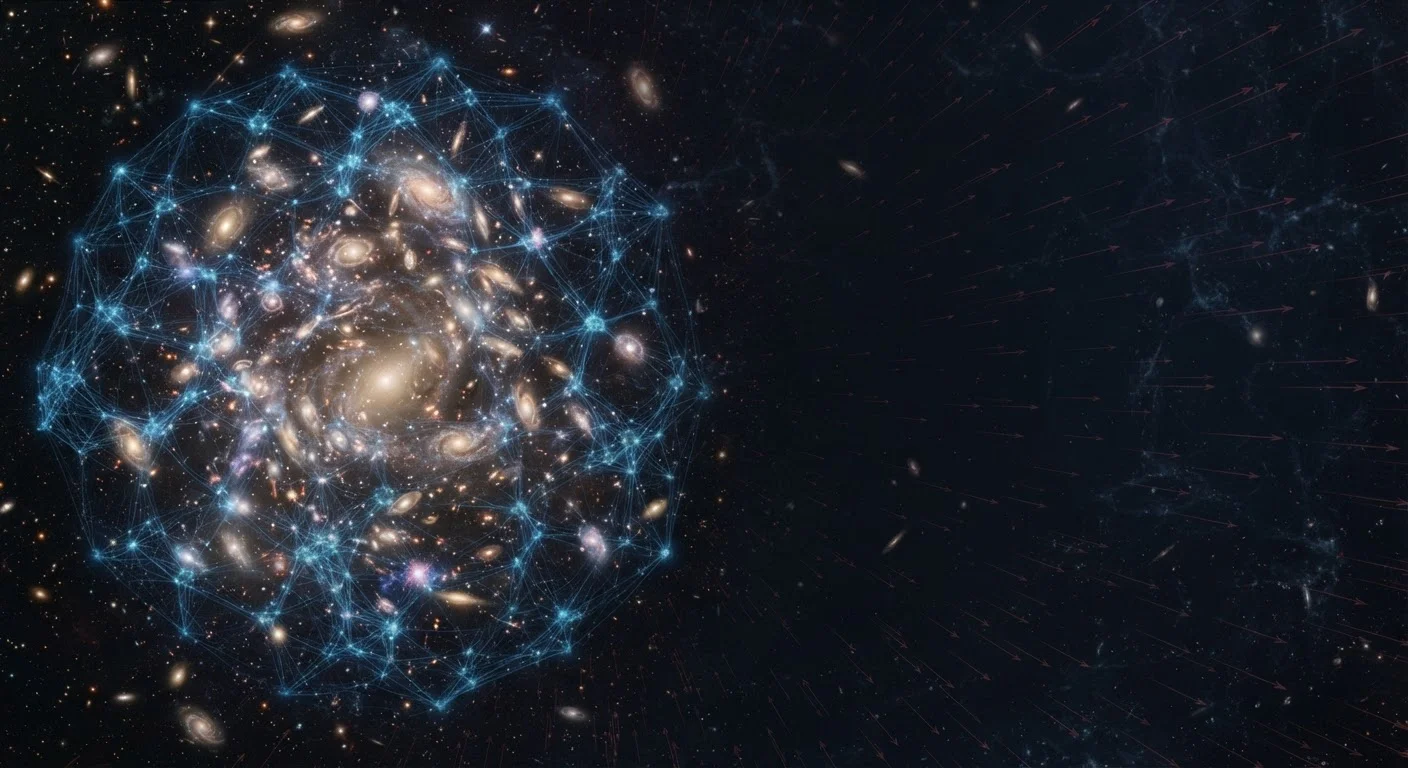
Despite often appearing together in popular science headlines, dark matter and dark energy are distinct phenomena with opposing effects. Dark matter attracts - it behaves like ordinary matter in that it exerts gravitational pull, clustering around galaxies and galaxy clusters. Dark energy repels - it acts as a property of space itself, driving every region of the universe to expand away from every other region at an ever-increasing rate.
Think of it this way: if the universe were a loaf of bread rising in an oven, dark matter would be the raisins clumping together inside it, while dark energy would be the yeast forcing the dough to expand. They operate on different scales, through different mechanisms, and astronomers study them using entirely different methods.
| Criterion | Dark Matter | Dark Energy |
|---|---|---|
| Primary effect | Gravitational attraction | Accelerated cosmic expansion |
| Share of universe's energy content | ~27% | ~68% |
| Scale of influence | Galaxies and galaxy clusters | The universe as a whole |
| Key observational evidence | Galaxy rotation curves, gravitational lensing | Accelerating expansion via Type Ia supernovae |
| Relationship to ordinary matter | Interacts gravitationally, not electromagnetically | Does not cluster; uniform throughout space |
| Detection status | Undetected directly; inferred gravitationally | Undetected directly; inferred from expansion data |
| Leading theoretical candidate | WIMPs, axions, sterile neutrinos | Cosmological constant (vacuum energy) |
What the Evidence Says
Neither dark matter nor dark energy has been directly detected - both are inferred from their measurable effects on the things we can observe.
The Case for Dark Matter
In the 1970s, astronomer Vera Rubin and colleagues measured the rotation curves of spiral galaxies and found something unexpected: stars at the outer edges of galaxies orbit at roughly the same speed as those near the center. Under Newtonian gravity, outer stars should orbit much more slowly, as planets farther from the Sun do in our solar system. The only explanation consistent with the data is that a large, invisible mass - dark matter - surrounds galaxies in an extended halo, providing the additional gravitational force.
Gravitational lensing - where massive objects bend light from objects behind them - provides independent confirmation. The bending observed around galaxy clusters routinely exceeds what visible mass alone could produce.
The Case for Dark Energy
In 1998, two independent research teams studying Type Ia supernovae - which serve as reliable cosmic distance markers - discovered that distant supernovae appeared dimmer than expected. This indicated they were farther away than standard cosmological models predicted, meaning the universe's expansion was accelerating. This finding earned the 2011 Nobel Prize in Physics. The leading explanation introduced into cosmological models is a form of energy inherent to space itself, consistent with what Albert Einstein had originally called the cosmological constant.
~95%
Universe composed of dark matter and dark energy
According to NASA and ESA analyses of cosmic microwave background data, ordinary visible matter accounts for only about 5% of the universe's total energy content.
1998
Year accelerating expansion was discovered
Two independent supernova research teams published findings in 1998 showing cosmic expansion is speeding up, leading to the concept of dark energy.
~200×
Extra mass dark matter provides in galaxy clusters
Studies of galaxy clusters like the Bullet Cluster show dark matter outweighs visible gas and stars by a factor of roughly 200, based on gravitational lensing maps.
What Scientists Still Don't Know
Decades of searching have not yet identified what dark matter actually is. Leading candidates include weakly interacting massive particles (WIMPs), axions, and sterile neutrinos - but experiments at underground detectors and particle colliders have not yet produced a confirmed detection. Some physicists propose modified gravity theories as an alternative, though these have difficulty explaining all observations simultaneously.
Dark energy is arguably even more puzzling. The simplest explanation - Einstein's cosmological constant - fits observations well, but when physicists calculate what quantum field theory predicts for the energy density of empty space, the result is wildly larger than what is actually observed. Resolving this discrepancy is one of the deepest open problems in theoretical physics.
Upcoming observatories, including the Euclid space telescope launched in 2023 and the Vera C. Rubin Observatory in Chile, are designed specifically to map dark matter distribution and measure dark energy's behavior across cosmic time with unprecedented precision.
A Note on the Word 'Dark'
In both terms, 'dark' simply means these components do not emit, absorb, or reflect electromagnetic radiation - including visible light. It is not a description of color or danger. The word is a placeholder acknowledging our ignorance rather than a description of any known property. Scientists continue to debate whether 'dark matter' and 'dark energy' will eventually be explained by new particles, new fields, or modifications to the laws of gravity themselves.