

Key Takeaways
Option A
Renting
The flexible, lower-commitment path to housing.
Best for: People who prioritize mobility, lower upfront costs, or aren't yet ready to settle in one location long-term.
Option B
Buying
The long-term wealth-building, roots-setting option.
Best for: People with stable income, a clear long-term location plan, and the financial readiness to handle ownership costs.
If you expect to move within the next three years
Renting
Transaction costs when buying - including closing costs, agent commissions, and moving expenses - typically take several years to recoup. Selling quickly often means losing money.
If you have stable income, a strong credit score, and a solid down payment saved
Buying
You have the financial foundation to handle ownership costs and can begin building equity rather than paying a landlord indefinitely.
If your income is variable or you're still growing your savings
Renting
Homeownership brings unpredictable repair bills, property taxes, and insurance that can strain an irregular cash flow. Renting provides more budgeting predictability.
If you want to build long-term wealth and have chosen a location for the foreseeable future
Buying
Over a long enough time horizon, owning a home has historically been a meaningful wealth-building vehicle through equity and, in many markets, appreciation - though past trends do not guarantee future results.
If you value flexibility, low maintenance responsibility, or are navigating a life transition
Renting
Renting lets you respond to job changes, family shifts, or new opportunities without the financial and legal complexity of selling a property.
The Core Trade-Off: Flexibility vs. Equity
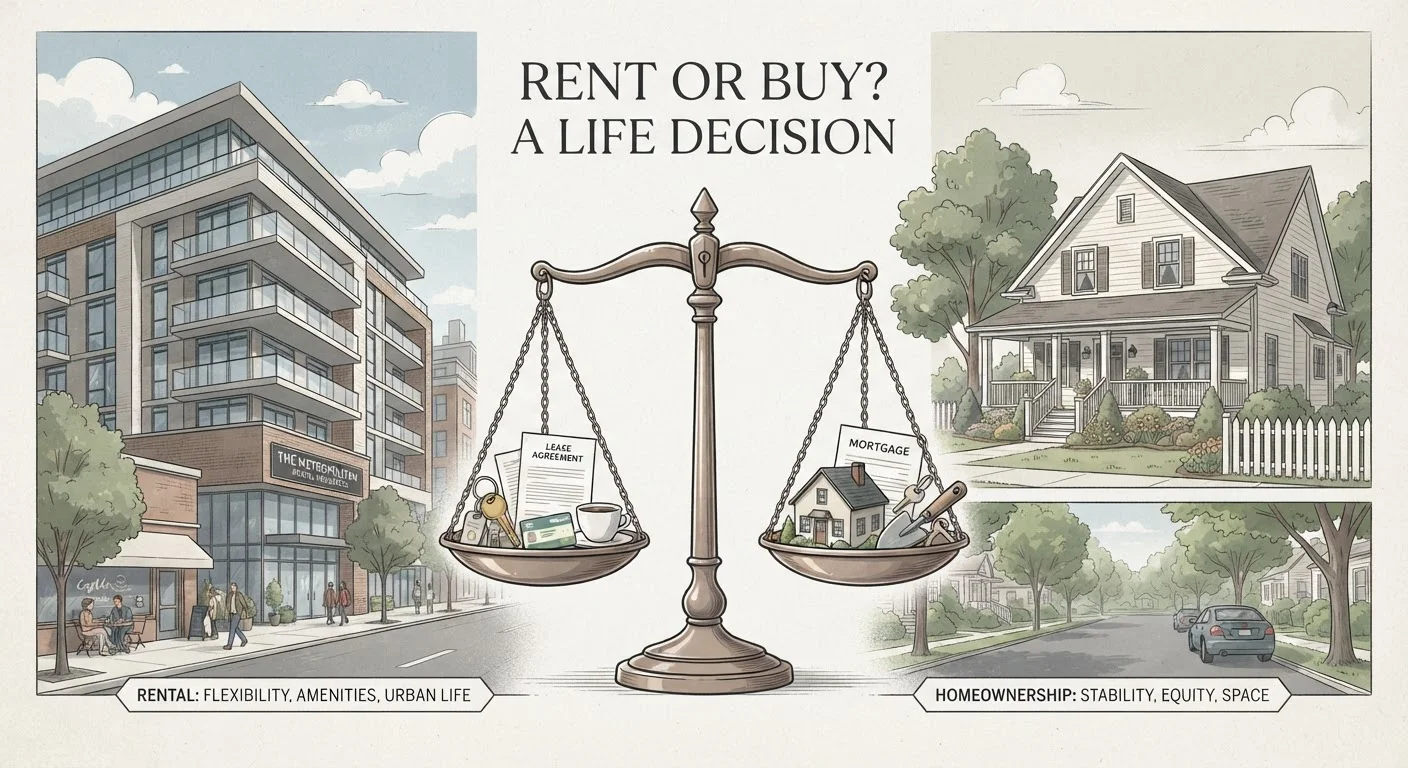
At its simplest, the renting vs. buying decision comes down to two competing values: flexibility and equity. Renting means paying for the right to live somewhere without accumulating ownership. Buying means taking on significant financial commitment in exchange for an asset that can grow in value over time.
Neither trade-off is inherently good or bad. Someone who needs to relocate for work every two years has very different housing needs than someone who has lived in the same city for a decade and plans to stay. The decision should reflect your life, not a general rule about what "smart" people do.
For renters exploring their options, it's also worth understanding the full cost picture beyond base rent - including utilities, fees, and renters insurance. See what renting actually costs before comparing it to a mortgage payment.
| Criterion | Renting | Buying |
|---|---|---|
| Upfront costs | Security deposit + first month | Down payment + closing costs (7-25% of price) |
| Monthly cost predictability | High - fixed rent term | Moderate - mortgage fixed, but taxes/repairs vary |
| Equity building | None | Yes, over time |
| Flexibility to move | High - lease end or break clause | Low - selling takes time and money |
| Maintenance responsibility | Landlord handles most repairs | Owner responsible for all costs |
| Appreciation potential | None | Yes, but not guaranteed |
| Credit/income requirements | Moderate - landlord screening | High - lender qualification required |
The Financial Reality of Each Path
Buying a home requires substantial upfront capital. A conventional mortgage typically calls for a 5-20% down payment, plus closing costs that often run 2-5% of the loan amount. On top of that, homeowners absorb property taxes, homeowners insurance, and ongoing maintenance - commonly estimated at 1-2% of the home's value annually.
Renting, by contrast, usually requires a security deposit (often one to two months' rent) and a first month's payment. Monthly costs are more predictable and don't include surprise repair bills. That said, rent payments don't build equity. Each dollar goes to your landlord, not toward ownership.
The financial comparison shifts significantly depending on how long you stay. Industry analysis consistently shows that buyers who sell within two to three years often come out behind renters after accounting for transaction costs - while those who hold for seven or more years often benefit meaningfully from equity gains. These outcomes vary by market and are not guaranteed.
~5 years
Typical breakeven point for buying vs. renting
Housing economists generally cite a five-to-seven year horizon as the point at which buying becomes financially competitive with renting in many U.S. markets, accounting for transaction costs.
35.9%
Share of U.S. households that rent
According to the U.S. Census Bureau's American Community Survey, roughly 36% of American households are renters - a figure that has remained relatively stable in recent years.
6-10%
Total transaction costs when selling a home
Agent commissions, title fees, transfer taxes, and other selling costs typically consume 6-10% of a home's sale price, directly affecting short-term buy-then-sell scenarios.
For a deeper look at how your budget fits into the broader picture, the budgeting basics hub offers practical frameworks for tracking costs and saving goals.
Lifestyle and Life-Stage Factors That Matter
Financial readiness is only part of the equation. Lifestyle and life stage carry equal weight in making the right call.
- Job stability and location: If your career could require a move, homeownership adds friction and financial risk to that transition.
- Family plans: A growing family may value the stability of a fixed mortgage and a permanent home in a specific school district.
- Maintenance tolerance: Homeowners handle (and pay for) repairs. Renters call the landlord. Honest self-assessment of how you feel about that responsibility matters.
- Community and roots: Buying often signals and reinforces commitment to a place. That intangible value is real for many people.
If you're currently renting and evaluating your lease structure, understanding your options between month-to-month and fixed-term leases is a useful next step - it can preserve flexibility while you make longer-term decisions.
This article is for general informational purposes only and does not constitute financial, legal, or investment advice. Individual circumstances vary significantly. Consult a licensed financial adviser or a HUD-approved housing counselor for guidance tailored to your situation.